
Introduction
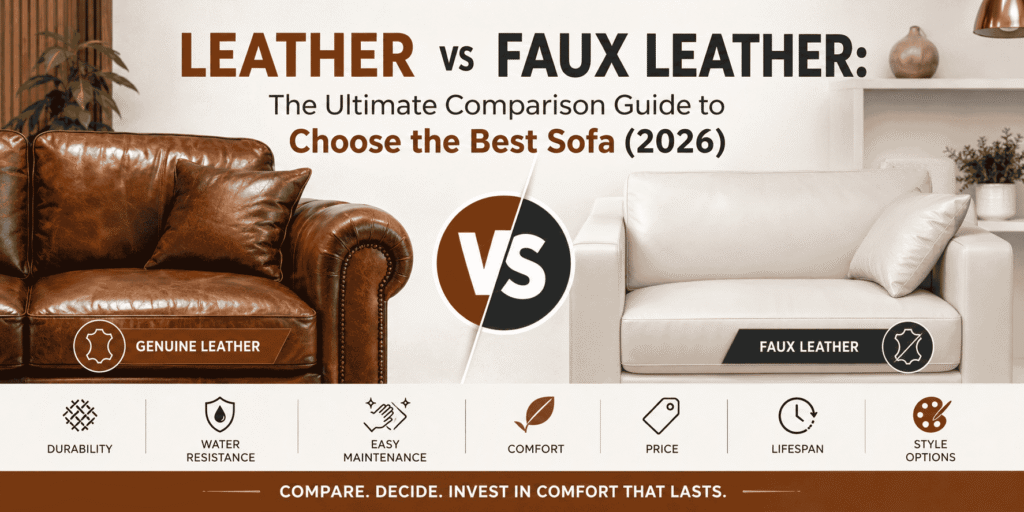
Choosing between a leather vs faux leather sofa is one of the biggest decisions you’ll make when furnishing your living room. Both materials look stunning in photos, but they behave very differently once they become part of daily life — surviving kids, pets, spilled coffee, and years of use.
This guide breaks down every meaningful difference between leather and faux leather sofas, from how each material is made to how it performs under real-world conditions, so you can make a confident, informed decision.
Table of Contents
What Is the Difference Between Leather and Faux Leather?
Genuine leather is made from natural animal hide that has been tanned and treated for upholstery use. Faux leather (also called synthetic or vegan leather) is a manufactured material, typically made from polyurethane (PU) or polyvinyl chloride (PVC), designed to mimic the look and feel of real leather at a fraction of the cost.
The core difference comes down to origin: one is a natural, breathable material that ages and develops character over time; the other is a man-made material engineered for consistency, affordability, and easier maintenance.
Why This Comparison Matters Before Buying a Sofa
A sofa is a long-term investment — most households keep one for 7 to 15 years. The material you choose directly affects:
- How the sofa feels every day you sit on it
- How much upkeep it demands
- How well it holds up to pets, kids, and spills
- How much it costs upfront and over its lifetime
- How it looks as it ages
Picking the wrong material for your lifestyle can mean early cracking, peeling, discoloration, or simply a sofa that never feels quite comfortable.
Quick Overview: Who Should Choose Each Material?
- Choose genuine leather if you want a long-term investment piece, love the way leather ages, and are willing to do occasional conditioning.
- Choose faux leather if you have a tighter budget, want low maintenance, have pets or young children, or prefer a cruelty-free, vegan material.
What Readers Will Learn in This Guide
By the end of this article, you’ll understand how leather and faux leather compare on appearance, comfort, durability, lifespan, maintenance, water and stain resistance, pet-friendliness, breathability, environmental impact, and price — plus which option fits your specific lifestyle.
Leather vs Faux Leather: Quick Comparison Table
$–$$
| Feature | Genuine Leather | Faux Leather |
|---|---|---|
| Material | Natural animal hide | PU, PVC, or bio-based synthetic |
| Appearance | Rich, natural grain; unique markings | Uniform texture; consistent pattern |
| Feel | Soft, supple, warms to touch | Slightly stiffer, cooler to touch |
| Comfort | High; improves with age | Good, but less breathable |
| Durability | Very high with care | Moderate; prone to cracking over time |
| Lifespan | 15–25+ years | 3–8 years |
| Water Resistance | Low to moderate | High |
| Stain Resistance | Moderate (needs quick cleanup) | High |
| Scratch Resistance | Low to moderate | Moderate |
| Pet Friendliness | Moderate (scratches show) | Good (easier to wipe, but scratches can peel it) |
| Maintenance | Regular conditioning needed | Wipe-clean, minimal upkeep |
| Breathability | High | Low to moderate |
| Eco-Friendliness | Resource-intensive, biodegradable | Petroleum-based (unless bio-based), less biodegradable |
| Price | –$ | |
| Best For | Long-term investment, luxury look | Budget buyers, pet owners, easy care |
What Is Genuine Leather?
Genuine leather is upholstery material made from the hide of animals — most commonly cows — that has been tanned to prevent decomposition and treated to create a durable, flexible surface suitable for furniture.
How Genuine Leather Is Made
The process starts with raw animal hide, which goes through cleaning, tanning (usually chrome or vegetable tanning), dyeing, and finishing. Tanning is what transforms raw hide into a stable material that resists rotting and can be shaped and stitched into sofa panels. The finishing stage determines the final texture, color, and protective coating.
Types of Leather
Full-Grain Leather The highest quality leather, made from the top layer of the hide with the natural grain intact. It shows natural imperfections and develops the richest patina over time.
Top-Grain Leather Slightly sanded and refined to remove imperfections, making it more uniform in appearance while still highly durable.
Genuine Leather Despite the name, this is often a lower grade — made from leftover layers of hide, treated and coated to look consistent. It’s more affordable but less durable than full-grain or top-grain.
Split Leather Made from the lower, fibrous layers of the hide split away from the top-grain. It’s usually coated with a polymer to create a leather-like surface.
Bonded Leather Made from leather scraps and fibers bonded together with adhesive and coated with a polyurethane layer. It’s the least durable “leather” option and tends to peel faster than any other type.
Advantages of Genuine Leather
- Ages beautifully, developing a rich patina
- Naturally breathable and comfortable in most climates
- Exceptionally durable when properly maintained
- Unique grain pattern means no two sofas look identical
- Strong resale and long-term value
Disadvantages of Genuine Leather
- Higher upfront cost
- Requires regular conditioning to prevent drying and cracking
- More vulnerable to scratches from pets and sharp objects
- Can fade or dry out in direct sunlight
- Not vegan or cruelty-free
What Is Faux Leather?
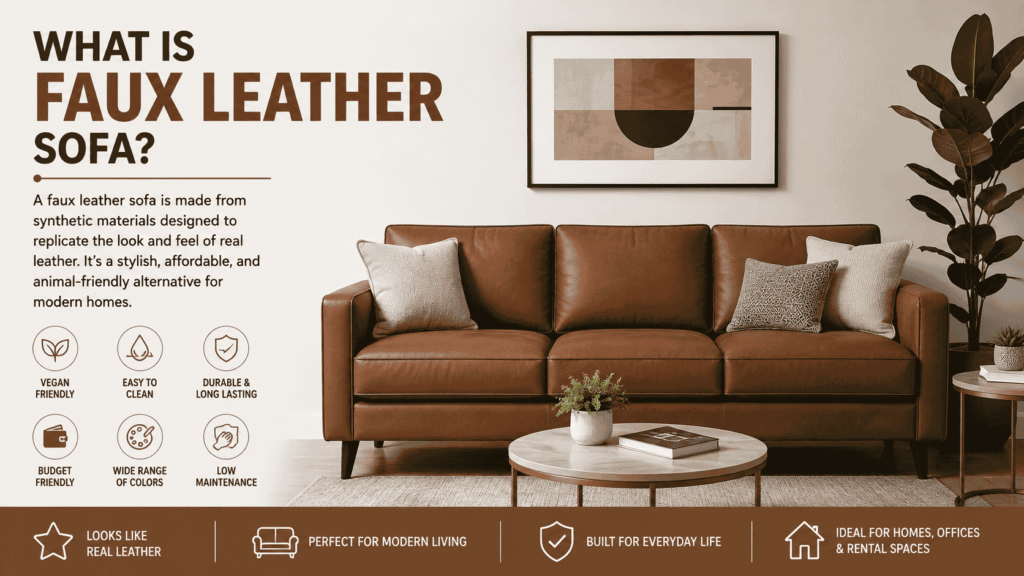
Faux leather is a synthetic material engineered to replicate the look and feel of genuine leather, typically applied over a fabric or polyester backing.
How Faux Leather Is Made
Manufacturers apply a layer of polyurethane or PVC onto a base fabric, then emboss it with a grain pattern to mimic natural leather texture. The material is then dyed and finished with a protective topcoat.
Types of Faux Leather
PU Leather Made with a polyurethane coating over a fabric base. It’s softer, more breathable, and more flexible than PVC, making it the most popular faux leather for furniture.
PVC Leather A thicker, more rigid synthetic made from polyvinyl chloride. It’s highly water-resistant but less breathable and can feel plasticky.
Silicone Leather A newer, premium synthetic option known for superior durability, heat resistance, and a softer hand-feel compared to standard PU.
Bio-Based Faux Leather Made using plant-based materials like cactus, mushroom (mycelium), pineapple leaf fiber, or cork instead of petroleum products. It’s a more sustainable alternative growing in popularity.
Advantages of Faux Leather
- Significantly more affordable than genuine leather
- Highly water- and stain-resistant
- Easy to wipe clean with minimal maintenance
- Available in a wider range of colors and finishes
- Vegan and cruelty-free
- Consistent appearance across the entire sofa
Disadvantages of Faux Leather
- Shorter lifespan; prone to cracking and peeling
- Less breathable, can feel warm or sticky in hot weather
- Doesn’t develop character or patina with age
- Difficult to repair once it starts peeling
- Lower resale value
Leather vs Faux Leather: Appearance
When people search for leather vs faux leather, appearance is often the first thing they want to compare, since it’s the most visible factor when browsing sofas online or in a showroom. While product photos can make both materials look nearly identical, the differences become far more apparent once you see and touch them in person.
Texture Genuine leather has a naturally soft, slightly irregular texture with visible grain variation. Faux leather is embossed to mimic this texture but tends to look and feel more uniform.
Natural Grain vs Artificial Grain Real leather’s grain pattern is unique to each hide, giving every sofa subtle one-of-a-kind character. Faux leather’s grain is stamped in a repeating pattern, which can look slightly artificial up close.
Aging Process This is where the two materials diverge most. Genuine leather develops a patina — a soft sheen and slight color variation that many people find more attractive over time. Faux leather doesn’t age gracefully; it tends to crack, peel, or fade rather than develop character.
Luxury Look Full-grain and top-grain leather are widely regarded as the gold standard for a premium, high-end look. High-quality PU or silicone faux leather can come close, but discerning eyes and touch can usually tell the difference.
Color Options Faux leather wins here, offering a much broader palette of colors, finishes, and even printed patterns, since it isn’t limited by natural hide tones.
Leather vs Faux Leather: Comfort
Comfort is where many buyers underestimate the difference between the two materials. A sofa might look identical in a showroom, but after a few hours of actual sitting — especially during a movie marathon or a long work-from-home day — the gap in comfort between genuine and faux leather becomes far more noticeable.
Softness Full-grain and top-grain leather soften with use, molding gently to the body. Faux leather starts relatively soft but can stiffen as the coating ages.
Breathability Genuine leather has natural pores that allow air circulation, making it more breathable during long sitting sessions. Faux leather is essentially a plastic coating on fabric, which traps heat and moisture more easily.
Temperature Regulation Leather adjusts to room temperature more naturally and feels less sticky in warm weather. Faux leather can feel cold in winter and warm-to-sticky in summer since it doesn’t breathe as well.
Seating Experience Leather generally offers a more premium, cushioned feel that improves with age. Faux leather offers a consistent but slightly firmer seating experience.
Long-Term Comfort Leather tends to remain comfortable for the life of the sofa. Faux leather’s comfort can decline as the coating stiffens or begins to crack.
Leather vs Faux Leather: Durability
Durability is arguably the single most important factor in the leather vs faux leather decision, because it directly determines how long your sofa will look and perform well before you need to replace or reupholster it. This is also where the two materials diverge the most dramatically over a multi-year ownership period.
Daily Wear Genuine leather, especially full-grain, withstands years of daily use exceptionally well. Faux leather holds up fine initially but shows wear faster, particularly in high-friction areas like armrests.
Peeling vs Patina This is the defining durability difference. Leather doesn’t peel — it develops a patina that many buyers consider desirable. Faux leather’s surface coating can crack and peel away from its fabric backing, especially with heat, sunlight, or heavy use.
Tear Resistance Genuine leather has strong natural fiber structure, making it resistant to tearing. Faux leather can tear more easily once the surface coating is compromised.
UV Resistance Both materials can fade in direct sunlight, but leather is more prone to drying out and cracking without conditioning, while faux leather can discolor or become brittle.
Moisture Resistance Faux leather clearly outperforms genuine leather here, resisting moisture penetration far better thanks to its synthetic coating.
Leather vs Faux Leather: Lifespan
Average Lifespan of Genuine Leather With proper care, a genuine leather sofa can last 15–25 years or more, especially full-grain leather.
Average Lifespan of Faux Leather Faux leather sofas typically last 3–8 years before cracking or peeling becomes noticeable, though higher-quality PU or silicone options can last longer.
Factors Affecting Longevity Sunlight exposure, humidity, frequency of use, presence of pets, cleaning habits, and quality of the original material all significantly impact how long either material lasts. A leather sofa placed away from direct sunlight and conditioned twice a year will easily outlast one that’s neglected and left near a sun-facing window. Similarly, a mid-range faux leather sofa cared for gently, kept away from heat sources, and cleaned with the right products can last noticeably longer than the low end of its typical lifespan range. Even the quality of the frame and cushioning underneath the material plays a role, since a weak frame can shorten the effective life of an otherwise durable cover material.
Leather vs Faux Leather: Maintenance
Cleaning Genuine Leather
Genuine leather requires regular dusting with a soft, dry cloth, occasional cleaning with a pH-balanced, leather-specific cleaner, and conditioning every 6–12 months to prevent drying and cracking. Spills should be blotted immediately with a clean cloth rather than rubbed, since rubbing can push liquid deeper into the grain. Harsh household cleaners, alcohol-based wipes, and direct heat sources should be avoided, as they can strip the leather’s natural oils and accelerate cracking. Many owners also rotate cushions periodically to distribute wear more evenly across the sofa.
Cleaning Faux Leather
Faux leather can typically be wiped down with a damp cloth and mild soap, making it one of the most forgiving upholstery materials for everyday household use. It doesn’t require conditioning and is far more tolerant of everyday spills and messes than genuine leather. That said, faux leather should still be kept away from prolonged direct sunlight and heat, since both can accelerate the breakdown of its synthetic coating and lead to premature cracking or discoloration.
Which Is Easier to Maintain?
Faux leather is significantly easier to maintain day-to-day. Genuine leather requires more deliberate care but rewards that effort with a much longer lifespan.
Leather vs Faux Leather: Water & Stain Resistance
Spills Faux leather handles spills confidently thanks to its non-porous coating. Genuine leather can absorb liquids if not cleaned up quickly, potentially leaving marks.
Food Stains Faux leather wipes clean easily from most food and drink stains. Leather may need a specialized cleaner and prompt attention to avoid staining.
Liquid Absorption Genuine leather’s natural pores allow some liquid absorption, while faux leather’s synthetic surface largely repels it.
Everyday Maintenance For households with frequent spills — young kids, casual dining on the sofa, entertaining guests — faux leather offers a more worry-free experience day to day. Genuine leather isn’t fragile by any means, but it does reward owners who clean up spills promptly rather than letting them sit, since prolonged moisture exposure is one of the few things that can genuinely damage a well-maintained leather sofa.
Leather vs Faux Leather: Scratch Resistance
Pets Cats and dogs with claws can scratch both materials, but faux leather is generally more vulnerable to visible, permanent damage since a scratch can tear through the surface coating. Leather can often be buffed or treated to minimize scratch marks.
Kids Toys, buckles, and rough play can mark either surface. Leather tends to hide light scuffs better due to its natural texture variation.
Sharp Objects Both materials can be damaged by sharp objects, though genuine leather’s fiber structure resists punctures slightly better than the coated layer of faux leather.
Repairability Genuine leather is easier to repair — light scratches can often be conditioned or buffed out at home, and professional leather repair services can fix deeper cuts, tears, or discoloration in a way that’s barely noticeable. Faux leather is much harder to repair invisibly once the coating is compromised, since the synthetic layer doesn’t respond to conditioning the way natural leather does, and touch-up kits rarely match the original finish perfectly. This is one of the more overlooked long-term factors in the leather vs faux leather decision for households expecting years of hard use.
Leather vs Faux Leather: Pet Friendliness
Dog Owners Faux leather is easier to wipe down after muddy paws or drool, but claws can cause lasting damage. Leather is more scratch-prone but ages in a way that can disguise minor marks.
Cat Owners Cat claws are a real risk to both materials, though faux leather is particularly vulnerable to peeling once punctured. Homes with cats often benefit from scratch-resistant fabric alternatives, but between these two, leather generally holds up slightly better long-term.
Hair Removal Both materials are easier to clean pet hair from compared to fabric upholstery, since hair doesn’t embed into the surface.
Odor Resistance Leather’s natural material is more breathable and less likely to trap pet odors long-term, while faux leather’s non-porous surface can sometimes trap odors at the seams.
Leather vs Faux Leather: Breathability
Summer Performance Genuine leather stays noticeably cooler and more comfortable in warm weather due to its natural breathability. Faux leather can feel warm and slightly sticky against skin.
Winter Comfort Leather adjusts to room temperature more gradually and comfortably. Faux leather can feel cold to the touch initially in cooler months.
Humid Climates In humid environments, leather’s breathability helps prevent the clammy feeling that faux leather can produce.
Long Sitting Sessions For households that spend hours on the sofa daily — movie nights, work-from-home lounging — leather’s breathability offers a clear comfort advantage.
Leather vs Faux Leather: Environmental Impact
Sustainability
Genuine leather is a byproduct of the meat industry, but the tanning process (especially chrome tanning) uses significant water and chemicals. Faux leather avoids animal use but is typically petroleum-based unless it’s one of the newer bio-based alternatives.
Carbon Footprint
Both materials carry environmental costs. Leather production is resource- and water-intensive; PU and PVC production relies on fossil fuels and chemical processing.
Recyclability
Genuine leather is biodegradable over time, while standard faux leather (PU/PVC) is largely non-biodegradable and difficult to recycle.
Vegan-Friendly Option
Faux leather is the clear choice for vegan or cruelty-free buyers, and bio-based faux leather options (cactus, mushroom, pineapple fiber) offer a more sustainable middle ground.
Leather vs Faux Leather: Price Comparison
Initial Cost Genuine leather sofas typically cost significantly more upfront — often 2 to 4 times the price of a comparable faux leather sofa.
Long-Term Value Because genuine leather lasts much longer, its cost-per-year of ownership can actually be lower than repeatedly replacing a faux leather sofa every few years.
Cost Per Year of Ownership A $3,000 leather sofa lasting 20 years costs roughly $150/year. A $900 faux leather sofa replaced every 5 years costs roughly $180/year over the same period — making leather a potentially smarter long-term investment despite the higher sticker price.
Is Genuine Leather Worth the Extra Money? For buyers planning to keep their sofa for a decade or more, genuine leather often justifies its price through durability and resale value. For buyers who redecorate frequently, move often, or need a budget-friendly option right now, faux leather offers excellent value without a large upfront commitment.
It’s also worth factoring in indirect costs. Genuine leather sofas may require occasional professional cleaning or conditioning products over their lifespan, while faux leather sofas that begin to peel or crack are typically not repairable in a way that restores their original appearance, often leading owners to replace the entire piece rather than patch it. When comparing leather vs faux leather purely on price, faux leather wins on affordability today, while leather tends to win on value over a full decade of ownership.
Leather vs Faux Leather: Which Material Is Better for Different Buyers?
Families with Children
Faux leather’s easy cleanup makes it practical for spills, snacks, and craft-time messes, though leather’s forgiving, textured surface can also hide minor scuffs and marks surprisingly well. Families who prioritize worry-free cleanup often lean toward faux leather, while those who want a durable piece that can survive to adulthood with the kids often choose leather.
Pet Owners
Genuine leather slightly edges out faux leather for long-term scratch resilience, since leather’s fiber structure resists punctures better than a thin synthetic coating. That said, neither material is fully scratch-proof, and households with particularly active cats may want to consider protective throws on high-traffic areas regardless of material choice.
Luxury Homeowners
Full-grain or top-grain leather is the clear choice for a premium, long-lasting statement piece that signals quality and ages into an even richer look over time — an important consideration for anyone furnishing a formal living room or a home they plan to stay in long-term.
Budget Buyers
Faux leather delivers a leather-like look at a fraction of the cost, making it an excellent option for first apartments, starter homes, or anyone furnishing multiple rooms on a limited budget.
Rental Properties
Faux leather’s low maintenance and strong water resistance make it ideal for landlords furnishing rental units, since it tolerates tenant turnover and everyday wear without demanding the specialized care leather needs.
Airbnb Hosts
Faux leather’s easy-clean surface handles frequent guest turnover, accidental spills, and quick cleaning between bookings far more efficiently than genuine leather, which can show wear more visibly under high-frequency, low-care use.
Office Furniture
Faux leather is a practical, budget-friendly choice for office lobbies, waiting rooms, and conference areas with heavy foot traffic, where easy cleaning and consistent appearance matter more than long-term patina.
Heavy Daily Use
Genuine leather, particularly full-grain, holds up best under years of intensive daily use, making it the preferred choice for primary family sofas, home theaters, or any seating that sees several hours of use every single day.
Leather vs Faux Leather Pros and Cons
Genuine Leather
Pros
- Premium appearance
- Long lifespan
- Develops a beautiful patina
- Excellent durability
Cons
- Higher price
- Requires conditioning
- Sensitive to scratches
- Less water resistant
Faux Leather
Pros
- Affordable
- Easy to clean
- Water resistant
- Wide variety of colors
Cons
- Can peel or crack
- Shorter lifespan
- Less breathable
- Doesn’t develop a natural patina
Leather vs Faux Leather: Which One Should You Choose?
Your decision should come down to a few key factors:
- Budget: If cost is the primary concern, faux leather offers a much lower entry price.
- Lifestyle: Busy households with frequent spills lean toward faux leather; households prioritizing long-term investment lean toward leather.
- Climate: Hot or humid climates favor leather’s breathability.
- Pets: Consider leather for long-term resilience, faux leather for easy cleanup.
- Children: Faux leather simplifies cleanup, but leather can be a durable, forgiving option too.
- Design Preference: If you want a unique, aging-with-character look, choose leather. If you prefer consistent, vibrant colors, choose faux leather.
- Long-Term Investment: If you plan to keep the sofa for over a decade, genuine leather typically offers better long-term value.
If you’re still unsure, consider your priorities: comfort and longevity point toward genuine leather, while affordability and easy maintenance point toward faux leather.
Frequently Asked Questions (FAQs)
Is faux leather as durable as genuine leather? No. While faux leather resists water and stains well, it typically has a shorter lifespan and is more prone to cracking and peeling than genuine leather, which can last 15–25+ years with proper care.
Which is easier to clean? Faux leather is easier to clean day-to-day since it can simply be wiped down with a damp cloth, while genuine leather requires specialized cleaners and periodic conditioning.
Does faux leather peel over time? Yes, faux leather can peel or crack over time, especially with sun exposure, heat, or heavy daily use, as the synthetic coating separates from its fabric backing.
Can genuine leather crack? Yes, but usually only if it isn’t conditioned regularly. Proper conditioning every 6–12 months prevents leather from drying out and cracking.
Which sofa material is better for pets? Genuine leather generally holds up slightly better long-term against pet claws, though both materials can be scratched. Faux leather is easier to wipe clean of pet messes.
Is faux leather waterproof? Faux leather is highly water-resistant, though not entirely waterproof at seams and stitching, where moisture can still seep through over time.
Which lasts longer? Genuine leather lasts significantly longer than faux leather — often two to three times as long — when properly maintained.
Which is more comfortable in hot weather? Genuine leather is more breathable and stays cooler in hot weather compared to faux leather, which can feel warm or sticky.
Which is more eco-friendly? Neither material is perfectly eco-friendly. Genuine leather is biodegradable but resource-intensive to produce; faux leather avoids animal use but is typically petroleum-based unless it’s a bio-based alternative.
Is genuine leather worth the higher price? For buyers keeping their sofa long-term, genuine leather’s durability and resale value often justify the higher upfront cost. For short-term or budget-conscious buyers, faux leather offers strong value.
Final Verdict
When comparing leather vs faux leather for your next sofa, the right choice depends on how you live, not just how a material looks in a showroom. Genuine leather offers unmatched durability, breathability, and a luxury look that improves with age — making it ideal for long-term investment buyers who don’t mind occasional conditioning. Faux leather offers outstanding value, easy maintenance, and strong water and stain resistance — making it the smarter pick for budget-conscious buyers, renters, and busy households that prioritize low upkeep.
If you want a sofa that will last decades and only gets more beautiful with time, genuine leather is worth the investment. If you want an affordable, practical, easy-to-clean option that still delivers a leather-inspired look, faux leather is the better fit.
Ultimately, there’s no single universally “better” material — only the material that’s better for your household. Walk through your own priorities one more time: how long you plan to keep the sofa, how much daily wear it will see, whether pets or kids are part of the equation, and how much time you’re realistically willing to spend on upkeep. Matching the material to your actual lifestyle, rather than just the showroom look, is what leads to a sofa you’ll still be happy with years from now.
Related Guides on SofasExpert.com
- Leather Sofa Material Explained
- Faux Leather Sofa Material Explained
- Full-Grain Leather Explained
- Top-Grain Leather Explained
- Genuine Leather Explained
- Sofa Materials Explained
- Leather vs Fabric Sofa
- Leather vs Microfiber Sofa
- Leather vs Polyester Sofa
- Leather vs Linen Sofa
- Leather vs Velvet Sofa
- How to Choose the Right Sofa Material
- Luxury Sofa Materials