
- Consumer Reports — furniture durability and care testing standards
- The Spruce — fabric and upholstery maintenance guides
- Good Housekeeping — stain removal and cleaning tips for home fabrics
Introduction
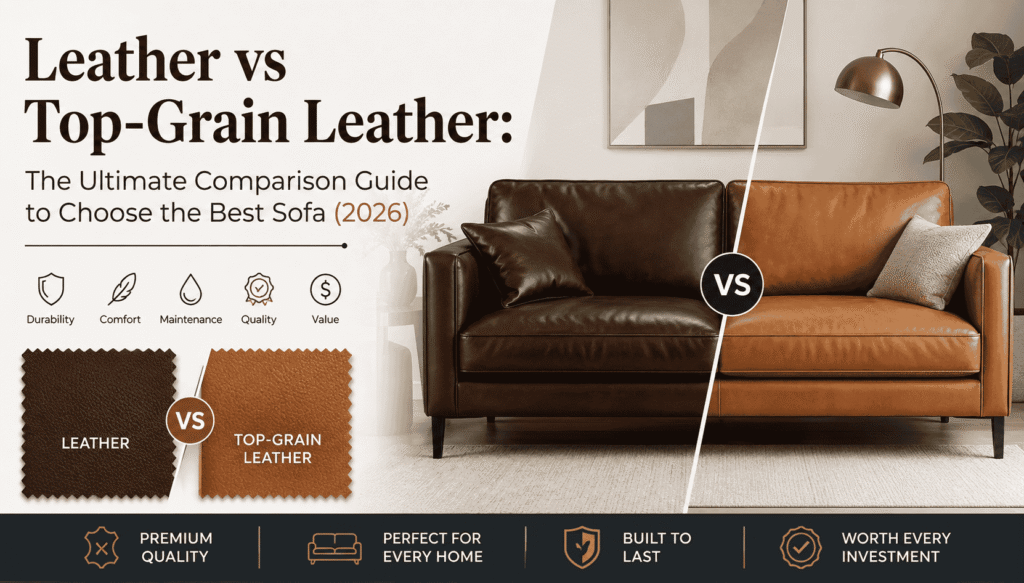
Choosing a new sofa often comes down to one confusing question: leather vs top-grain leather — which one is actually better? Leather is a broad category that includes several types of hides, each with different quality, durability, and price points. Top-grain leather is one specific type within that category, known for its smooth surface and refined finish.
People compare leather with top-grain leather because sofa listings rarely explain the difference clearly, and the wrong choice can mean paying too much for a lower-quality material — or missing out on a more durable option that fits the budget just as well.
This guide is for anyone shopping for a new sofa: first-time buyers, homeowners upgrading their living room, pet owners, and anyone who wants long-term value from their furniture investment. Whether you care most about softness, durability, price, or how the material ages over time, this guide breaks it all down.
Quick answer: Top-grain leather generally offers a more refined look, easier maintenance, and better consistency, while other leather types (like full-grain or genuine leather) may offer more natural character or a lower price. The “better” choice depends on your lifestyle, budget, and priorities — which this guide will help you figure out.
Table of Contents
Leather vs Top-Grain Leather at a Glance
| Factor | Leather (General/Other Types) | Top-Grain Leather |
|---|---|---|
| Surface | Varies (natural to heavily processed) | Sanded and refinished, smooth |
| Durability | Varies by type | Strong and consistent |
| Softness | Varies | Soft, supple feel |
| Maintenance | Varies (can be high or low) | Easier, more stain-resistant |
| Price | Wide range, often lower | Mid-to-high range |
| Best For | Budget buyers, natural texture lovers | Families, everyday use, modern homes |
Main differences: Leather is a general category that includes full-grain, top-grain, genuine, split, and bonded leather — each made differently and priced differently. Top-grain leather specifically has the top layer sanded down and refinished, which removes natural imperfections and creates a more uniform, softer surface.
Overall winner: For most sofa buyers, top-grain leather wins on the balance of durability, appearance, and maintenance. However, full-grain leather (a type of leather) wins for those who want maximum durability and natural aging character, while genuine or bonded leather wins on price for budget-conscious buyers.
What Is Leather?
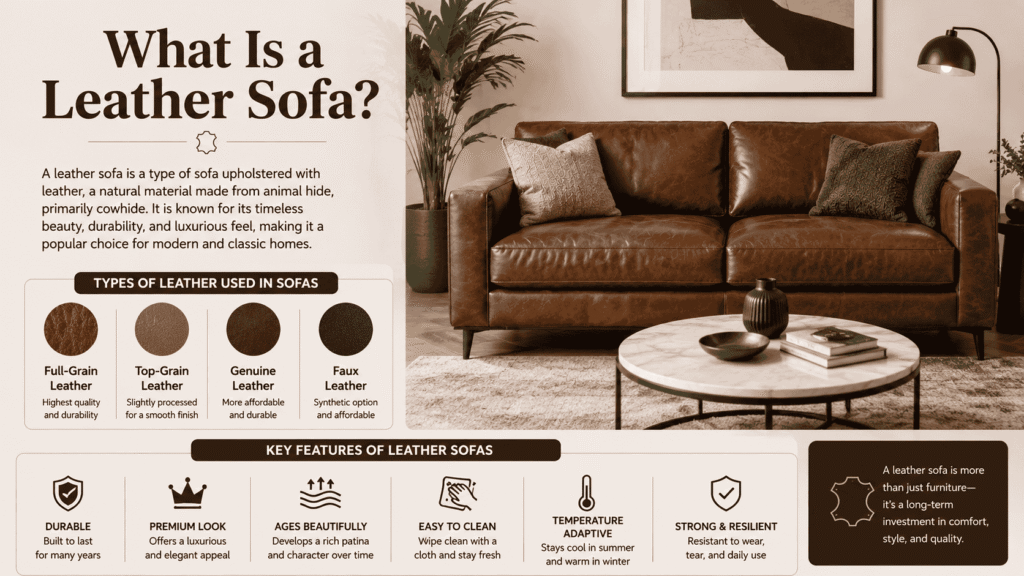
Leather is a material made from tanned animal hide, most commonly cowhide. It’s prized in furniture for its durability, comfort, and the way it looks better with age. “Leather” is really an umbrella term — the quality, feel, and price of a leather sofa depend entirely on which type of leather was used to make it.
How Leather Is Made
Raw animal hides go through a multi-step tanning process to become usable leather. This includes cleaning, tanning (using chromium or vegetable-based methods), dyeing, and finishing. Depending on how much of the hide’s natural surface is kept or removed, and how it’s finished, the result becomes one of several distinct leather types.
Types of Leather
- Full-Grain Leather – The entire hide, including the outermost layer with natural grain and imperfections. Not sanded or buffed, making it the most durable and authentic type.
- Top-Grain Leather – The top layer of the hide with the very outer surface sanded off and refinished for a smoother, more uniform look.
- Genuine Leather – Made from lower layers of the hide after the top layers are split away. Real leather, but lower quality than full-grain or top-grain.
- Split Leather – Comes from the fibrous lower part of the hide, often coated or embossed to imitate a grain pattern.
- Bonded Leather – Made from leftover leather scraps bonded together with adhesive and a polyurethane coating. The most affordable but least durable option.
Pros of Leather
- Naturally durable and long-lasting (depending on type)
- Ages well and can develop a rich patina
- Breathable and comfortable in most climates
- Wide range of price points to fit different budgets
- Timeless, classic appearance
Cons of Leather
- Quality varies drastically between types
- Lower-grade leather (bonded, split) can peel or crack
- Can be more expensive than fabric alternatives
- Requires occasional conditioning to prevent drying out
- Susceptible to scratches from pets or sharp objects
What Is Top-Grain Leather?
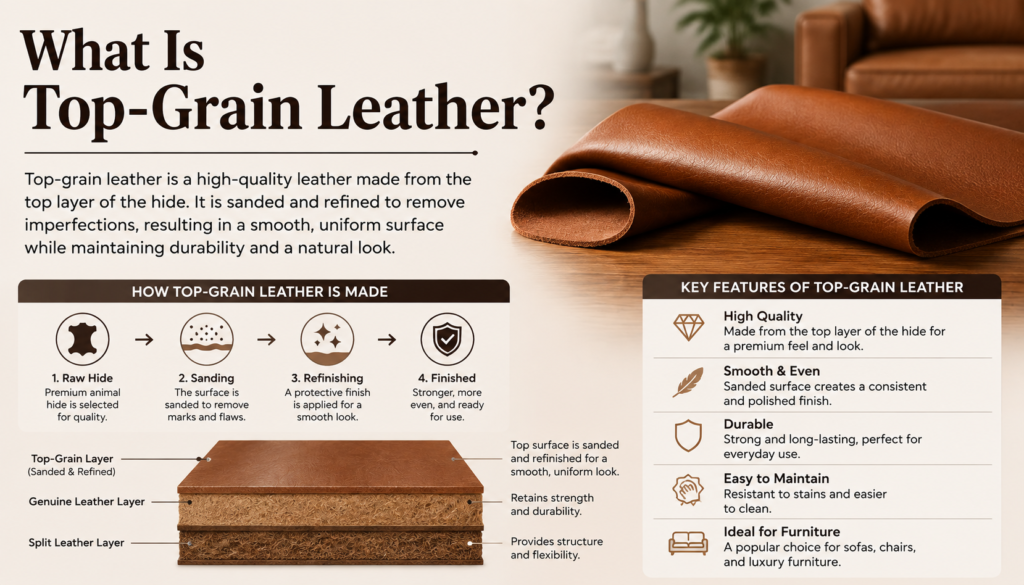
Top-grain leather is the second-highest quality leather available, just below full-grain. It’s created by taking the top layer of the hide and sanding away surface imperfections like scars, insect bites, or uneven texture, then applying a finish coat. This process makes top-grain leather smoother, more consistent in color, and easier to maintain than full-grain leather — while remaining a genuine, high-quality material.
How Top-Grain Leather Is Manufactured
After the hide is split, the top layer goes through a sanding or buffing process to remove blemishes. A finish or pigmented coating is then applied, sometimes with an embossed pattern to simulate a natural grain look. This gives manufacturers more control over color consistency and surface texture, which is why top-grain leather is popular in modern furniture design.
Characteristics of Top-Grain Leather
- Smooth, even surface with minimal visible imperfections
- Slightly less breathable than full-grain due to the finish coating
- More resistant to stains and spills
- Softer and more pliable to the touch
- Consistent color and texture across the entire piece
Pros of Top-Grain Leather
- Premium, polished appearance
- Softer feel right out of the box
- Easier to clean and maintain
- Better resistance to stains
- More affordable than full-grain leather
Cons of Top-Grain Leather
- Doesn’t develop the same natural patina as full-grain leather
- The sanding process removes some of the hide’s natural strength
- Can feel slightly less “authentic” to leather purists
- Still pricier than genuine, split, or bonded leather
Leather vs Top-Grain Leather: Key Differences
Understanding leather vs top-grain leather at a granular level helps you know exactly what you’re paying for. Below is a breakdown of every factor that matters when choosing a sofa.
Appearance
Leather (in its full-grain form) shows natural marks, wrinkles, and grain variations. Top-grain leather looks more polished and uniform, since surface imperfections are sanded away before finishing.
Texture
Full-grain and other natural leathers have a slightly rougher, more organic texture. Top-grain leather feels smoother and more refined due to the buffing and finishing process.
Softness
Top-grain leather is generally softer to the touch right away. Full-grain leather starts firmer but softens naturally with years of use.
Durability
Full-grain leather is the most durable overall since its natural fiber structure stays intact. Top-grain leather is still highly durable, just slightly less rugged because the outer fibers are removed during sanding.
Scratch Resistance
Top-grain leather’s finish coating offers moderate scratch resistance, but scratches can be more noticeable against its smooth surface. Full-grain leather tends to hide minor scratches better within its natural texture.
Stain Resistance
Top-grain leather has better stain resistance thanks to its protective finish coat, making it more practical for households with kids or frequent guests.
Water Resistance
Neither leather type is fully waterproof, but top-grain leather’s finish provides slightly better short-term water resistance than untreated full-grain leather.
Breathability
Full-grain leather breathes better since it retains the hide’s natural pores. Top-grain leather’s finish coating reduces breathability slightly, which can matter in hot climates.
Aging and Patina
Full-grain leather develops a rich, natural patina over time — a major reason leather purists prefer it. Top-grain leather ages more slowly and evenly, without the same dramatic character shift.
Maintenance
Top-grain leather is easier to maintain day-to-day thanks to its smoother, more stain-resistant surface. Full-grain leather requires more regular conditioning to stay supple.
Comfort
Both types offer excellent comfort, though top-grain leather’s immediate softness gives it a slight edge for buyers who want comfort from day one.
Lifespan
Full-grain leather can last 20–25+ years with proper care. Top-grain leather typically lasts 15–20 years, still an excellent lifespan for everyday furniture.
Eco-Friendliness
Full-grain leather uses more of the hide with less processing, often making it the more sustainable option. Top-grain leather involves additional sanding and finishing steps, using more resources per hide.
Weight
Leather types are generally similar in weight, though heavily coated top-grain leather can feel marginally heavier due to the finish layer.
Price
Full-grain leather is typically the most expensive, followed by top-grain leather, then genuine, split, and bonded leather at the lower end.
Resale Value
Sofas made from full-grain and top-grain leather tend to hold resale value better than fabric, genuine, or bonded leather options, since buyers recognize their quality.
Leather vs Top-Grain Leather Comparison Table
| Material | Surface | Feel | Appearance | Durability | Comfort | Water Resistance | Stain Resistance | Scratch Resistance | Maintenance | Lifespan | Price | Best For |
|---|---|---|---|---|---|---|---|---|---|---|---|---|
| Full-Grain Leather | Natural, unsanded | Firm, softens over time | Rustic, authentic | Excellent | Very Good | Moderate | Moderate | Good | Moderate | 20–25+ yrs | High | Luxury buyers, longevity |
| Top-Grain Leather | Sanded, refinished | Soft, smooth | Polished, uniform | Very Good | Excellent | Moderate-High | Very Good | Moderate | Low-Moderate | 15–20 yrs | Mid-High | Families, everyday use |
| Genuine Leather | Lower hide layer | Firm | Basic, less refined | Fair | Good | Low | Fair | Fair | Moderate | 5–10 yrs | Mid-Low | Budget buyers |
| Split Leather | Fibrous, coated | Stiff | Imitation grain | Fair | Fair | Low | Fair | Low | Moderate | 5–8 yrs | Low | Occasional use |
| Bonded Leather | Scrap + coating | Plasticky | Uniform but artificial | Poor | Fair | Low | Low | Low | Low | 2–5 yrs | Lowest | Very tight budgets |
This table is designed to give a quick, scannable answer to the leather vs top-grain leather debate across every major buying factor.
Which Leather Is Better for Sofas?
Family Homes
Top-grain leather is the better choice for family homes thanks to its stain resistance and easier cleanup after everyday spills and messes.
Luxury Living Rooms
Full-grain leather suits luxury living rooms best, offering a rich, natural look that develops character and exclusivity over time.
Homes with Pets
Top-grain leather handles pet claws slightly better due to its finish coating, though full-grain leather hides minor scratches more naturally within its texture. Either way, a protective throw is recommended for homes with active pets.
Homes with Kids
Top-grain leather is the practical winner here — its stain resistance and smoother surface make cleanup far easier than more porous leather types.
Heavy Daily Use
Full-grain leather is built for heavy daily use since its intact fiber structure resists wear better over years of constant sitting.
Budget Buyers
Genuine leather offers a real-leather feel at a lower price point, making it a solid middle ground for buyers who want leather without the top-grain or full-grain price tag.
Advantages of Choosing Top-Grain Leather
- Premium appearance — a smooth, consistent finish that looks polished in any living room style.
- Softer feel — comfortable seating right from the first use, without a long break-in period.
- Easier maintenance — simple wipe-downs handle most everyday spills and dust.
- Better stain resistance — the finish coating helps repel spills before they set in.
- Modern furniture choice — widely used in contemporary sofa designs for its clean, uniform look.
Advantages of Choosing Other Leather Types
- Better natural character — full-grain leather in particular shows unique grain patterns and develops a one-of-a-kind patina.
- Wider price range — from premium full-grain to budget-friendly bonded leather, there’s an option for nearly every price point.
- Suitable for different budgets — genuine and split leather let buyers enjoy real leather without paying top-grain or full-grain prices.
- Variety of finishes — different leather types offer distinct textures, from rustic and natural to smooth and embossed.
Leather vs Top-Grain Leather: Maintenance Tips
Cleaning
Wipe down leather sofas weekly with a dry or slightly damp microfiber cloth. For spills, blot immediately rather than rubbing to prevent the stain from spreading.
Conditioning
Apply a leather conditioner every 3–6 months to keep the material supple and prevent cracking, especially important for full-grain leather.
Protecting from Sunlight
Keep leather sofas out of direct sunlight or use curtains/blinds, since prolonged UV exposure can fade color and dry out the material over time.
Preventing Scratches
Trim pets’ nails regularly and avoid placing sharp objects like keys or belts directly on the leather surface.
Increasing Lifespan
Rotate cushions periodically, avoid overloading one seating area, and clean spills immediately to extend the life of any leather sofa by several years.
Common Myths About Top-Grain Leather
Myth #1: Top-grain leather is fake. False. Top-grain leather is genuine, real leather — it’s simply sanded and refinished, not synthetic.
Myth #2: All leather is the same. Not true. Leather ranges from full-grain to bonded, each with major differences in quality, durability, and price.
Myth #3: Expensive always means better. Not necessarily. The “best” leather depends on your priorities — full-grain isn’t automatically better for everyone, especially families who value top-grain’s easier maintenance.
Myth #4: Leather requires too much maintenance. With basic cleaning and occasional conditioning, most leather sofas require less maintenance than people expect.
Myth #5: Top-grain leather doesn’t last long. Top-grain leather typically lasts 15–20 years with proper care, making it a durable long-term investment.
Who Should Buy Leather?
Best buyers: Those who want maximum durability, natural character, and are willing to invest in a long-term luxury piece — particularly buyers considering full-grain leather.
Ideal lifestyle: Buyers who value authenticity and don’t mind a natural patina developing over years of use.
Pros and cons:
- Pros: Long lifespan, unique aging character, strong resale value
- Cons: Higher price, more maintenance for full-grain, quality varies widely across types
Who Should Buy Top-Grain Leather?
Best buyers: Families, everyday households, and anyone who wants a refined look without the higher price or maintenance demands of full-grain leather.
Ideal lifestyle: Busy households that need practicality, stain resistance, and consistent appearance over time.
Pros and cons:
- Pros: Softer feel, easier cleaning, better stain resistance, more affordable than full-grain
- Cons: Less natural patina, slightly less durable than full-grain over decades
Leather vs Top-Grain Leather: Which One Should You Choose?
- Budget: Choose genuine or split leather for lower upfront cost; top-grain if you can stretch the budget slightly for better durability.
- Luxury: Full-grain leather is the top choice for a premium, long-term investment piece.
- Durability: Full-grain leather wins for raw durability; top-grain leather is a close second with easier upkeep.
- Appearance: Top-grain leather suits modern, polished interiors; full-grain suits rustic or classic styles.
- Families: Top-grain leather’s stain resistance makes it the practical winner.
- Pets: Top-grain leather for easier cleanup, though both types need occasional protection from claws.
- Daily Use: Full-grain leather handles constant heavy use slightly better over the long term.
- Long-Term Value: Both full-grain and top-grain leather hold resale value well compared to lower leather grades or fabric.
Frequently Asked Questions (FAQs)
Is top-grain leather real leather?
Yes. Top-grain leather is genuine leather made from the top layer of the hide, sanded and refinished for a smoother surface—it is not synthetic or fake.
Which is more durable, leather or top-grain leather?
Full-grain leather (a type of leather) is generally more durable than top-grain leather, since its natural fiber structure remains fully intact.
Does top-grain leather crack over time?
With proper conditioning, top-grain leather resists cracking well. Neglecting maintenance or exposing it to excessive sunlight can lead to cracking over many years.
Is top-grain leather worth the extra cost?
Yes, for most buyers. Top-grain leather offers a strong balance of durability, softness, and easy maintenance that justifies its mid-to-high price point.
Which leather is best for sofas?
Top-grain leather is best for most households due to its balance of comfort, durability, and stain resistance. Full-grain leather is best for buyers prioritizing longevity and natural character.
Which leather is easiest to maintain?
Top-grain leather is the easiest to maintain among high-quality leathers, thanks to its protective finish coating and stain resistance.
Can pets damage top-grain leather?
Yes, sharp claws can scratch top-grain leather’s smooth surface. Regular nail trimming and protective throws help minimize damage.
How long does top-grain leather last?
Top-grain leather typically lasts 15–20 years with proper care, making it a durable and cost-effective long-term choice for most households.
Is top-grain leather better than full-grain leather?
Not necessarily better — just different. Full-grain leather offers more durability and natural character, while top-grain leather offers a softer feel, smoother look, and easier maintenance at a lower price.
Does top-grain leather peel?
Top-grain leather rarely peels because it’s genuine leather with a bonded finish coat, unlike bonded leather, which is prone to peeling since it’s made from scraps and a polyurethane layer.
Can top-grain leather be repaired if scratched or torn?
Yes. Minor scratches can often be buffed out with a leather conditioner, and small tears can be professionally repaired using leather filler and colour-matched dye.
Is top-grain leather good for hot or humid climates?
Top-grain leather performs reasonably well in most climates, though its finish coating makes it slightly less breathable than full-grain leather in very hot, humid conditions.
How do I tell top-grain leather apart from genuine or bonded leather?
Top-grain leather has a smooth, consistent surface with a soft, natural feel, while genuine leather feels firmer and less refined, and bonded leather often has a plasticky texture and uniform, artificial grain pattern.
Does top-grain leather smell like real leather?
Yes. Since top-grain leather is genuine leather, it carries the same natural leather scent, though it may be slightly milder than full-grain leather due to the finishing process.
Is top-grain leather a good investment for resale value?
Yes. Top-grain leather sofas generally hold resale value better than fabric, genuine, split, or bonded leather sofas since buyers recognize it as a quality, durable material.
Can top-grain leather be used outdoors?
No. Top-grain leather is not designed for outdoor use, as prolonged sun and moisture exposure can damage the finish and shorten its lifespan. Outdoor furniture typically uses weather-resistant synthetic materials instead.
How much more expensive is top-grain leather compared to genuine leather?
Top-grain leather typically costs 20–40% more than genuine leather, reflecting its higher quality, smoother finish, and longer lifespan.
Final Verdict
When comparing leather vs top-grain leather, both are genuine, high-quality materials — the real difference lies in how they’re processed and what each buyer values most.
Quick summary: Top-grain leather offers a softer, more polished, easier-to-maintain option ideal for everyday family life. Full-grain leather (the premium end of the leather category) offers unmatched durability and natural aging character for buyers seeking a long-term luxury investment.
Pros and cons recap:
- Top-grain leather: Easier care, softer feel, more affordable than full-grain, slightly less durable long-term.
- Full-grain/other leather: Maximum durability and character, higher price, more maintenance required.
Final recommendation: For most sofa buyers — especially families and everyday households — top-grain leather is the smarter overall choice. For buyers who prioritize longevity, authenticity, and don’t mind a higher investment, full-grain leather remains the premium pick.
Best choice for different buyers:
- Families & pet owners → Top-grain leather
- Luxury seekers → Full-grain leather
- Budget-conscious buyers → Genuine leather
- Occasional-use furniture → Split or bonded leather
Still deciding on the right sofa material for your home? Explore our related guides on Full-Grain Leather Explained, Leather vs Fabric Sofa, and How to Choose the Right Sofa Material to make a fully informed decision.
Suggested Internal Links
- Sofa Materials Explained
- Leather Sofa Material Explained
- Full-Grain Leather Explained
- Leather vs Full-Grain Leather
- Leather vs Fabric Sofa
- Leather vs Microfiber Sofa
- Leather vs Linen Sofa
- Leather vs Velvet Sofa
- Luxury Sofa Materials
- How to Choose the Right Sofa Material
Further reading on care and buying: Consumer Reports – How to Find Quality Furniture | Good Housekeeping – Leather Couch Buying Guide | Living Spaces – How to Clean a Fabric Sofa | ScS – Leather Sofa Care Guide