
Introduction
The top-grain leather vs. faux leather decision is one of the most common questions shoppers face when buying a new sofa, sectional, or accent chair. Both materials look similar at a glance. Both come in a wide range of colors and finishes, and both are marketed as “leather”—but the similarities mostly end there.
Top-grain leather is a genuine, animal-derived material valued for its natural texture and long-term durability. Faux leather is a synthetic alternative built for affordability and easy maintenance.
If you’ve been comparing these two materials and aren’t sure which one fits your home, your budget, and your lifestyle, this guide breaks down the seven biggest differences between top-grain leather and faux leather. We’ll cover everything from construction and comfort to cost and sustainability, so you can make a confident, informed decision.
Table of Contents
What Is Top-Grain Leather? (Top-Grain Leather vs. Faux Leather Basics)
Top-grain leather is real animal hide that has had the outermost layer of the skin—the part with the most scarring and imperfections—sanded or buffed away. A finish or embossed grain pattern is then applied to create a more uniform, polished surface. It still retains much of the hide’s natural fiber structure underneath.
This process makes top-grain leather more affordable and more stain-resistant than full-grain leather. It still offers a supple hand-feel and a look that’s clearly derived from a natural material.
It sits just below full-grain leather in the quality hierarchy. Full-grain leather uses the entire original hide surface with no sanding, so it shows more natural marks but develops a richer patina over time. Top-grain leather trades a small amount of that raw character for a smoother, more consistent finish that resists spills and scratches slightly better.
You’ll typically find top-grain leather used in mid-to-premium sofas, sectionals, recliners, and accent chairs. It’s especially common in designs where a clean, upscale look is the priority. If you want to understand exactly how it compares to the highest grade of leather available, our guide on full-grain leather vs. top-grain leather breaks the differences down in detail.
What Is Faux Leather? (Top-Grain Leather vs. Faux Leather Basics)
Faux leather — also called synthetic leather, vegan leather, or “leatherette” — is a manufactured material designed to mimic the look and feel of genuine leather without using animal hide. The two most widely used options include the following:
- PU (polyurethane) leather — a fabric or synthetic backing coated with a flexible polyurethane layer, generally softer and more breathable than PVC.
- PVC (polyvinyl chloride) leather — a more rigid, plastic-based coating that’s highly water-resistant but less breathable and less flexible over time.
Manufacturers use faux leather because it can be produced at scale, in consistent colors and textures, at a fraction of the cost of genuine hide. Modern faux leather has improved significantly. It can be difficult to distinguish from real leather at first glance, particularly in well-made, higher-grade PU versions.
It’s a popular choice for budget-friendly sofas, children’s furniture, and pieces used in humid or high-spill environments. For a deeper look at how synthetic materials stack up against premium hide, see our comparison of full-grain leather vs. faux leather.
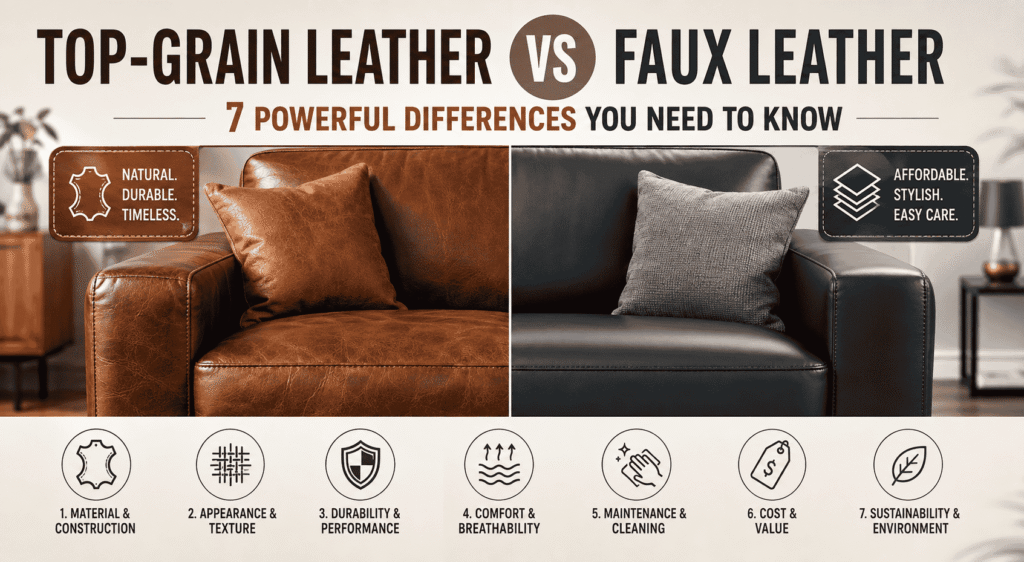
Top-Grain Leather vs. Faux Leather: 7 Key Differences
1. Material and Construction
Top-grain leather starts as an actual animal hide that’s tanned, sanded, and finished. Every piece has a natural fiber structure underneath the surface treatment.
Faux leather, by contrast, is engineered from synthetic polymers applied over a fabric or polyester backing. There’s no natural hide involved at any stage.
This basic construction difference drives nearly every other distinction between the two materials, from how they breathe to how they age.
2. Appearance and Natural Texture
Top-grain leather typically shows subtle grain variation, even after finishing, because it comes from a living material with natural imperfections. No two hides — and occasionally no two cushions — look completely identical, which many shoppers see as a mark of authenticity.
Faux leather, being manufactured, tends to have a more uniform grain pattern repeated across the entire surface. High-quality faux leather can look very convincing in photos and even in person, but the texture often feels slightly more “printed” on close inspection.
Over years of use, top-grain leather tends to soften and develop character. Faux leather generally keeps its original appearance until it begins to show wear.
3. Durability: Top-Grain Leather vs. Faux Leather in Everyday Use
Both materials can perform well, but they age differently. Top-grain leather is naturally resistant to punctures and generally holds up well to years of everyday use when properly conditioned, though it can scratch or scuff, particularly from pet claws or sharp objects.
Faux leather’s durability varies enormously by quality and construction. A well-made PU faux leather with a strong backing can last for years, while a thinner, lower-grade version may begin to crack or peel within a couple of seasons, especially with heat or direct sunlight exposure.
It’s difficult to say one material universally “lasts longer,” since quality, household use, and maintenance all play a major role in the outcome for both.
4. Comfort, Feel, and Breathability
Genuine leather is naturally breathable, meaning it doesn’t trap heat and moisture against the skin the way many synthetics do. It tends to feel cooler in summer and warms slightly to body temperature in winter.
Faux leather, particularly PVC-based versions, is less breathable and can feel warmer or slightly tacky during long periods of sitting, though quality PU versions have improved on this.
In terms of hand-feel, top-grain leather generally has a softer, more supple texture that many people find more comfortable. Faux leather can feel smoother but slightly firmer or more plastic-like, depending on the grade.
Common questions this addresses:
- Is top-grain leather comfortable? Yes, it’s widely regarded as one of the more breathable and adaptable upholstery materials.
- Does faux leather feel like real leather? Higher-end PU faux leather can come close, but most people can still tell the difference upon close contact.
5. Maintenance: Top-Grain Leather vs. Faux Leather Cleaning Routines
Top-grain leather requires periodic conditioning to keep it supple and prevent drying or cracking. Prompt cleanup of spills using leather-safe products also matters—harsh chemicals, direct sunlight, and heat sources can all shorten its lifespan.
Faux leather is generally easier to maintain day-to-day. Most spills wipe away with a damp cloth, and it doesn’t need conditioning. However, it’s still sensitive to certain solvents and excessive heat, which can cause the coating to break down over time.
For a full breakdown of cleaning routines for either material, our ultimate guide to sofa cleaning at home covers safe products and common mistakes to avoid.
6. Cost and Long-Term Value: Top-Grain Leather vs. Faux Leather Pricing
Top-grain leather sofas typically cost more upfront due to the price of raw hide, tanning, and finishing processes. Faux leather sofas are usually significantly more affordable, making them appealing for buyers furnishing a home on a budget or outfitting spaces with higher wear-and-tear risk.
When comparing long-term value, top-grain leather can be a smarter investment if it’s properly maintained and expected to last many years. That effectively lowers its cost-per-year of use.
Faux leather offers strong short-to-medium-term value, but lower-quality versions may need replacing sooner, which can offset the initial savings.
Is top-grain leather worth the extra money? It depends on your priorities. If you want a long-term furniture piece, prioritize natural texture, and are willing to do occasional maintenance, the higher price is often justified. If you’re budget-conscious, expect to replace furniture more frequently, or want maximum flexibility in color and style, faux leather delivers strong value without the higher upfront cost.
7. Sustainability: Top-Grain Leather vs. Faux Leather Environmental Impact
Sustainability is genuinely complicated for both materials, and neither is a clear winner in every respect. Top-grain leather is a byproduct of the meat industry in most cases, but tanning processes can involve chemicals that raise environmental concerns. Leather production also has a notable water and carbon footprint.
Faux leather avoids animal-derived materials, but most versions are petroleum-based plastics that aren’t biodegradable and can contribute to microplastic concerns over their life cycle. Because faux leather with poor durability may need replacing more often, its overall environmental impact can add up over time despite a lower footprint per unit.
Buyers who care deeply about sustainability should look into how a specific manufacturer sources and produces its materials rather than assuming one category is automatically “greener.” Organizations like Textile Exchange publish research on material sourcing that’s helpful for comparing sustainability claims across product categories.
Top-Grain Leather vs Faux Leather Comparison Table
| Feature | Top-Grain Leather | Faux Leather |
|---|---|---|
| Material | Natural leather | Synthetic material |
| Appearance | Natural grain | More uniform |
| Texture | Premium natural feel | Manufactured feel |
| Breathability | Generally better | Generally lower |
| Durability | High with proper care | Varies by construction |
| Maintenance | Moderate | Usually easier |
| Price | Higher | Usually lower |
| Aging | Develops character | May show wear differently |
| Best for | Long-term premium furniture | Budget-conscious buyers |
Pros and Cons of Top-Grain Leather (Top-Grain Leather vs Faux Leather Trade-Offs)
Advantages
- Premium, upscale appearance
- Natural, breathable texture
- Strong durability with proper care
- Comfortable in varying temperatures
- Develops attractive character over time
- Well-suited to premium furniture pieces
Disadvantages
- Higher upfront price
- Requires periodic conditioning
- May develop visible marks when exposed to pet claws or pointed objects.
- Natural grain variation is unavoidable.
- Sensitive to certain cleaning products
Pros and Cons of Faux Leather (Top-Grain Leather vs. Faux Leather Trade-Offs)
Advantages
- Lower upfront cost
- Easy day-to-day cleaning
- Consistent, uniform appearance
- Wide range of colors and styles available
- Practical for budget-conscious households
Disadvantages
- A synthetic feel can be noticeable, especially in lower grades.
- Quality varies significantly between manufacturers.
- Can peel or crack depending on construction and heat/sun exposure
- Generally lacks the natural aging character of genuine leather
Which Is Better for a Sofa: Top-Grain Leather or Faux Leather?
Choose top-grain leather if you
- Want a premium, long-term sofa
- Prioritize natural texture and breathability
- Expect frequent, everyday use
- Prefer materials that develop character with age
- Are comfortable with occasional conditioning and care
Choose faux leather if you:
- Are working with a tighter furniture budget
- Want the easiest possible day-to-day cleaning
- Prefer a consistent, uniform look
- Need a specific color or trend-driven style
- Don’t want to invest heavily in genuine hide furniture
Top-Grain Leather vs. Faux Leather for Different Lifestyles
The right answer to the top-grain leather vs. faux leather question often comes down to how you actually live day to day. Here’s how each material fits common household situations.
Best for Families: Faux leather often wins for young families due to easy spill cleanup, though a well-finished top-grain leather sofa can also handle daily wear if conditioned regularly.
Best for Pet Owners: Neither material is scratch-proof, but thicker top-grain leather with a protective finish tends to resist claw marks slightly better than thinner faux leather, which can tear more easily.
Best for Luxury Living Rooms: Top-grain leather’s natural texture and richer appearance generally make it the stronger choice when the goal is an upscale, high-end look.
Best for Budget Buyers: Faux leather delivers a leather-like appearance at a fraction of the cost, making it ideal for furnishing a home affordably.
Best for Heavy Everyday Use: A high-quality version of either material can perform well. The deciding factor is construction quality and finish grade rather than the material category alone.
How to Identify High-Quality Top-Grain Leather
- Read the product description carefully for the exact leather grade.
- Ask the retailer directly what type of leather is used.
- Examine the grain for natural, non-repeating variation.
- Feel the surface—genuine leather has a distinct, supple texture.
- Check the sofa’s overall frame and cushion construction.
- Ask about the type of finish applied
- Review the manufacturer’s warranty terms.
- Don’t judge quality by price alone—always verify material specifications.
How to Identify Good-Quality Faux Leather
- Understand whether it’s PU or PVC-based
- Check for surface consistency and even coloring
- Assess the thickness of the material
- Look at the backing fabric quality.
- Inspect stitching for tight, even seams
- Test flexibility—quality faux leather shouldn’t feel stiff or brittle.
- Research the manufacturer’s reputation.
- Check warranty coverage
- Watch for signs of poor quality, like uneven texture or a strong chemical smell
Common Mistakes to Avoid When Choosing Leather Sofa Material
- Selecting a sofa solely by its price without considering the quality and grade of the material
- Confusing full-grain and top-grain leather as the same thing
- Assuming all faux leather products are identical in quality
- Ignoring the sofa’s underlying frame and cushion construction
- Neglecting ongoing maintenance requirements
- Buying without reviewing the warranty
- Choosing a material that doesn’t match your household’s actual lifestyle
Top-Grain Leather vs. Faux Leather: Frequently Asked Questions
Is top-grain leather better than faux leather? It depends on priorities. Top-grain leather generally offers better breathability, natural texture, and long-term durability, while faux leather offers affordability and easier maintenance.
Does faux leather last as long as top-grain leather? It varies by quality. High-grade faux leather can last several years, but it typically doesn’t match the long-term durability of well-maintained top-grain leather.
Is top-grain leather worth the higher price? For buyers seeking a long-term, premium sofa, yes — the natural texture and durability often justify the investment. For budget-focused buyers, faux leather may offer better value.
Which is easier to clean, top-grain leather or fake leather? Faux leather is generally easier for everyday cleanup since it doesn’t require conditioning and most spills wipe away quickly.
Does faux leather peel? Lower-quality faux leather can peel or crack over time, especially with heat or sun exposure. Higher-grade versions are more resistant but not immune.
Does top-grain leather scratch easily? It can show scratches from pets, keys, or sharp objects, though a quality finish adds some resistance.
Which is better for a family sofa? Faux leather is often preferred for families due to easy cleanup, though top-grain leather can also work well with regular care.
Which leather looks more luxurious? Top-grain leather generally has a more premium, natural appearance due to its authentic grain texture.
Can you tell top-grain leather from faux leather? Often yes, especially on close inspection—genuine leather has natural grain variation and a distinct feel that’s hard to fully replicate synthetically.
Which material is better for pets? Neither is scratch-proof, but a thicker, well-finished top-grain leather tends to hold up slightly better than thinner faux leather.
Final Verdict: Top-Grain Leather vs. Faux Leather
Top-grain leather is generally the stronger choice for shoppers who prioritize premium feel, natural appearance, durability, and long-term furniture value. Faux leather is the smarter option for buyers who prioritize affordability, easier maintenance, and design flexibility.
Ultimately, the right choice comes down to your budget, lifestyle, expected usage, and personal preferences. Both materials can deliver a great-looking, comfortable sofa when you choose a quality product and care for it properly.
Related Reading on SofasExpert
- Full-Grain Leather vs Top-Grain Leather
- Full-Grain Leather vs Faux Leather
- Leather vs Fabric Sofa
- Leather vs Velvet Sofa
- Leather vs Chenille
- Leather Sofa Material Guide
- How to Choose the Right Sofa Material
- Luxury Sofa Materials
- Sofa Materials Explained
Further Reading (External Sources)
- Leather Naturally — leather terminology, production, and material characteristics
- Consumer Reports — furniture buying guidance and product considerations
- U.S. EPA — environmental and material impact information