
Introduction
Choosing a sofa is never just about color or shape — the material you sit on every day shapes your comfort, your cleaning routine, and how long the piece will actually last. Among the most common decisions buyers face is full-grain leather vs. cotton. Both are natural materials, yet they behave in almost opposite ways once they enter a living room.
Full-grain leather brings a rich, structured feel and a surface that ages with character. Cotton brings softness, breathability, and a relaxed, everyday comfort. Neither is automatically “”better”—the right pick depends on your household, your budget, and how you actually use your sofa.
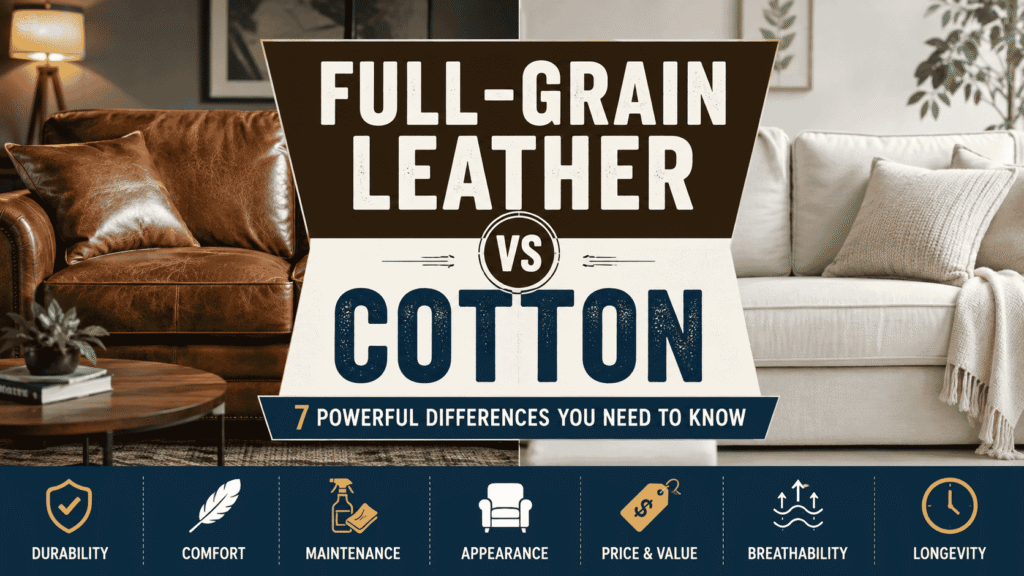
This guide breaks down full-grain leather vs. cotton across durability, comfort, appearance, maintenance, stain resistance, and price, so you can make a confident, informed choice. If you’re still considering your options, our guide on selecting the right sofa material is a wonderful starting point.
Table of Contents
Full-Grain Leather vs Cotton at a Glance
| Feature | Full-Grain Leather | Cotton |
|---|---|---|
| Material type | Natural animal hide | Natural plant fiber |
| Feel | Rich, firm, smooth-to-textured | Soft, breathable, comfortable |
| Durability | Excellent | Moderate to good, depending on construction |
| Stain resistance | Generally better with a suitable finish | More absorbent |
| Maintenance | Moderate | Moderate to high |
| Aging | Develops a patina over time | Can fade and show wear |
| Breathability | Good | Excellent |
| Appearance | Luxurious, distinctive | Casual, versatile |
| Price | Usually higher | Usually more affordable |
| Best for | Long-term, premium furniture | Comfortable, casual interiors |
Cotton is a natural plant fiber and one of the most widely used textiles in upholstery, as noted by Textile Exchange, which tracks natural and preferred fiber production globally. Full-grain leather, by contrast, is leather that retains its original grain surface without any sanding or correction, a definition confirmed by the Leather Research Laboratory.
1. What Is Full-Grain Leather?
How Full-Grain Leather Is Made
Full-grain leather comes from the outermost layer of the hide — the part with the tightest fiber structure and the most natural strength. During tanning, this layer is left essentially untouched: no sanding, buffing, or heavy correction is applied to remove imperfections. That means the natural grain pattern, along with small marks like wrinkles or healed scars, often remains visible.
This is a key distinction from “corrected-grain” or heavily processed leathers, where the surface is sanded down and reprinted with an artificial texture. Full-grain leather keeps its original surface intact, which is precisely why it behaves so differently over time compared to lower grades.
Why Full-Grain Leather Is Considered Premium
Several factors give full-grain leather its premium reputation:
- Natural surface – no artificial texture or heavy coating masking the hide
- Strong fiber structure – the tightest, most durable layer of the hide
- Long-term aging – improves in appearance rather than simply wearing out
- Patina development – subtle color and sheen changes build character over years
- Distinctive appearance – no two pieces look exactly alike
Because of this natural construction, full-grain leather is often positioned at the top of the leather-quality hierarchy, above top-grain and bonded leather.
2. What Is Cotton Sofa Fabric?
How Cotton Is Produced
Cotton begins as a plant-based fiber harvested from the cotton boll. The raw fiber is cleaned, spun into yarn, and then woven or knitted into fabric suitable for upholstery. The specific weave — whether a tight twill, a heavier canvas, or a looser blend — has a major effect on how the finished fabric performs on a sofa.
Not all cotton upholstery is created equal. A densely woven cotton canvas will hold up very differently from a lightweight, loosely woven cotton blend, even though both start from the same raw fiber.
Why Cotton Is Popular for Sofas
Cotton remains one of the most requested upholstery fabrics for good reason:
- Soft, natural hand feel against the skin
- Excellent breathability, especially in warmer rooms
- A relaxed, natural appearance that suits many interior styles
- Wide availability in colors, prints, and textures
- Generally comfortable for everyday, all-season seating
According to Textile Exchange’s cotton fiber glossary, cotton’s natural composition is part of what makes it breathable and soft but also part of why it behaves differently from animal-hide materials like leather when it comes to spills and staining.
3. Full-Grain Leather vs Cotton: Durability
Durability is often the deciding factor for buyers comparing full-grain leather vs. cotton, especially for busy households.
Full-Grain Leather Durability
When properly cared for, full-grain leather resists everyday wear exceptionally well. The tight, natural grain structure gives it strength that holds up to years of use, and rather than simply degrading, the surface often becomes more characterful with age, developing the soft sheen known as patina.
Cotton Durability
Cotton is not inherently fragile, but its real-world durability depends heavily on:
- The specific weave (twill, canvas, plain weave, etc.)
- Fabric weight (measured in ounces per yard)
- Construction quality and finishing treatments
- Abrasion resistance, often measured by rub counts
A heavyweight, tightly woven cotton can perform admirably for years, while a lightweight cotton blend may show wear much sooner. This variability is why “cotton” alone doesn’t provide a complete picture of durability.
Which Lasts Longer?
Rather than making a blanket claim, it’s more useful to compare realistic use cases. Full-grain leather generally has an edge in raw material strength and long-term resilience. However, a sofa’s overall lifespan also depends on the frame, suspension system, cushion quality, and upholstery construction—not the surface material alone. A well-built cotton sofa can easily outlast a poorly constructed leather one.
For a deeper comparison of how different upholstery types hold up, see our guide to different sofa materials.
4. Comfort and Breathability
How Full-Grain Leather Feels
Leather tends to feel cool to the touch initially, then adapts to room and body temperature the longer you sit. Over time and with regular use, it softens and develops a more relaxed character, though it starts firmer than most fabrics.
How Cotton Feels
Cotton is naturally soft from the first touch and stays breathable throughout use, making it comfortable in warm environments. Texture can vary noticeably depending on the weave and finishing — some cotton fabrics feel crisp and structured, while others feel plush and relaxed.
Which Is More Comfortable?
The answer depends on context:
- Warm climates – cotton’s breathability tends to feel more comfortable
- Cold climates—leather adapts to warmth from the body and room over time
- Bare-skin contact—cotton is generally softer and less noticeable against the skin.
- Long sitting sessions—both perform well, though cotton stays consistently soft.
- Family living rooms – cotton’s approachable softness often suits everyday lounging
If you’re weighing fabric options beyond cotton, our comparison of cotton vs microfiber covers how these two soft materials differ in feel and upkeep.
5. Appearance and Style
The Look of Full-Grain Leather
Full-grain leather delivers a premium, sophisticated look defined by natural grain variation and the gradual development of patina. It tends to suit modern, traditional, industrial, and luxury interior styles particularly well, largely because its visual richness works as a statement piece rather than a background element.
The Look of Cotton
Cotton upholstery reads as casual, soft, and versatile. It’s available in an enormous range of colors, prints, and textures, making it easy to match almost any design concept—from minimalist to eclectic to classic.
Which Looks More Luxurious?
Full-grain leather usually creates the stronger premium visual impression, thanks to its natural texture and the way it ages into something more distinctive over time. Cotton, on the other hand, offers far greater decorative flexibility, letting you match a specific color palette or pattern that leather simply can’t replicate.
Related reading: Leather vs. fabric sofas and Full-grain vs. top-grain leather explore these style distinctions in more depth.
6. Cleaning and Maintenance
How to Maintain Full-Grain Leather
- Dust regularly with a soft, dry cloth
- Wipe up spills promptly before they can soak in
- Use leather-specific care products, not generic household cleaners
- Avoid harsh chemicals, which can dry out or damage the finish
- Keep the sofa away from prolonged direct sunlight and heat sources.
How to Maintain Cotton Upholstery
- Vacuum regularly to remove dust and debris from the weave.
- Treat spills quickly with a clean, absorbent cloth.
- Always follow the manufacturer’s fabric cleaning code.
- Consider removable or washable covers where available
- Don’t assume every cotton fabric is machine washable—check first.
Which Is Easier to Maintain?
For households with young children, pets, or heavy daily use, full-grain leather often has a practical edge because spills tend to sit on the surface rather than soak in, making wipe-downs quick and simple. Cotton, while soft and pleasant to live with, generally requires more frequent and careful attention to avoid staining, especially in spill-prone households.
For a full walkthrough of upkeep routines, see our sofa cleaning guide.
7. Stain Resistance and Everyday Practicality
Full-Grain Leather
Leather’s surface behavior around spills depends heavily on the type of finish applied. Generally, surface spills, food, and drink can often be wiped away before they set, though oils and certain dyes can be more stubborn. Scratches are also a consideration, since the natural grain can show marks from pets or sharp objects. A quality protective finish makes a noticeable difference here.
Cotton
Because cotton is an absorbent natural fiber, spills can soak in quickly and lead to visible staining if not addressed right away. Food and drink accidents, along with gradual color fading from sunlight, are common concerns. Fabric treatments and protective sprays can improve resistance, but performance still varies by weave and finish.
It’s worth remembering that not all leather or cotton upholstery performs identically—finishing, tanning method, and fabric construction all play a role, so it pays to check the specifics before buying.
8. Price and Long-Term Value
Why Full-Grain Leather Costs More
Full-grain leather commands a higher price for several reasons: the premium raw material itself, the more involved tanning and processing required to preserve the natural grain, careful selection of hides with minimal blemishes, and its overall positioning as a higher-end upholstery option.
Why Cotton Can Be More Budget-Friendly
Cotton benefits from wide availability, a broad range of grades and weaves, and a price spectrum that spans budget to premium options—giving buyers more flexibility to match a sofa to their budget without sacrificing style.
Which Offers Better Value?
Value isn’t simply about the lowest sticker price. A fair comparison should weigh the following:
- Initial purchase price
- Expected longevity of the material
- Ongoing maintenance requirements and costs
- How often the sofa might need replacing or reupholstering
- The aesthetic you actually want in your space
A higher upfront cost for full-grain leather can pay off over a decade of use, while a well-chosen cotton sofa can deliver excellent comfort and style at a lower initial investment.
9. Full-Grain Leather vs. Cotton: Pros and Cons
Full-Grain Leather Pros
- Excellent durability
- Premium, distinctive appearance
- Natural grain with visible character
- Develops patina and improves with age
- Generally easy to wipe clean
Full-Grain Leather Cons
- Higher upfront cost
- Can be scratched by pets or sharp objects
- Requires appropriate leather care products
- May not suit every decorating style
- Can be sensitive to sunlight and heat depending on the finish
Cotton Pros
- Soft and comfortable
- Highly breathable
- Natural fiber with a relaxed feel
- Wide range of colors and patterns
- Often more accessible in price
Cotton Cons
- Can absorb spills quickly
- May stain more easily than leather
- Can fade with prolonged sun exposure
- Durability varies significantly by construction.
- May require more frequent cleaning
10. Full-Grain Leather vs Cotton: Which Is Better for a Sofa?
Choose Full-Grain Leather If You:
- Want a premium, statement sofa
- Prioritize long-term durability
- Prefer a classic or luxury appearance
- Want a surface that’s relatively quick to wipe clean
- Enjoy natural aging and patina development
Choose Cotton If You:
- Prefer the feel of soft fabric upholstery
- Want more flexibility in color and design
- Value breathability, especially in warmer rooms
- Prefer a relaxed, casual aesthetic
- Are working with a tighter initial budget
Full-Grain Leather vs Cotton for Different Households
| Household | Better Choice | Why |
|---|---|---|
| Luxury living room | Full-Grain Leather | Premium, distinctive appearance |
| Casual family room | Cotton | Soft, relaxed everyday feel |
| Frequent spills | Full-Grain Leather | Easier surface cleanup |
| Hot climate | Cotton | Breathable fabric |
| Long-term investment | Full-Grain Leather | Strong, ages gracefully |
| Design flexibility | Cotton | More colors and patterns available |
| Minimal maintenance | Full-Grain Leather | Surface generally easier to wipe |
| Soft-touch preference | Cotton | Naturally comfortable textile feel |
How to Choose Between Full-Grain Leather and Cotton
Ask yourself these five questions before deciding:
- What is your sofa budget? Leather typically requires a higher initial investment.
- How heavily will the sofa be used? High-traffic households may benefit from leather’s resilience.
- Do you prioritize softness or durability? Cotton wins on softness; leather often wins on durability.
- How much maintenance are you willing to do? Leather needs occasional specialized care; cotton needs consistent attention to spills.
- What style do you want for your room? Leather suits premium and classic looks; cotton suits casual and design-flexible spaces.
If durability, a premium look, and easy cleanup top your list, full-grain leather is likely the stronger choice. If softness, breathability, and design variety matter more, cotton is probably the better fit.
Common Mistakes to Avoid When Choosing Sofa Upholstery
- Choosing based only on appearance without considering daily use
- Assuming every leather product is full-grain leather
- Assuming all cotton fabrics offer the same level of durability
- Ignoring the sofa’s underlying construction and frame quality
- Overlooking cleaning requirements before purchase
- Buying without checking the fabric or leather specifications
- Forgetting to account for sunlight exposure in the room
- Focusing only on the initial price instead of long-term value
FAQs About Full-Grain Leather vs. Cotton
Is full-grain leather better than cotton for sofas? It depends on your priorities. Full-grain leather generally offers better durability and a more premium appearance, while cotton offers superior softness and breathability. Neither is universally “better.”
Is cotton more comfortable than full-grain leather? Cotton is typically softer to the touch and more breathable, especially in warm rooms. Leather can feel firmer at first but softens and adapts over time.
Which lasts longer, full-grain leather or cotton? Full-grain leather generally has stronger durability due to its natural fiber structure, but a sofa’s overall lifespan also depends on construction quality, frame, and how well either material is cared for.
Is full-grain leather easier to clean than cotton? Yes, in most cases. Because leather is less absorbent, spills can often be wiped away before they set, while cotton tends to absorb liquids more readily.
Is cotton good for a family sofa? Yes, cotton is a popular family-room choice thanks to its softness and comfort, though it may need more frequent cleaning attention with kids or pets around.
Is full-grain leather worth the extra cost? For buyers prioritizing longevity, premium appearance, and easier maintenance, full-grain leather’s higher price often reflects genuine long-term value.
Which is better for hot weather, leather or cotton? Cotton generally performs better in hot weather due to its breathability, though leather also adapts to room temperature over time.
Which material is more luxurious? Full-grain leather is typically regarded as the more luxurious option, thanks to its natural grain and the way it develops character with age.
Can cotton upholstery be durable? Yes. A heavyweight, tightly woven cotton fabric with quality construction can be quite durable, though performance varies significantly between products.
What should I choose for a sofa: full-grain leather or cotton? Choose full-grain leather for durability, premium style, and easy cleanup. Choose cotton for softness, breathability, and design flexibility. Base your final decision on your household’s daily use, budget, and style preferences.
Final Verdict
When comparing full-grain leather vs. cotton, there’s no single winner—only the right fit for your household.
Full-grain leather is the stronger choice for durability, premium appearance, long-term value, and easier surface cleaning.
Cotton stands out for softness, breathability, design variety, and a more relaxed, everyday feel.
Neither material is universally “better.” The smartest choice comes down to how you live: your budget, your household’s daily demands, and the style you want your living room to reflect.
For more guidance on premium options, see our Sofa Materials Explained and Luxury Sofa Materials guides, or explore How to Choose the Right Sofa Material and Best Sofa Material for Your Home for additional perspectives.
Further reading on care and buying: Consumer Reports – How to Find Quality Furniture | Good Housekeeping – Leather Couch Buying Guide | Living Spaces – How to Clean a Fabric Sofa | ScS – Leather Sofa Care Guide