
Introduction
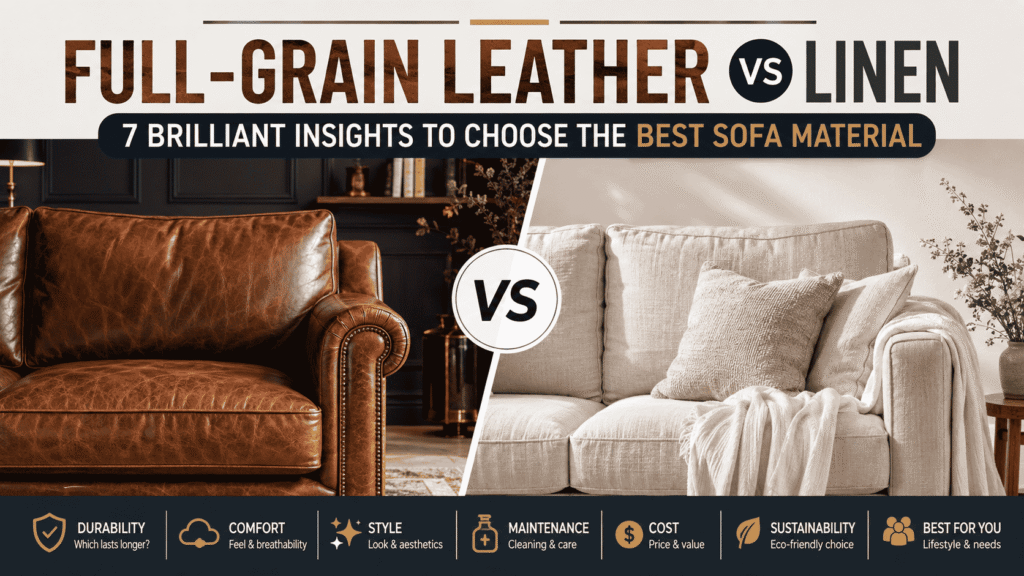
Choosing a new sofa is never just about color or shape — the material you pick decides how the piece feels, how long it lasts, and how much work it takes to keep looking good. Two of the most popular choices on the market today are full-grain leather and linen, and the full-grain leather vs. linen debate is one that almost every furniture shopper eventually runs into.
Both materials are prized for very different reasons. Full-grain leather is known for its strength, richness, and the way it ages with character. Linen, on the other hand, is loved for its light, breathable feel and relaxed, natural look. There’s no one-size-fits-all winner—the ideal material depends on your lifestyle, local climate, spending range, and the style you want for your space.
In this guide, we’ll break down seven key insights comparing full-grain leather and linen sofas, covering durability, comfort, style, maintenance, resistance to damage, price, and lifestyle fit—so you can make a confident, informed decision.
Table of Contents
What Is Full-Grain Leather?
How Full-Grain Leather Is Made
“Full-grain” refers to leather that uses the entire top layer of the hide, including its natural grain—the outermost, most durable part of the animal skin. Unlike corrected-grain or bonded leather, full-grain leather is not sanded down or heavily processed to remove imperfections. This means the natural markings, slight scars, and texture variations of the original hide remain visible.
Because the grain layer is left intact, full-grain leather retains the tightest fiber structure of any leather type, which is a major reason it holds up so well over years of use. It’s also why no two full-grain leather sofas look exactly alike—each one carries its own natural fingerprint.
Key Characteristics of Full-Grain Leather
- Durability – The tightly woven fiber structure makes it highly resistant to everyday wear.
- Natural appearance – Visible grain and subtle imperfections give it an authentic, high-end look.
- Breathability – Leather has natural pores that allow some airflow, helping it adapt to body temperature over time.
- Patina development – With use and light exposure, full-grain leather develops a rich patina that deepens in color and character.
- Premium feel – Thick, substantial, and smooth to the touch, it’s often associated with luxury furniture.
What Is Linen?
How Linen Fabric Is Made
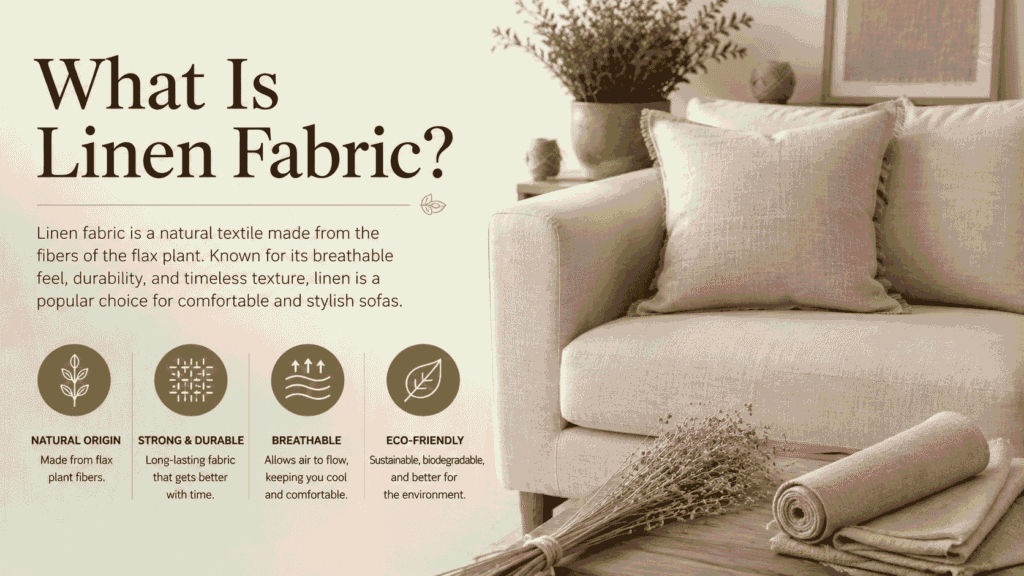
Linen is a plant-based fabric made by spinning and weaving fibers extracted from the flax plant. The process starts with harvesting flax stalks, which are then retted (soaked to loosen the fibers), dried, and combed to separate the usable fibers from the woody core. These fibers are spun into yarn and woven into fabric.
Because it comes from a plant rather than an animal hide, linen has an entirely different feel and performance profile compared to leather — it’s lighter, softer, and has a naturally textured weave.
Key Characteristics of Linen
- Lightweight feel – Linen is noticeably lighter than leather, both in weight and visual presence.
- Breathability – Its loose weave allows excellent airflow, making it a popular choice in warmer climates.
- Natural texture – The fabric has a slightly nubby, organic surface that adds visual interest.
- Casual appearance – Linen leans toward relaxed, understated interiors rather than formal ones.
- Moisture absorption—Linen fibers can absorb and release moisture efficiently, which contributes to their breathable feel.
Full-Grain Leather vs. Linen: 7 Brilliant Insights
1. Durability and Lifespan
Full-Grain Leather
- Has a strong surface structure and excellent long-term durability.
- Develops a distinctive patina over time instead of simply wearing out.
- Well-suited for high-use furniture, especially when properly maintained.
Linen
- It can be durable, but performance depends heavily on the weave, fabric construction, and overall quality.
- More susceptible to visible wear, snagging, and general fabric-related damage over time.
Winner: Full-Grain Leather
2. Comfort and Feel
Full-Grain Leather
- Offers a smooth, substantial feel right from the start.
- Becomes more supple with regular use as the fibers relax.
- Can feel cooler when you first sit down, warming up with body contact over time.
Linen
- Soft, breathable, and naturally textured against the skin.
- Especially comfortable in warm environments where airflow matters.
- Offers a relaxed, casual sitting experience rather than a formal one.
Winner: Linen for lightweight breathability; Leather for a substantial, premium feel
3. Appearance and Style
Full-Grain Leather
- Luxurious and sophisticated, with a natural grain that creates a one-of-a-kind appearance.
- Complements classic, modern, industrial, and luxury interior styles.
Linen
- Creates a soft, relaxed, natural aesthetic that feels effortless rather than formal.
- Works particularly well with minimalist, coastal, Scandinavian, and farmhouse interiors.
- Available in a wide range of colors and textures to match different design schemes.
Winner: Depends on your interior style
4. Maintenance and Cleaning
Full-Grain Leather
- Requires regular dusting and occasional conditioning to keep it supple.
- Spills can often be wiped away quickly before they soak in.
- Needs leather-specific care products rather than general household cleaners.
Linen
- Can absorb liquids and stains more readily than leather, since it’s a woven textile.
- May require more careful, prompt cleaning to avoid permanent marks.
- Removable covers, when available, can make ongoing maintenance considerably easier.
Winner: Full-grain leather for easier everyday spill management
5. Resistance to Stains, Scratches, and Everyday Damage
Full-Grain Leather
- Resistant to many everyday spills when properly protected and cleaned promptly.
- Scratches can appear but often blend into the leather’s developing patina rather than standing out permanently.
- Sharp objects and pet claws can still damage the surface, so some caution is still needed.
Linen
- More vulnerable to stains and spills simply because it is a woven fabric.
- Can be prone to snagging and abrasion from rough use or pet claws.
- Protective fabric treatments may help improve real-world performance.
Winner: Full-Grain Leather
6. Price and Long-Term Value
Full-Grain Leather
- Usually commands a premium price compared to fabric options.
- Higher initial investment upfront.
- Its long lifespan can make it a genuinely good value over many years of use.
Linen
- Often provides a lower-cost alternative to leather sofas.
- Price varies significantly depending on fabric quality, weave density, and construction.
- Replacement or professional cleaning costs should be factored into the long-term budget.
Winner: Linen for lower initial cost; leather for long-term investment potential
7. Lifestyle and Best Use
Full-Grain Leather Is Best For:
- Busy households with frequent furniture use
- High-use living rooms and family spaces
- People who prefer a luxury furniture look and feel
- Buyers seeking long-term longevity
- Homes where easy spill management matters most
Linen Is Best For:
- Warm climates where breathability is a priority
- Relaxed, laid-back living spaces
- Minimalist and natural-inspired interiors
- People who prefer the feel of natural fabric
- Buyers who value a soft, breathable textile over a structured surface
Winner: Depends on your lifestyle
Full-Grain Leather vs Linen Comparison Table
| Feature | Full-Grain Leather | Linen |
|---|---|---|
| Material Type | Natural animal hide | Natural flax-based fiber |
| Durability | Excellent | Good to very good, depending on construction |
| Comfort | Supple and substantial | Soft and breathable |
| Breathability | Good | Excellent |
| Stain Resistance | Generally better | Generally lower |
| Scratch Resistance | Moderate | Moderate to low |
| Maintenance | Moderate | Moderate to high |
| Appearance | Premium and luxurious | Natural and relaxed |
| Price | Usually higher | Usually lower |
| Patina | Yes | No |
| Best For | Long-term durability | Breathable, casual comfort |
Pros and Cons of Full-Grain Leather
Pros
- Exceptional durability
- Premium, sophisticated appearance
- Develops a natural patina that adds character over time
- Good long-term value for the investment
- Easier everyday spill management
Cons
- Higher upfront cost
- Requires leather-specific care and conditioning
- Can be scratched from sharp objects or pet claws
- May feel less casual than a fabric sofa
Pros and Cons of Linen
Pros
- Naturally breathable and light
- Comfortable in warm weather
- Soft, textured appearance with natural appeal
- Wide availability of colors and weaves
- Excellent fit for relaxed, casual interiors
Cons
- More vulnerable to stains than leather
- Can wrinkle with regular use
- May show wear more easily over time
- Requires more careful, prompt cleaning
- Quality varies significantly depending on fabric construction.
Which Is Better for Families With Kids?
Families with young children deal with food spills, drink accidents, crayon marks, and general daily wear on a regular basis. In this scenario, cleaning speed and durability matter more than anything else.
Full-grain leather tends to have the edge here — spills can usually be wiped away before they soak in, and the surface holds up well against daily bumps and activity. Linen, while soft and comfortable, absorbs spills more readily and may need more frequent, careful cleaning to avoid stains.
Recommended choice: Full-grain leather is generally the stronger option for households prioritizing durability and easier spill management around kids.
Which Is Better for Homes With Pets?
Pet owners often worry about scratches, claw marks, shedding hair, and odor. Neither full-grain leather nor linen is completely pet-proof, and the right choice depends largely on the pet’s behavior.
- Scratches and claws: Both materials can be damaged by sharp claws, though leather may show scratches less dramatically since marks can blend into its natural grain and patina.
- Pet hair: Leather generally sheds pet hair more easily than woven linen, which can trap fibers in its texture.
- Odor absorption: Fabric surfaces like linen are more prone to absorbing odors compared to leather’s smoother surface.
- Cleaning: Leather is typically quicker and easier to wipe clean after pet-related messes.
In the end, a well-behaved pet may do little damage to either material, while an especially active or clawed pet may challenge both—so behavior matters as much as material choice.
Which Is Better for Hot Climates?
For warmer regions, airflow and surface temperature play a big role in comfort.
- Airflow: Linen’s loose weave allows air to pass through easily, keeping the seating surface cooler and more breathable.
- Moisture: Linen absorbs and releases moisture efficiently, which helps it feel less clammy in humid conditions.
- Summer comfort: Many people find linen more comfortable to sit on during hot weather.
- Surface temperature: Leather can feel warm to the touch after prolonged sun exposure, though it can still perform well with good ventilation, air conditioning, or shaded placement.
Linen tends to be the more naturally suited option for hot climates, but leather can still work well in warm environments depending on room temperature, ventilation, and personal preference.
Which Material Is More Eco-Friendly?
It’s tempting to assume that “natural” automatically means “sustainable,” but the reality is more nuanced for both materials.
- Natural origins: Full-grain leather comes from animal hides, often as a byproduct of the meat industry, while linen is derived from the flax plant, a crop that generally requires fewer pesticides and less water than some other textile crops.
- Production processes: Leather tanning can involve chemical treatments, while textile processing for linen also involves its own resource and chemical inputs, depending on the manufacturer.
- Longevity: A longer-lasting product, whether leather or linen, generally has a lower environmental footprint over its lifetime simply because it needs replacing less often.
- Repairability: Leather can often be conditioned, cleaned, and repaired, extending its usable life.
- End-of-life considerations: How a material breaks down, and whether it can be recycled or repurposed, also affects its overall environmental impact.
Neither material is automatically the more sustainable option. The real environmental impact depends on sourcing practices, manufacturing methods, chemical use, transportation, how long the product lasts, and how it’s eventually disposed of.
How to Choose Between Full-Grain Leather and Linen
Choose full-grain leather if you prioritize the following:
- Durability
- A luxurious look and feel
- Long-term use without frequent replacement
- Easier spill cleanup
- The character that comes with a developing patina
Choose linen if you prioritize the following:
- Breathability
- A lightweight, soft comfort
- Natural textile texture
- A casual, relaxed aesthetic
- Warm-weather comfort
Full-Grain Leather vs Linen: Which Sofa Material Wins?
There isn’t a single universal winner in the full-grain leather vs. linen comparison—the best choice depends on what matters most to you.
- Best Overall for Durability: Full-Grain Leather
- Best for Breathability: Linen
- Best for Luxury: Full-Grain Leather
- Best for Relaxed Style: Linen
- Best for Long-Term Investment: Full-Grain Leather
- Best for Warm-Weather Comfort: Linen
Frequently Asked Questions
Is full-grain leather better than linen for a sofa? It depends on your priorities. Full-grain leather generally offers better durability, stain resistance, and long-term value, while linen offers superior breathability and a more casual, lightweight feel.
Is linen more comfortable than leather? Linen tends to feel lighter and cooler to the touch, especially in warm climates, while leather offers a smooth, substantial comfort that many people associate with premium furniture.
Which lasts longer, full-grain leather or linen? Full-grain leather typically lasts longer due to its dense fiber structure and ability to develop a patina instead of simply wearing out. Linen’s lifespan depends heavily on the quality of the weave and how it’s maintained.
Is linen harder to clean than full-grain leather? Generally, yes. Linen absorbs spills more readily and often requires more careful, prompt cleaning, while leather spills can usually be wiped away quickly.
Is full-grain leather good for families with kids? Yes, full-grain leather is often a strong choice for families because it handles spills and everyday wear more easily than fabric alternatives.
Is linen good for homes with pets? Linen can work in pet-friendly homes, but it’s more prone to snagging, shedding retention, and odor absorption compared to leather.
Which is more expensive, full-grain leather or linen? Full-grain leather usually costs more upfront due to the material and craftsmanship involved, while linen is often a more budget-friendly option, though prices vary by quality.
Does full-grain leather get better with age? Yes, one of full-grain leather’s defining qualities is its ability to develop a rich patina over time, which many people consider a desirable feature rather than a flaw.
Is linen suitable for a hot climate? Yes, linen’s breathable weave makes it a popular choice for warmer climates where airflow and a cool seating surface are priorities.
Which sofa material should I choose for everyday use? For high-traffic, everyday use, full-grain leather is often the more practical choice due to its durability and easier maintenance, though linen remains a comfortable option for lower-traffic, relaxed spaces.
Final Verdict
When it comes to full-grain leather vs. linen, both materials bring real strengths to the table. Full-grain leather stands out for durability, easy maintenance, and long-term value, while linen shines in breathability, comfort, and casual style. Your climate, household habits, budget, and design preferences should all play a role in the final decision.
There’s no single “correct” answer in the full-grain leather vs. linen comparison—only the material that best fits your specific needs. Take a moment to evaluate how your household actually uses its furniture, and choose the sofa material that will serve you best for years to come.
Related Reading
- Linen Sofa Material
- Polyester Sofa Material
- Fabric Sofa Material
- How to Choose the Right Sofa Material
- Velvet Sofa Material
- Cotton Sofa Material
- Microfiber Sofa Material
- Chenille Sofa Material
- Leather Sofa Material
- Linen vs Cotton
- Velvet vs Polyester
- Leather vs Fabric Sofa
- Full-Grain Leather
External Links — Recommended Sequence
- Leather Naturally — leather characteristics and production
- American Leather Chemists Association — leather science and tanning
- Alliance for European Flax-Linen & Hemp — flax and linen information
- Textile Exchange — textile sustainability and natural fibers
- Consumer Reports — furniture buying guidance
- Good Housekeeping — furniture and sofa cleaning guidance