
Introduction
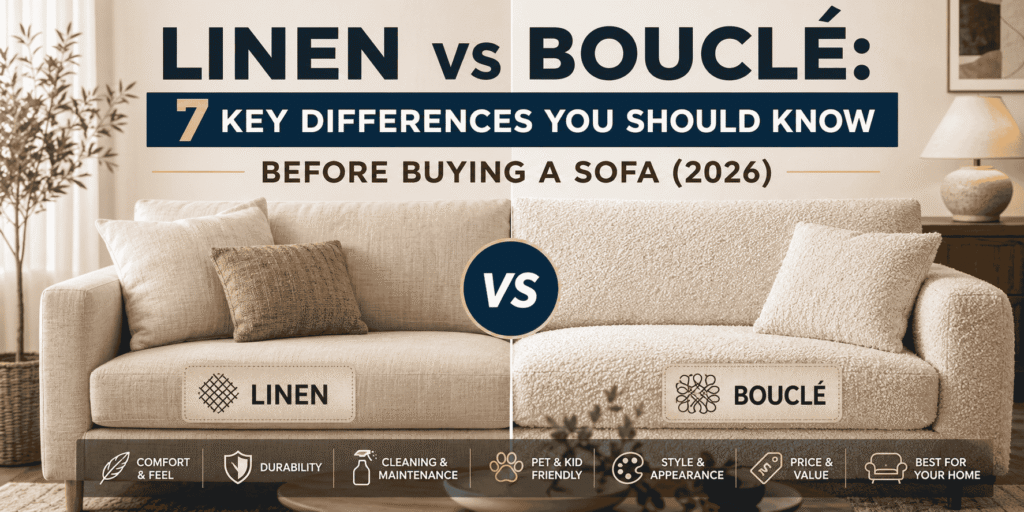
Linen vs Bouclé is an important comparison for anyone choosing a sofa fabric that balances style, comfort, and everyday practicality. Linen offers a relaxed, natural appearance with a light, breathable feel, while bouclé is known for its soft, textured surface and cozy, luxurious look. However, neither fabric is automatically the better choice for every home. Your decision should depend on comfort, durability, cleaning, stain resistance, pets, children, appearance, price, and ongoing maintenance. In this guide, we’ll compare linen and bouclé across these key factors so you can understand their strengths and limitations and choose the sofa fabric that best fits your lifestyle and space.
Table of Contents
Linen vs Bouclé at a Glance
| Feature | Linen | Bouclé |
|---|---|---|
| Material | Natural flax fiber | Looped yarn construction; fiber varies (wool, cotton, linen, polyester, acrylic, or blends) |
| Texture | Smooth to slightly slubby | Nubby and textured |
| Feel | Cool and breathable | Soft and cozy |
| Appearance | Relaxed and natural | Plush and sophisticated |
| Wrinkle tendency | Higher | Lower visible wrinkling |
| Durability | Good, but depends heavily on upholstery construction | Highly dependent on fiber content and loop tightness |
| Pet friendliness | Moderate | Can be challenging — loops may snag claws |
| Cleaning | Requires fabric-specific care | Requires gentle, low-friction care |
| Best for | Natural, relaxed interiors | Cozy, textured, contemporary interiors |
Keep this table in mind as a quick-reference starting point — the sections below unpack why each row is true, and where the exceptions live.
What Is Linen Sofa Fabric?
How Linen Is Made
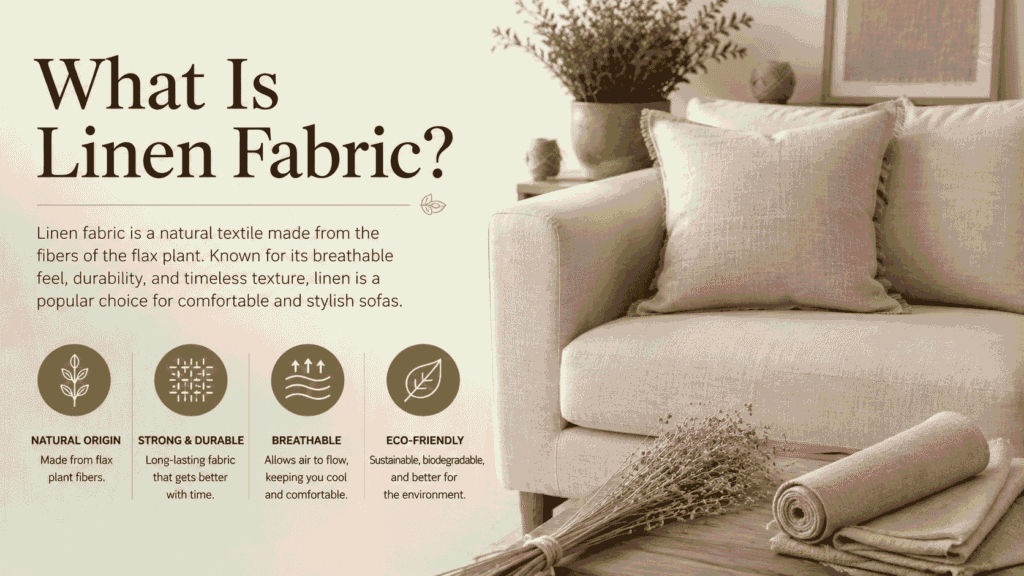
Linen is woven from fibers extracted from the stalks of the flax plant, one of the oldest cultivated fibers in human history. Flax fiber is longer and coarser than cotton, and that length is a big part of why linen fabric holds up as well as it does over time. Producing linen yarn is a slower, more labor-intensive process than producing cotton or synthetic yarn, which is part of why authentic linen upholstery tends to sit at a mid-to-premium price point.
It’s worth noting that not everything marketed as “linen” on a furniture tag is 100% flax. Many upholstery-weight fabrics are linen blends — combined with cotton, polyester, or viscose to improve durability, reduce wrinkling, or lower cost — and some “linen-look” fabrics contain no flax at all. If durability and authenticity both matter to you, check the fiber content label rather than relying on the word “linen” alone.
Key Characteristics of Linen
- Breathability—an open weave structure that lets air move through the fabric, which is why linen feels cool against the skin.
- Natural texture — a subtle, slightly irregular surface with visible slubs, giving it an organic, handmade quality.
- Strength — flax fibers are naturally strong and resist stretching or distortion under stress.
- Wrinkling — because linen fibers have low elasticity, the fabric creases more visibly than many synthetic blends.
- Absorbency — linen absorbs moisture readily, which affects how it should be cleaned and how it responds to spills.
- Appearance — a matte, relaxed look with a faint natural sheen, rather than the high shine of synthetic upholstery.
Pros of Linen Sofa Fabric
- Natural, earthy appearance that suits a wide range of interior styles
- Breathable, cool-to-the-touch surface — a genuine advantage in warmer climates
- A timeless look that doesn’t read as trend-driven
- Tends to soften pleasantly with age and regular use
- Complements minimalist, Scandinavian, coastal, and relaxed-modern interiors
Cons of Linen Sofa Fabric
- Visible wrinkling, especially on seat cushions that see regular use
- Linen can take in moisture quickly, which means accidental spills may become noticeable sooner than they would on synthetic or specially treated fabrics.
- High-friction areas—arm edges, cushion fronts—can experience abrasion over years of heavy use.
- Cleaning requirements vary significantly depending on whether the linen is treated, blended, or left in its natural state.
Textile references on flax fiber generally describe it as strong and abrasion-resistant relative to many other natural fibers, though real-world upholstery performance still depends heavily on weave density, weight, and any protective finish applied during manufacturing.
Related reading: Linen Sofa Material · Fabric Sofa Material · How to Choose the Right Sofa Material
What Is Bouclé Sofa Fabric?
What Makes Bouclé Different?
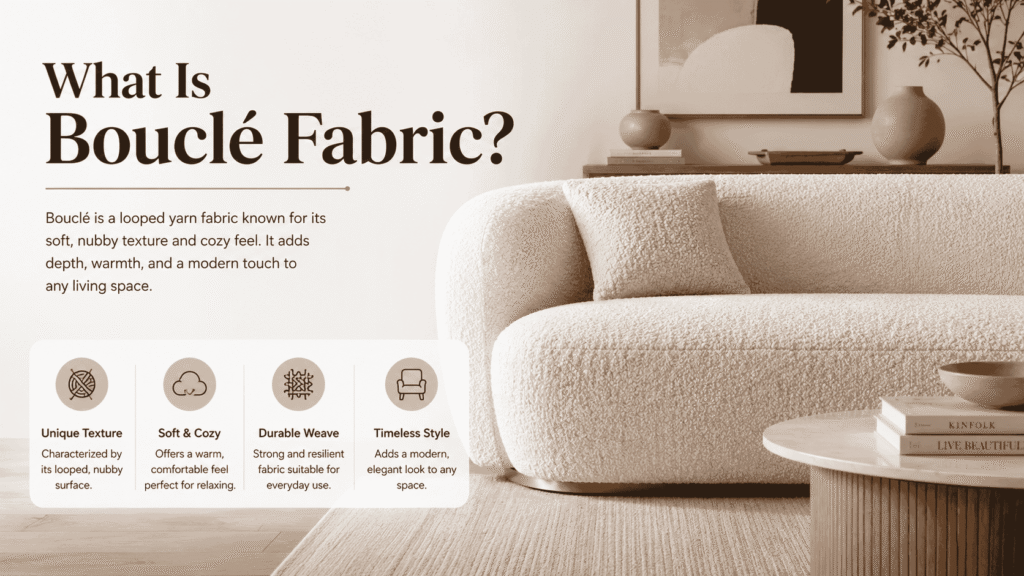
The most important thing to understand about bouclé is that it isn’t a fiber—it’s a construction. The word comes from the French for “curled” or “looped,” and it describes a yarn (and the fabric woven or knitted from that yarn) with small, irregular loops that create a nubby, three-dimensional surface. Because “bouclé” describes a technique rather than a material, it can be made from wool, cotton, linen, silk, polyester, acrylic, or blends of any of these—which means two sofas both labeled “bouclé” can perform completely differently depending on what’s actually in the yarn.
This is the single most useful fact to walk into a furniture showroom with: don’t judge bouclé durability by the name on the tag. Find out which type of fiber forms the loops and whether the loops are woven tightly enough for everyday use.
What Does Bouclé Feel Like?
- Soft, almost cloud-like to the touch
- Nubby and textured rather than smooth
- Cozy and warm — a noticeably different tactile experience from flat-weave fabrics
- Visually dimensional, with a texture that catches light and shadow
- Often available in richly rounded, sculptural sofa silhouettes that suit the fabric’s soft profile
Pros of Bouclé Sofa Fabric
- A luxurious, tactile appearance that photographs and reads as premium
- Genuinely cozy texture that invites touch
- Adds visual depth and interest to an otherwise simple room
- Works particularly well with curved, contemporary, and mid-century-inspired furniture shapes
- Available across a wide range of fiber compositions and price points
Cons of Bouclé Sofa Fabric
- The looped structure can snag on rings, buttons, zippers, and—notably—pet claws.
- Pet hair and small debris can work their way into the loops and become difficult to remove.
- Lower-quality or loosely constructed bouclé is more prone to pilling.
- Cleaning is more delicate than flat-weave fabrics, since aggressive scrubbing can distort or flatten the loops.
- Very popular, heavily marketed cream/ivory bouclé has become a common look, so buyers wanting a distinctive room may want to consider color or texture variation.
Design coverage of bouclé traces its rise in home furnishings back to mid-century pieces like Eero Saarinen’s Womb Chair and its earlier fashion-world popularity through Chanel’s iconic tweed-adjacent suiting—context that helps explain why the fabric still reads as a design statement rather than a purely practical choice.
Related reading: Bouclé Sofa Material
Linen vs. Bouclé: 7 Key Differences
1. Texture and Appearance
Linen’s texture is understated: a smooth-to-slightly-slubby surface with a natural, woven look that reads as casual-elegant. It suits interiors that lean toward organic minimalism — think exposed wood, neutral palettes, and a general sense of restraint.
Bouclé is the opposite instinct: chunky, nubby, and visually louder in a good way. It suits interiors built around softness and tactility — rounded silhouettes, warm neutrals, and a more maximalist, cocooning feel. If your room’s design language is “clean lines and quiet materials,” linen will fit more naturally. If it’s “curves, warmth, and texture layering,” bouclé tends to fit better.
2. Comfort and Feel
Both fabrics are genuinely comfortable, but they deliver comfort differently. Linen’s open weave makes it breathable and cool, which is a real advantage for people who run warm, live somewhere hot, or simply prefer a crisper seating surface. Bouclé’s looped construction traps a bit more air near the surface, giving it a warmer, plusher feel that many people associate with coziness—a strong pick for colder climates or rooms meant to feel enveloping.
Seasonal comfort is worth thinking about here too: a linen sofa can feel like the right call in a sunroom or a warm-climate living room, while a bouclé sofa often feels more at home in a den or a room built around winter evenings.
3. Durability and Everyday Wear
This is the section where it’s most important to resist a simple headline like “bouclé is more durable” or “linen lasts “longer”—neither claim holds up consistently, because so much depends on the specific fabric specification rather than the fabric family.
For linen, durability is tied to weave density, fiber blend, and finish. A tightly woven, protected linen upholstery fabric can hold up well to years of regular use; a loosely woven, untreated linen will show wear faster, especially at friction points like arm edges and cushion seams.
For bouclé, durability depends almost entirely on two things: what fiber the loops are made from and how tightly those loops are constructed. A dense, well-constructed wool or wool-blend bouclé with a sturdy backing can perform well in daily use. A loosely looped, synthetic-blend bouclé is more likely to pill, flatten, or snag over time.
The practical takeaway: ask about abrasion or rub-count ratings, fiber content, and construction quality for both fabrics rather than choosing based on the fabric name alone.
4. Cleaning and Maintenance
Linen generally tolerates light vacuuming and prompt blotting of spills well, but because it’s absorbent, liquids can soak in quickly—so speed matters more than with treated or synthetic fabrics. The cleaning method depends heavily on whether the linen has a protective finish; always check the manufacturer’s cleaning code (W, S, WS, or X) before using any cleaning product.
Bouclé needs a gentler touch specifically because of its loop structure. Vigorous scrubbing can pull, flatten, or distort the loops, so the safer approach is regular gentle vacuuming with a soft brush attachment and careful blotting—never rubbing—of spills. Coverage of bouclé care in interior design and lifestyle publications consistently emphasizes this gentle-maintenance approach as the main practical trade-off for the fabric’s cozy texture.
For a broader walkthrough of general upholstery cleaning routines, see our Ultimate Guide to Sofa Cleaning at Home.
5. Stain and Spill Resistance
Neither linen nor bouclé is inherently stain-proof, and both can show spills more visibly on lighter colors. For linen, absorbency is the main factor—a fast response to spills makes a real difference in outcome. For bouclé, the loop structure itself can trap spilled liquid and food particles unless the fabric has a protective treatment.
Fiber content and finish matter as much as the fabric family name here. A performance-treated linen blend or a bouclé with a stain-resistant finish will behave very differently from an untreated natural version of either fabric, so it’s worth asking specifically about protective treatments rather than assuming based on the fabric type.
6. Pet and Kid Friendliness
This is one of the most searched and most practically important comparisons for buyers.
Linen sits in a moderate zone for pets and kids. It doesn’t have loops for claws to catch on, but it can show stains and wrinkles from daily wear-and-tear, and lighter colors will show pet hair and dirt more readily than darker or patterned upholstery.
Bouclé deserves closer scrutiny in households with pets, especially cats. The looped surface is precisely the kind of texture that claws can catch and pull, and pet hair tends to work its way into the loops rather than sitting on the surface where it’s easy to wipe away. Several current furniture-buying guides specifically caution against using bouclé in homes with shedding pets or claw-scratching cats, while still noting that it can work well as an accent piece—such as an ottoman or accent chair—even in a pet household, rather than a full sofa.
For kids, both fabrics can handle normal household use, but neither is a stand-in for a true performance fabric if you’re expecting frequent spills, crayon marks, or rough play. If that’s your household’s reality, it’s worth comparing both against a dedicated performance option like our guide to polyester sofa material.
7. Style, Price, and Long-Term Value
Linen tends to anchor interiors described as natural, relaxed, coastal, minimalist, or Scandinavian. Bouclé tends to anchor interiors described as cozy-modern, curved, sculptural, or “quiet luxury.” Both can appear in traditional spaces, though bouclé leans more contemporary overall.
On price, resist the idea that one fabric is universally cheaper—cost is driven far more by fiber quality, weave density, brand, and overall upholstery construction than by whether the label says “linen” or “bouclé.” A premium linen can cost more than a budget bouclé, and vice versa. What tends to hold value over time, in either fabric, is quality construction: a well-built frame, dense cushion fill, and a durable, well-specified fabric—not the fabric category alone.
Linen vs Bouclé Comparison Table
| Attribute | Linen | Bouclé |
|---|---|---|
| Material | Natural flax fiber | Looped construction; fiber varies |
| Texture | Smooth to slubby | Nubby, dimensional |
| Softness | Crisp, natural hand-feel | Plush, cloud-like |
| Breathability | High | Moderate |
| Durability | Good with dense weave and finish | Depends on fiber and loop tightness |
| Abrasion resistance | Generally good, varies by construction | Varies widely by fiber content |
| Wrinkling | Noticeable | Minimal visible wrinkling |
| Pilling | Low | Possible with loose, synthetic-blend loops |
| Stain resistance | Moderate; absorbs liquid | Moderate; loops can trap debris |
| Cleaning difficulty | Moderate — fabric-specific | Moderate to high — gentle care required |
| Pet friendliness | Moderate | Lower — snagging risk |
| Kid friendliness | Moderate | Moderate |
| Maintenance | Regular vacuuming, prompt blotting | Gentle vacuuming, careful spot cleaning |
| Appearance | Natural, relaxed | Plush, sophisticated |
| Style versatility | Broad — minimalist to traditional | Strong in contemporary, curved designs |
| Price | Varies by weave and finish | Varies by fiber and construction |
| Best use | Natural, breathable interiors | Cozy, textured, statement interiors |
| Overall suitability | Everyday living rooms, warm climates | Low-to-moderate traffic, design-forward spaces |
Linen vs Bouclé: Which Is Better for Different Homes?
Best for Hot or Warm Climates
Linen’s breathability gives it a clear edge here. Its open weave lets air circulate, so it doesn’t trap heat the way a denser, looped fabric can—a meaningful comfort difference if your living room gets a lot of direct sun or you don’t rely heavily on air conditioning.
Best for Families With Children
Both fabrics can work, but success depends more on the specific upholstery specification than the fabric family. Prioritize a protective finish or performance-treated version of either fabric, and check the manufacturer’s cleaning code before committing.
Best for Homes With Pets
Linen is the generally safer starting point because it lacks a looped surface for claws to catch on. If you’re drawn to bouclé’s look, consider it for lower-contact pieces—an accent chair, ottoman, or throw pillow—rather than the primary sofa, or look specifically for a tightly constructed, performance-backed bouclé designed with durability in mind.
Best for Minimalist Interiors
Linen’s understated, natural texture complements the restraint that minimalist design calls for. It doesn’t compete visually with clean lines and negative space the way a heavily textured fabric can.
Best for Cozy Modern Interiors
Bouclé is practically built for this look. Its softness and dimensional texture pair naturally with curved silhouettes, warm neutral palettes, and the broader “tactile, cocooning” design direction that’s been prominent in recent sofa trends.
Best for High-Traffic Sofas
For a sofa that will see heavy daily use, don’t choose based on the fabric family name at all—request the specific abrasion/rub rating and fiber content for the exact fabric you’re considering, in either linen or bouclé, and prioritize that data over general assumptions.
Linen vs. Bouclé for Different Sofa Styles
Sectional sofas—Linen works well for large-format sectionals in relaxed, everyday living rooms; bouclé sectionals lean into the cozy, sink-in aesthetic that’s become popular in curved modular designs.
Living room sofas—Both are strong general-purpose choices; the decision usually comes down to climate and desired style more than functional limitations.
Accent chairs—This is an especially good use case for bouclé if you’re pet-conscious, since a single chair carries a lower snagging risk than a full sofa in daily use.
Apartment sofas—Linen’s lighter visual weight can suit smaller spaces; bouclé’s rounded, soft silhouettes also work well in compact rooms where sharp edges feel cramped.
Curved sofas—Bouclé and curved silhouettes are a natural pairing; the looped texture emphasizes the sculptural shape in a way flat fabrics don’t.
Modern sofas—Both fit; bouclé leans slightly more toward the current design-forward, “tactile modern” direction.
Traditional sofas—Linen has a longer track record in traditional and transitional upholstery; bouclé is a more contemporary addition.
Luxury sofas—Both fabrics appear at premium price points; luxury in either case is driven by fiber quality and construction, not the fabric family.
For more fabric-specific detail, see our guides to velvet sofa material, chenille sofa material, and fabric sofa material.
How to Choose Between Linen and Bouclé
Choose linen if you:
- Prefer a natural-looking, understated sofa
- Want a relaxed, casual-elegant aesthetic
- Value breathability, especially in a warm climate
- Aren’t bothered by some natural wrinkling with use
- Prefer a subtle texture over a dramatic one
Choose bouclé if you:
- Want a cozy, plush, textured statement piece
- Prefer a contemporary or sculptural sofa silhouette
- Like a fabric with strong visual and tactile depth
- Don’t have pets that scratch or shed heavily.
- Are comfortable with a gentler, more careful cleaning routine
What to Check Before Buying a Linen or Bouclé Sofa
Before you commit to either fabric, ask the retailer or check the product listing for the following:
- Exact fiber composition — not just “linen” or “bouclé,” but the actual percentage breakdown
- Upholstery cleaning code (W, S, WS, or X)
- Abrasion or rub rating, if provided, such as double rubs or Martindale cycles
- Pilling resistance, particularly for bouclé
- Colorfastness, especially for lighter shades near sunny windows
- Fabric backing, which affects both durability and how the fabric handles cleaning
- Loop tightness, specifically for bouclé—tighter, denser loops generally resist snagging better
- Warranty terms on the fabric and frame
- Cushion construction, since fill quality affects long-term comfort and shape retention
- Manufacturer’s care instructions, which should take priority over general fabric advice, since finishes vary between brands
How to Care for a Linen Sofa
Daily Maintenance
Vacuum with a soft upholstery attachment weekly to prevent dust and debris from settling into the weave.
How to Handle Spills
Blot immediately with a clean, dry cloth — don’t rub, which can push liquid deeper into the absorbent fibers. Follow the manufacturer’s cleaning code before applying any water or cleaning solution.
How Often to Vacuum
Weekly for general upkeep; more often in high-traffic households or homes with pets.
What Cleaning Products to Avoid
Skip harsh solvents, bleach-based cleaners, and anything not explicitly approved for the fabric’s cleaning code, since these can cause discoloration or fiber damage.
When to Use Professional Cleaning
For deep stains, general refreshing every year or two, or any fabric coded “S” or “X” (solvent-only or professional-clean-only), bring in a professional upholstery cleaner rather than experimenting at home.
How to Care for a Bouclé Sofa
Regular Vacuuming
Use a soft brush attachment and gentle suction to lift dust and debris without flattening or pulling the loops.
Removing Pet Hair
A rubber pet-hair brush or lint roller tends to work better than a standard vacuum attachment, since it can lift hair out of the loops without disturbing the weave.
Treating Spills
Blot gently and immediately — never scrub — and use only cleaning products approved for the specific fiber content of your bouclé, since wool, cotton, and synthetic bouclé all respond differently to moisture and cleaning agents.
Protecting the Loops
Avoid placing items with sharp edges, buckles, or zippers directly on bouclé cushions, and keep pets’ claws trimmed if they have regular access to the sofa.
Preventing Pilling and Snagging
Rotate cushions regularly to distribute wear evenly, and address any loose loops promptly by snipping (never pulling) stray threads to prevent runs.
Common Mistakes to Avoid When Choosing Linen or Bouclé
- Buying based purely on appearance without checking fiber content or construction quality
- Ignoring the specific fiber composition behind a “bouclé” or “linen” label
- Skipping the cleaning code before purchase
- Choosing white or cream upholstery without honestly weighing your household’s daily wear-and-tear
- Assuming every bouclé sofa performs the same—composition and loop tightness vary enormously.
- Overlooking abrasion or durability information when it’s available
- Skipping an in-person fabric sample test before buying
- Forgetting to factor in pets and children when comparing options
- Ignoring sun exposure, which can fade or weaken either fabric over time near unshaded windows.
Linen vs. Bouclé: Which Sofa Fabric Should You Choose?
There isn’t a universal winner here—the right choice depends on what you’re optimizing for.
Choose linen if your priority is a natural, breathable, relaxed look that ages gracefully and suits a wide range of interior styles, especially in warmer climates.
Choose bouclé if your priority is tactile coziness, visual texture, and a more design-forward, contemporary statement—and your household can accommodate its gentler care needs.
For heavy everyday use in either fabric, evaluate the specific upholstery specification — fiber content, weave density, and cleaning code — rather than assuming performance based on the fabric name alone.
Frequently Asked Questions
Is linen or bouclé better for a sofa?
Neither is universally better—linen suits breathable, natural, low-maintenance households, while bouclé suits design-forward households that prioritize texture and coziness and can manage gentler cleaning.
Is bouclé more durable than linen?
It depends entirely on the specific fabric’s fiber content and construction. A tightly woven, protected linen can outlast a loosely constructed synthetic bouclé, and the reverse is also true with a dense wool bouclé versus a thin, untreated linen.
Is linen more comfortable than bouclé?
Comfort is subjective and climate-dependent. Linen feels cooler and crisper; bouclé feels warmer and plusher. Neither is objectively “more” comfortable—they suit different preferences and seasons.
Is bouclé good for homes with pets?
It requires caution. The looped texture can snag on claws and trap pet hair, so many buyers reserve bouclé for accent pieces rather than a primary, heavily used sofa in pet households.
Is linen easy to clean on a sofa?
It’s manageable with prompt spill response and the right cleaning code, but its absorbency means speed matters more than with treated synthetic fabrics.
Does bouclé stain easily?
It can, particularly because the loop structure traps liquid and debris rather than letting it sit on a flat surface. A protective finish reduces this risk significantly.
Does linen wrinkle on sofas?
Yes, more visibly than many other upholstery fabrics, due to the low elasticity of flax fibers. Many buyers consider this part of linen’s relaxed, lived-in character rather than a flaw.
Does bouclé pill?
It can, especially with loosely constructed or synthetic-blend loops. Denser, higher-quality construction reduces pilling risk.
Which is better for children, linen or bouclé?
Both can work with a protective finish and the right cleaning code; neither fully replaces a dedicated performance fabric if you expect frequent spills or rough daily use.
Is linen or bouclé better for a hot climate?
Linen has a clear advantage here thanks to its breathable, open weave construction.
Which sofa fabric looks more luxurious?
This is largely subjective—linen reads as understated, natural luxury, while bouclé reads as plush, tactile luxury. Both appear across premium upholstery lines.
Is bouclé still a good choice for sofas in 2026?
Yes, though current design commentary suggests using it more intentionally than in its recent trend-driven cream-on-cream moment—pairing it with contrasting materials like wood, linen, or color or reserving it for accent pieces rather than treating it as an automatic default.
Final Verdict
- Best for natural style: Linen
- Best for cozy texture: Bouclé
- Best for breathable feel: Linen
- Best for textured modern interiors: Bouclé
- Best for pet-heavy homes: Depends on construction — inspect the exact fabric before buying
- Best for easy maintenance: Depends on the specific upholstery specification, not the fabric family alone
Whichever direction you lean, the details on the label matter more than the fabric name on its own. Check the fiber content, the cleaning code, and — where available — the abrasion rating before you buy, and always test a physical fabric sample against your actual lifestyle before committing to a full sofa.
Related guides: Linen Sofa Material · Bouclé Sofa Material · Cotton Sofa Material · Polyester Sofa Material · Chenille Sofa Material · Microfiber Sofa Material · Luxury Sofa Materials · Linen vs Cotton · Ultimate Guide to Sofa Cleaning at Home
Sources consulted: