
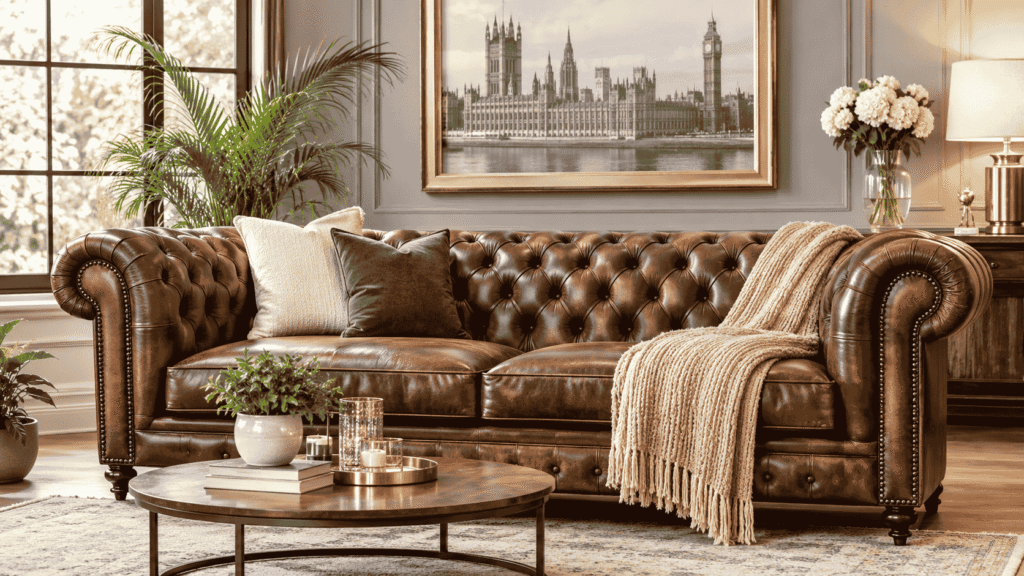
Introduction
A Chesterfield sofa is one of the few pieces of furniture that has barely changed in over a century, and it still looks current. Deep button tufting, rolled arms, and a sculpted frame give it a presence that plain, modern sofas rarely match. Whether you are furnishing a traditional living room, a city loft, or a home office, this guide covers what a Chesterfield is, where it came from, the main styles, how to buy a good one, and how to look after it.
In this guide:
- What a Chesterfield sofa is and how to recognize one
- Its historical background, along with the anecdote about the Earl of Chesterfield
- Leather, velvet, and fabric options compared
- A buying checklist and price ranges
- Styling ideas and care tips
Table of Contents
What Is a Chesterfield Sofa?
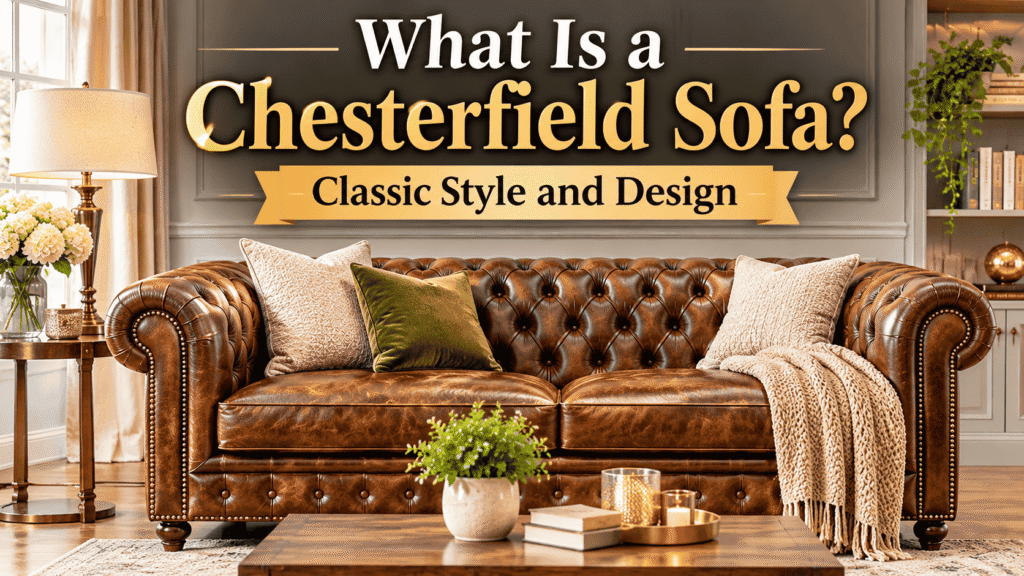
A Chesterfield sofa is an upholstered sofa with deep button tufting, rolled arms that sit at the same height as the back, and a continuous frame with no visible break between the arms, back, and seat. It is traditionally made with a hardwood frame and often covered in leather.
Three features separate a true Chesterfield from a sofa that is simply “inspired by” the style.
Deep Button Tufting
The buttoned, diamond-patterned surface is the signature of the design. On a well-made piece, each button is pulled deep into the filling and secured by hand, which creates the pleats and gives the sofa its sculpted look. Cheaper versions use shallow, glued, or stitched-on buttons, and the difference is easy to see.
The rolled arms are at the same height as the back of the sofa.
On most sofas, the arms are lower than the back. On a Chesterfield, the arms and back are level, and the arms curve outward in a roll. This creates a clean, uniform line across the top.
Continuous, Uniform Frame
The back and arms flow into one another as a single shape. Traditional Chesterfields also have a fixed seat, with no loose seat cushions, although many modern versions add a cushion for comfort.
The History of the Chesterfield Sofa
Origins in 18th-Century England
The tufted, button-backed style grew out of English upholstery traditions of the 18th and 19th centuries. Upholsterers were developing deep-buttoning techniques that gave furniture a rich, padded look and kept stuffing firmly in place. The Chesterfield design incorporated this upholstery method into a sofa, giving it a distinctive, bold, and well-defined silhouette.
The Earl of Chesterfield Legend: Fact vs. Myth
The most popular story says the design was commissioned by Philip Stan-hope, the 4th Earl of Chesterfield (1694-1773), who wanted a sofa a gentleman could sit on without creasing his clothes. It is a fascinating story, but historians treat it with caution. There is no solid evidence that the Earl designed or ordered the sofa, and the earliest known printed uses of “chesterfield” as a type of furniture appear much later than his lifetime. The name may instead refer to a later Earl of Chesterfield or simply to the fashionable association of the title. For a comprehensive overview of the competing theories, see the Chesterfield (sofa) article on Wikipedia.
The honest answer: nobody can say for sure where the name came from, and that mystery is part of the sofa’s charm.
From Gentlemen’s Clubs to Modern Homes
By the Victorian era, Chesterfields were common in libraries, clubs, and offices, where they signalled status and permanence. Leather versions became closely linked with law firms, private members’ clubs, and hotel lobbies. In the 20th century the style spread worldwide, and designers began reimagining it in velvet, bright colors, and slimmer proportions. Today it appears everywhere from boutique hotels to family living rooms.
Types of Chesterfield Sofas
Classic Leather Chesterfield
The original and still the most recognizable. Full-grain or top-grain leather develops a soft patina with age, and scuffs often add character rather than detract from it. A leather Chesterfield sofa suits studies, libraries, and traditional living rooms.
Velvet Chesterfield
A velvet Chesterfield sofa feels softer and more glamorous. It comes in jewel tones such as emerald, navy, and burgundy, and works well in modern or eclectic rooms. Choose performance velvet if you have children or pets.
Fabric and Linen Chesterfield
Linen, cotton blends, and woven fabrics give a lighter, more relaxed look. They are a good fit for Scandinavian, coastal, and farmhouse interiors.
Camelback, Lawson, and Knole Variations
- Camelback: a curved, hump-shaped back, often with fewer or no tufts.
- Lawson: a more relaxed style with loose back cushions and straight arms.
- Knole: a historic design with adjustable side panels, tassels, and a more formal character.
These are related styles, not true Chesterfields, but shoppers often compare them.
Two-Seater, Three-Seater, and Corner Chesterfields
Two-seaters (love seats) suit small rooms and entryways. Three-seaters are the standard living room size. Corner and sectional versions are available but break from the classic look, so check that the tufting and arm detail stay consistent.
Why Choose a Chesterfield Sofa? Key Benefits
Durability. A well-made Chesterfield has a hardwood frame, sprung seat, and strong upholstery. With care, it can last for decades.
Resale and investment value. Quality leather Chesterfields, especially older hand-made pieces, tend to hold their value far better than flat-pack sofas.
Versatility. The shape works in traditional, modern, industrial, and eclectic rooms. Changing the rug, cushions, and lighting changes the whole mood.
Visual impact. It anchors a room as the centerpiece without needing much else around it.
Comfort that improves. Leather softens with use, and the firm, upright seat supports good posture, which many people prefer for conversation and reading.
How to Choose the Right Chesterfield Sofa
Leather vs. Velvet vs. Fabric
| Feature | Leather | Velvet | Fabric / Linen |
|---|---|---|---|
| Look | Classic, traditional | Luxurious, bold | Relaxed, casual |
| Durability | Excellent | Good (choose performance velvet) | Moderate to good |
| Ageing | Develops patina | Can flatten in high-use areas | Can wear or pill |
| Maintenance | Condition 1-2 times a year | Vacuum and spot clean | Vacuum and spot clean |
| Best for | Studies, formal rooms | Living rooms, statement spaces | Family and casual homes |
| Typical price | Higher | Mid to high | Low to mid |
Frame and Construction Quality
The frame decides how long the sofa will last. Look for:
- Kiln-dried hardwood such as beech or oak, not particleboard
- Joints that are doweled, glued, and screwed, not just stapled
- – The seat may feature either traditional eight-direction hand-tied coils or zigzag (sinuous) spring support.
- Hand-tied buttons rather than glued-on ones
If a seller cannot tell you what the frame is made of, treat that as a warning sign.
Filling and Comfort
- Feather-wrapped foam: soft and luxurious, but needs regular plumping.
- High-density foam: firm, holds its shape, and needs little upkeep.
- Fiber fill: budget-friendly but flattens faster.
Sit on the sofa before buying if you can. Chesterfields are naturally firmer than modern lounge sofas.
Size and Room Measurements
Chesterfields are heavy and bulky, so measure carefully:
- Measure the room, leaving at least 60-90 cm (24-36 in) of walking space around the sofa.
- Check the width of all door openings, corridors, and staircases the sofa will pass through
- Compare the sofa’s width, depth, and height with your space, and mark it out on the floor with tape.
A standard three-seater is about 190-220 cm (75-87 in) wide.
Color Selection
Deep brown, tan, and black are timeless leather choices. Navy, emerald, and burgundy bring depth and drama. Grey, cream, and sand suit lighter, calmer rooms. If you are unsure, pick a neutral and add color with cushions and throws.
Budget and Price Ranges
A Chesterfield sofa’s price depends mainly on materials and build quality. These are rough ranges only and vary by country, brand, and size:
are rough ranges only and vary by country, brand, and size:
| Tier | Approx. price (3-seater) | What you usually get |
|---|---|---|
| Budget | Under $800 | Bonded or faux leather, fibre fill, glued buttons, shorter lifespan |
| Mid-range | $800-$2,500 | Fabric, velvet, or top-grain leather, solid frame, better springs |
| Premium | $2,500-$6,000 | Full-grain leather, kiln-dried hardwood, hand-tied buttons |
| Heritage / bespoke | $6,000+ | Hand-made in small workshops, custom sizes and finishes |
How to Style a Chesterfield Sofa in Your Home
Traditional and Classic Interiors
Pair it with dark wood, a patterned wool rug, brass lamps, and framed artwork. Place a classic leather armchair beside a fitted bookshelf to create a cozy, library-inspired atmosphere.
Modern and Minimalist Spaces
Let the Chesterfield be the one ornate piece in a simple room. Use neutral walls, a clean-lined coffee table, and minimal accessories so the sofa stands out.
Industrial and Loft Styles
A brown or black leather Chesterfield looks excellent against exposed brick, concrete, and metal. Add a jute rug and a black metal floor lamp.
Rugs, Cushions, and Lighting That Work Best
- Rugs: large enough that at least the front legs of the sofa sit on the rug.
- Cushions: two to four in complementary textures, such as linen on leather or wool on velvet.
- Lighting: warm light from a floor lamp beside the arm highlights the tufting and creates depth.
Looking for more room ideas? See our guide to living room decorating ideas.
Chesterfield Sofa Care and Maintenance
Leather Care
- Dust weekly with a soft, dry cloth.
- Wipe spills straight away with a slightly damp cloth.
- Apply a quality leather conditioner every 6-12 months.
- Keep it at least 30 cm (12 in) from radiators and out of direct sunlight.
For detailed steps, read our leather sofa care guide.
Velvet and Fabric Care
- Vacuum weekly with a soft brush attachment.
- Gently stroke the velvet along its natural nap to maintain a smooth, uniform appearance.
- Check the care tag for a cleaning code: W (water-based), S (solvent), WS (either), or X (vacuum only).
- Treat stains quickly by blotting, never rubbing.
Preventing Sagging and Fading
- Rotate and plump cushions regularly.
- Avoid sitting on the arms, which can strain the frame.
- Use curtains or UV-filtering film on bright windows.
- Do not drag the sofa across floors. Lift it or use furniture sliders.
Chesterfield Sofa vs. Other Sofa Styles
| Style | Key features | Feel |
|---|---|---|
| Chesterfield | Deep tufting, equal-height rolled arms | Formal, structured, statement |
| Camelback | Humped back, lower arms, usually less tufting | Elegant, traditional |
| Tuxedo | Square arms level with the back, straight lines, little or no tufting | Modern, tailored |
| Modern lounge sofa | Low back, loose cushions, minimal frame | Soft, casual, relaxed |
Choose a Chesterfield for character and longevity. Choose a lounge sofa if you mainly want sink-in softness for movie nights.
Frequently Asked Questions
Why is it called a Chesterfield sofa?
The name is usually linked to an Earl of Chesterfield, but the exact origin is uncertain. The popular story about the 4th Earl is a legend rather than documented fact.
Are Chesterfield sofas comfortable?
Yes, though they are firmer and more upright than modern lounge sofas. Adding cushions or choosing a feather-wrapped seat makes them softer.
How long does a Chesterfield sofa last?
A well-built leather Chesterfield can last 20 years or more with proper care. Lower-cost models often last only a few years.
How much does a good Chesterfield sofa cost?
Expect roughly $2,500-$6,000 for a high-quality three-seater, with mid-range options starting around $800. Prices vary by region and brand.
Is a leather or velvet Chesterfield better?
Leather is more durable and ages beautifully, so it suits heavy use. Velvet is softer and more colourful, so it suits style-led rooms. Performance velvet narrows the durability gap.
Final Thoughts
A Chesterfield sofa combines craftsmanship, history, and flexibility in a way few other furniture pieces can. Focus on frame quality, filling, and material rather than price alone, measure carefully before you buy, and look after the upholstery. Do that, and your Chesterfield sofa should look good and serve you well for decades.