
Introduction
A reclining sofa turns an ordinary evening into something far more restful. Instead of perching upright or propping yourself up with cushions, you simply tilt the backrest, raise the footrest, and settle in. That small change is why the reclining sofa has moved from the den into the heart of modern UK living rooms, where families use it for films, reading, gaming, and afternoon naps.
Whether you prefer a simple manual lever or a smooth push-button power recliner, there is a design to suit nearly every room and budget. In this guide you will learn how a recliner works, the nine biggest benefits, the main types, how manual and power models compare, which materials last, what to expect when buying, and how to prevent common errors that could result in returning your sofa.
Table of Contents
What Is a Reclining Sofa?
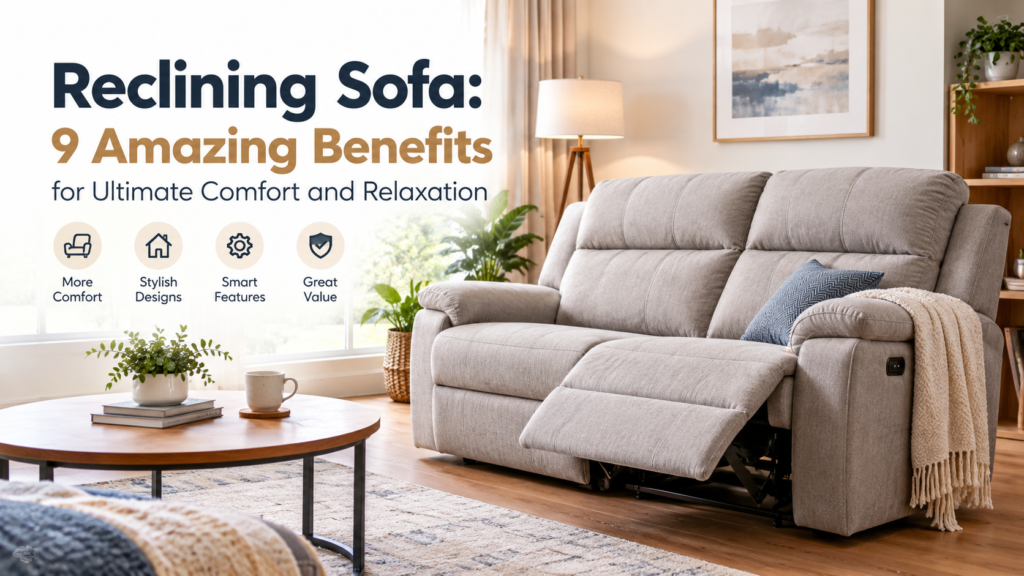
A reclining sofa is a sofa with one or more seats that adjust. The backrest tilts back, and, on most models, a footrest rises from beneath the seat so your legs are supported. A standard sofa holds one fixed shape; a reclining sofa lets each seat change position, so a single piece of furniture can serve for sitting upright, lounging, or semi-lying.
How the mechanisms work
- Manual reclining: you pull a lever or handle or press back with your body weight, and a spring-and-linkage mechanism moves the seat. No electricity is needed.
- Power reclining: an electric motor moves the seat when you press a button or switch. Most plug into a mains socket, and some use a rechargeable battery pack.
- Wall-hugger (wall-saver) reclining: the seat slides forward as it reclines, so the backrest needs only a few inches of clearance from the wall instead of the usual foot or more.
Who benefits most? Film fans, bookworms, gamers, families who share one living room, and anyone who simply wants more adjustable comfort than a fixed sofa offers. If you have a specific health condition or mobility need, speak to a healthcare professional or occupational therapist before choosing seating.
9 Amazing Benefits of a Reclining Sofa
1. Enjoy Customizable Seating Comfort
No two people sit alike. With a reclining sofa, a tall person and a short person can sit side by side and each find a position that suits them. You can sit upright for a conversation, lean back slightly for television, or fully recline for a rest, all without rearranging cushions.
2. Relax With Adjustable Backrests and Footrests
The footrest is the real star. Raising your legs while the backrest tilts gives a lounge-style position that a fixed sofa cannot copy. Some power models let you move the headrest and the footrest independently, so you can fine-tune the angle.
3. Create a Cosy Home Entertainment Space
A reclining sofa makes an excellent centerpiece for a TV room. Many designs include cup holders, storage consoles, and USB charging ports, so snacks, remotes, and phones stay within reach. Position it at a comfortable viewing distance from the screen, and you have a mini cinema at home.
4. Find a Comfortable Position for Reading
Not everyone enjoys reading in bed, and sitting bolt upright can become tiring. A recliner lets you set a gentle angle that suits a book or tablet, with your legs raised and your head supported by a high back or headrest. Add a small side table and a lamp and you have a proper reading corner.
5. Choose Styles That Suit Modern Interiors
Recliners are no longer bulky and old-fashioned. Today’s reclining sofas come with slim arms, clean lines, tapered legs, and a wide palette of fabrics and finishes, from soft neutral weaves to rich leather. A closed recliner can look just like a conventional sofa, so it blends into minimalist, Scandinavian or traditional rooms.
6. Explore Convenient Power Reclining Features
Power models add push-button control, and some offer memory positions, adjustable headrests, lumbar adjustment, built-in USB ports, and even under-seat lighting. Because the motor does the work, anyone in the household can change position smoothly and quietly, which is handy when others are watching a film.
7. Make Family Movie Nights More Enjoyable
A three-seater reclining sofa or a reclining sectional gives everyone their own adjustable seat. Instead of squabbling over the best spot, each person can recline to their own taste. Sectionals with a shared center console are especially popular for families who want a dedicated cinema corner.
8. Discover Space-Saving Reclining Designs
Many people assume a recliner needs a huge room. Wall-hugger and zero-clearance designs are made precisely for smaller homes: they recline forward rather than backwards, so the sofa can sit close to the wall. Compact reclining loveseats are another way to fit a recliner into a modest living room or flat.
9. Find Options for Different Budgets and Needs
Reclining sofas span a very wide price range. Simple manual two-seaters sit at the budget end, while premium leather power models and large corner sectionals cost considerably more. This range means you can usually find a model that matches your priorities, whether that is price, comfort, size, or long-term durability.
Different Types of Reclining Sofas
- Manual reclining sofa: operated by a lever or pull handle. Simple, no electrics, usually more affordable.
- Power reclining sofa: uses an electric motor and a button or switch. Smoother and often more adjustable, but it needs a nearby socket or battery.
- Wall-hugger reclining sofa: needs far less space behind it, making it ideal for tighter rooms.
- Reclining loveseat: a compact two-seater for smaller rooms, flats, and snug lounges.
- Three-seater reclining sofa: the classic family choice, with two or three seats that recline.
- Reclining sectional sofa: an L-shaped or modular layout with several seats and flexible configurations, best for larger rooms.
- Lift-assist reclining furniture: these are specialist chairs that gently raise the user to a standing position. They are designed for people who find standing up difficult and are different from an ordinary reclining sofa. If you or a relative need this support, a dedicated lift-and-rise chair, ideally chosen with advice from a professional, is usually more appropriate than a standard sofa.
Manual vs Power Reclining Sofa: Which Is Better?
There is no single winner. The right choice depends on your budget, your room, and how you plan to use it.
Actual costs, features, and durability vary from model to model, so always check the specification and warranty rather than relying on the mechanism type alone. Choose manual if you want simplicity and a lower price. Choose power if you value smooth, infinitely adjustable positions and extras such as USB ports and memory settings. If you are buying power, check where your sockets are first, and look at models with a battery pack if the sofa will sit away from the wall.
How to Choose the Best Reclining Sofa for Your Home
Measure Your Room and Reclining Clearance
This is the single most important step. Measure the room, then look at the sofa’s fully reclined length and its clearance behind the backrest. A standard recliner may need roughly 30 cm or more behind it, while wall-hugger styles need much less, but always follow the manufacturer’s stated figures. Allow space so the footrest does not hit a coffee table, radiator, or door.
Select the Right Sofa Size
Choose the number of seats based on who will use it daily. A loveseat suits couples and small rooms; a three-seater suits families; a sectional suits large, open-plan spaces. Do not buy bigger than the room can comfortably take, because a recliner that dominates the space feels cramped.
Compare Manual and Electric Mechanisms
Try the mechanism in a showroom if you can. A manual lever should move smoothly without jerking, and a power motor should be quiet. Check how easy it is to operate for everyone who will use it, including children and older relatives.
Check Frame Strength and Construction
The frame is what keeps the sofa going for years. Look for a solid hardwood or sturdy engineered-wood frame, reinforced joints, and a mechanism that feels firm rather than wobbly. Ask the retailer about the frame material and its guarantee.
Choose Supportive Seat Cushions
Seat comfort depends on the filling. High-resilience foam holds its shape well, while feather or fiber toppings feel softer but need plumping. Sit for at least a few minutes, and test both upright and reclined positions, since a seat can feel different in each.
Pick a Suitable Upholstery Material
Balance appearance, comfort, upkeep, and price. Our section on materials below explains the trade-offs in detail.
Check the Weight Capacity and Warranty
Reclining mechanisms are rated for a maximum load. Check the stated weight capacity per seat and make sure it suits everyone who will use the sofa. Compare warranty length and what it covers, such as frame, mechanism, motor, and upholstery, separately.
Consider USB Ports, Storage, and Other Extras
Cup holders, storage consoles, USB ports, adjustable headrests, and lumbar support are useful, but each adds cost and potential repair points. Choose the extras you will really use.
Practical reminder: before ordering, measure doorways, hallways, stairs, tight corners, and lift dimensions, and compare them with the sofa’s packed and assembled sizes. Many reclining sofas are heavy, and some arrive in sections that you assemble yourself.
Best Reclining Sofa Materials
- Fabric: comes in a huge range of colors and textures and often feels warm and welcoming. It can mark more easily, so look for stain-resistant or washable finishes if you have children or pets.
- Leather: a premium look that can last well with proper care. It needs suitable cleaners and conditioning, and it may feel cool in winter and warm in summer.
- Faux leather (PU): gives a leather-like look at a lower price. Durability and breathability vary widely between products, and cheaper finishes can peel over time.
- Microfiber: soft, often easy to wipe clean, and popular in family homes. Check the manufacturer’s care label, as cleaning methods differ.
- Velvet: a decorative, luxurious option that looks stunning in stylish interiors but needs gentle, suitable care.
Ultimately it is a trade-off between appearance, comfort, maintenance, durability, and price. For a busy family room, a hard-wearing, easy-clean fabric or microfiber often makes sense. For a formal lounge, leather or velvet may feel right.
In the UK, upholstered furniture must also meet fire-safety rules. Look for the permanent fire-safety label, and read the Furniture and Furnishings (Fire) (Safety) Regulations 1988 for the legal requirements.
How Much Does a Reclining Sofa Cost in the UK?
Prices change frequently with retailer promotions, so check current listings before you decide. In general, the market breaks down like this:
- Budget-friendly manual reclining sofas: the most affordable entry point, typically simple fabric or faux-leather designs.
- Mid-range power reclining sofas: better build quality, smoother motors, and added features such as USB ports.
- Premium leather reclining sofas: higher-grade hides, stronger frames, and longer warranties, at a premium price.
- Large reclining sectional sofas: several seats, consoles, and modular layouts that push the price higher.
What affects the price? Upholstery type, the number of reclining seats, motor and electrical features, frame construction, delivery charges, and warranty length. Always compare the total cost, including delivery and any assembly or removal of your old sofa.
Editor’s note: before publishing, add verified current UK price examples from retailer pages or your Amazon affiliate listings rather than estimates.
For general advice on comparing products and spotting good value, which? Sofa reviews and buying advice are useful independent resources.
Are Reclining Sofas Suitable for Small Living Rooms?
Yes, if you choose carefully. Small rooms can still enjoy a recliner when you:
- Pick a compact reclining loveseat or a two-seater instead of a full three-seater.
- Choose a wall-hugger design, which needs only a small gap behind the backrest.
- Measure the space behind and in front of the sofa, including the footrest extension when fully reclined.
- Avoid blocking doors, walkways, radiators, and other furniture, and leave a clear path for safe movement.
- Look at apartment-friendly designs with slim arms, raised legs, and, where available, removable or modular components that make delivery easier.
If your room is genuinely tight, a standard sofa plus a single recliner chair can be a more practical compromise.
How to Clean and Maintain a Reclining Sofa
Good care keeps your sofa looking fresh and working smoothly:
- Follow the manufacturer’s cleaning code and care label for your upholstery.
- Vacuum regularly along cushions, seams, and crevices where crumbs and dust gather.
- Clean spills promptly, blotting rather than rubbing, using a method suited to the material.
- Keep liquids away from electrical controls and motors on power models, and unplug before any deep cleaning.
- Check the moving parts and cables occasionally, making sure nothing is trapped, frayed, or loose, and stop using the sofa if you spot damage.
- Follow the manufacturer’s guidance for servicing, and do not open the mechanism or motor yourself.
For electrical safety around furniture and mains-powered products, see the advice from Electrical Safety First.
Internal linking opportunity: link here to your SofasExpert guides on sofa cleaning and sofa materials.
Common Reclining Sofa Buying Mistakes to Avoid
- Not measuring the fully reclined dimensions, which leads to a sofa that hits walls or tables.
- Choosing a style that overwhelms the room.
- Ignoring power socket placement for power models.
- Selecting upholstery without thinking about cleaning, especially with kids or pets.
- Overlooking warranties and return policies.
- Assuming a higher price always means better quality. Compare frame, mechanism, warranty, and reviews.
- Ignoring delivery access and assembly requirements, such as narrow hallways and stairs.
If something goes wrong after purchase, your rights as a UK buyer are explained in the Consumer Rights Act 2015 and on the Citizens Advice consumer pages. The Chartered Trading Standards Institute also offers guidance for shoppers.
Is a Reclining Sofa Worth Buying?
For most people who love to lounge, a reclining sofa is absolutely worth it. Advantages: adjustable comfort, great for entertainment and reading, a wide choice of styles and power features, and options for many budgets. Limitations: they usually cost more than a standard sofa of similar size, they need extra clearance, they are heavier, and the mechanism adds parts that can eventually need repair.
A reclining sofa is a smart choice for a family TV room, a relaxed lounge, or a home cinema. A standard sofa may be more practical in a very small room with limited clearance or where you want a slim, minimal look. Decide based on your space, budget, and the features you will actually use.
Is a reclining sofa good for everyday use?
Yes. Reclining sofas are designed for daily use, especially when you choose a model with a sturdy frame, a quality mechanism, and supportive cushions. Check the weight rating and warranty to be sure it suits regular use.
What is the difference between a reclining sofa and a regular sofa?
A regular sofa has fixed seats, while a reclining sofa has seats that tilt back and usually raise a footrest. This makes a recliner more adjustable, though it is generally heavier and needs more clearance.
Is a manual or power reclining sofa better?
Manual models are simpler and often cheaper. Power models offer smoother, more precise adjustment and extras such as USB ports, but they cost more and need electricity. The best choice depends on your budget and how you like to use the sofa.
How much space does a reclining sofa need?
It depends on the design. A traditional recliner may need around 30 cm or more behind it plus room in front for the footrest, while wall-hugger models need far less. Always check the manufacturer’s fully reclined dimensions and measure your room.
Are reclining sofas suitable for small rooms?
Yes, when you choose a compact loveseat or a wall-hugger design, measure carefully. In very tight rooms, a standard sofa with a separate recliner chair may work better.
Do power reclining sofas use a lot of electricity?
No. A recliner motor runs only briefly while the seat moves, so everyday energy use is generally low. Some models also use a small standby transformer. For general ways to keep energy use down, see the Energy Saving Trust.
How long does a reclining sofa typically last?
Lifespan varies with build quality, frame, mechanism, how often it is used, and how well it is looked after. A well-made sofa with good care and a solid warranty can last many years, but there is no fixed figure that applies to every model.
Is a leather or fabric reclining sofa easier to maintain?
It depends. Leather can be wiped clean but needs conditioning, while fabric needs regular vacuuming and prompt spot cleaning. Stain-resistant and microfiber fabrics are often the easiest for busy homes, so always follow the care label.
Conclusion: Find the Right Reclining Sofa for Your Home
A reclining sofa brings adjustable comfort, great entertainment value, and a wide range of styles to your living room. The key is to match the sofa to your space and lifestyle: measure the fully reclined size, choose between manual and power, check frame quality and materials, and compare warranties before you commit.
Ready to find yours? Compare a few suitable reclining sofas, check their measurements, materials, mechanisms, and warranties, and pick the one that fits your room and budget. Browse our recommended models below, and read our related SofasExpert buying guides and sofa material guides to make the best decision.
Affiliate placement: Insert your Amazon product boxes (3 to 5 reclining sofas) here, with price, size, material, and a short pros and cons list.
Note on sources: the external links above point to official UK government legislation and well-known UK consumer and safety organizations. Please click each one before publishing to confirm it still works.
Related Sofa Guides
- The Ultimate Guide to Sofa Types
- Sofa Bed Guide
- Corner Sofa Guide
- L-Shaped Sofa Guide
- U-Shaped Sofa Guide
- Sectional Sofa Guide
- Sleeper Sofa Guide
- Fabric Sofa Material Guide
- Leather Sofa Material Guide
- Faux Leather Sofa Guide
- Velvet Sofa Material Guide
- Linen Sofa Material Guide
- Sofa Cleaning and Care Guides
- Sofa Materials Guides