
Introduction
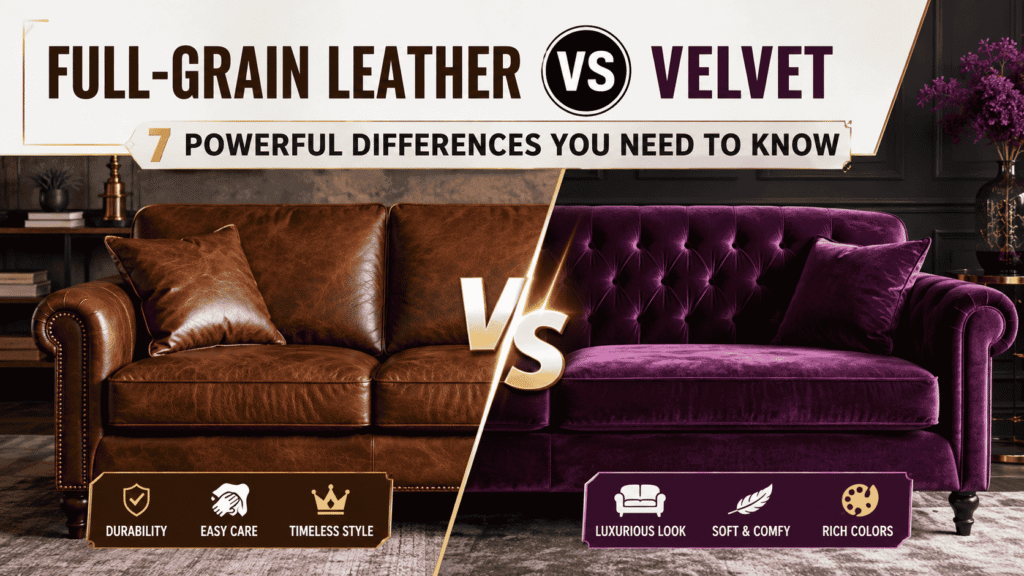
Choosing new upholstery is never just about color. It’s a decision that affects how your sofa feels, how long it lasts, how much upkeep it needs, and how much value it holds over time. When it comes to full-grain leather vs. velvet, the two materials sit at almost opposite ends of the upholstery spectrum—one natural and structured, the other soft and textile-based—and each brings a distinct set of trade-offs to your living room.
This guide breaks the comparison down into seven practical differences: durability, comfort, appearance, maintenance, stain resistance, price, and temperature. By the end, you’ll know exactly which material fits your household, your style, and your budget.
Table of Contents
Full-Grain Leather vs Velvet at a Glance
| Feature | Full-Grain Leather | Velvet |
|---|---|---|
| Material type | Natural leather | Woven textile |
| Appearance | Natural, refined, luxurious | Soft, rich, decorative |
| Durability | Excellent | Good to excellent, depending on construction |
| Comfort | Cool initially, softens with use | Plush and cozy |
| Maintenance | Moderate | Moderate to high |
| Stain resistance | Usually easier to wipe clean | Depends heavily on fabric and finish |
| Aging | Develops patina | Can show crushing or wear |
| Pet friendliness | Practical, though scratches can show | Hair and marks may be more noticeable |
| Style | Classic, premium | Glamorous, contemporary, vintage |
| Price | Usually premium | Wide price range |
Whether you’re weighing a leather vs velvet sofa for a first apartment or a leather or velvet sofa for a full living-room refresh, this table is a fast reference point before you dig into the details below.
What Is Full-Grain Leather?
Definition
Full-grain leather is the uppermost layer of the hide, left with its natural grain intact rather than sanded or buffed away. That’s what gives it visible pores, subtle scars, and texture variation—features that are typically removed from lower-grade leathers to create a more uniform surface.
Full-grain leather retains the hide’s natural grain surface, and its natural markings and aging characteristics are part of its appeal rather than a flaw to be hidden. For a deeper technical breakdown of grading and identification, read our Full-Grain Leather Explained guide.
Key Characteristics
- Natural, unaltered grain
- Unique markings from hide to hide
- Strong fiber structure
- Premium, tactile appearance
- Develops character and patina with age
Why It’s Popular for Sofas
Full-grain leather is a favorite for statement seating because it combines long-term durability with a distinctive look that shifts subtly over years of use. It also tends to be simple to wipe down after everyday spills, which matters a lot in busy households.
What Is Velvet Sofa Upholstery?
Understanding Velvet
Velvet is a woven textile defined by its dense, cut pile—short fibers standing upright that create a soft surface and a light-reflecting sheen. Velvet can appear lighter or darker depending on the angle, making it dynamic and rich in a room.
Why It’s Popular on Sofas
Velvet delivers a tactile softness that’s difficult to match, along with deep, saturated color that photographs beautifully and anchors a room. It suits both bold, modern spaces and traditional interiors leaning into a vintage aesthetic. Learn more in our Velvet Sofa Material Guide.
Different Velvet Options
- Cotton velvet—natural feel, but more prone to watermarking
- Polyester velvet—affordable and fairly resilient
- Performance velvet—engineered for stain resistance and everyday wear
- Synthetic velvet blends—balance softness with practicality
Full-Grain Leather vs Velvet: 7 Key Differences
1. Durability and Everyday Wear
Full-grain leather is prized for its strength. Because the grain layer hasn’t been sanded away, the fiber structure stays dense, which helps it resist punctures and general wear better than corrected or bonded leathers. That said, “durable” doesn’t mean damage-proof—sharp claws, keys, or rough handling can still mark the surface.
Velvet’s durability depends heavily on construction. A performance-grade velvet with a tight, dense weave can hold up impressively well to daily sitting and friction, while a delicate cotton velvet may show wear faster in high-traffic households.
2. Comfort and Feel
Velvet gives an immediately plush, cozy sensation—it’s soft to the touch from day one and stays that way. Full-grain leather feels smoother and cooler when new, and many owners notice it softening gradually as the hide flexes with regular use. Neither material is objectively “more comfortable”—it comes down to whether you prefer a cushioned, textile feel or a sleek, natural one.
3. Appearance and Interior Style
Full-grain leather reads as sophisticated, timeless, and natural, with a patina that deepens character over the years—a strong fit for classic, minimalist, or luxury interiors.
Velvet reads as rich, dramatic, and color-focused, making it a natural choice for glamorous, contemporary, or maximalist spaces where the sofa is meant to be a centerpiece.
4. Cleaning and Maintenance
Full-grain leather:
- Dust regularly with a soft, dry cloth.
- Wipe spills promptly before they soak in.
- Use leather-specific conditioning products.
- Avoid harsh household cleaners or alcohol-based solutions.
Velvet:
- Vacuum gently using a brush attachment
- Blot spills quickly rather than rubbing
- Follow the manufacturer’s cleaning code (W, S, or WS).
- Be mindful of pile direction when brushing out marks.
For a full routine, see our Ultimate Guide to Sofa Cleaning at Home.
5. Stains, Spills, Pets, and Children
This is often the deciding factor for busy households. Full-grain leather generally handles spills well because liquid tends to sit on the surface long enough to be wiped away, though unsealed or aniline finishes can absorb stains more readily. Velvet’s performance varies enormously by fabric type—a treated performance velvet can resist spills competently, while an untreated cotton velvet may stain or watermark easily.
Not all velvet is equally stain-resistant, and not all leather has the same protective finish—so it’s worth checking the specific product spec sheet rather than assuming based on material name alone. Pet claws can snag both materials, and pet hair tends to show more visibly against velvet’s pile.
6. Price and Long-Term Value
It’s a common assumption that leather always costs more than velvet, but that isn’t strictly true. High-end designer velvets can rival or exceed the price of mid-range leather, while budget-corrected leathers can undercut premium velvet. What really drives cost is quality of construction, hide selection or fabric grade, and brand.
Full-grain leather often justifies a higher upfront price with lower long-term replacement costs, since it tends to hold up over many years of use. Velvet’s value depends more on the specific fabric’s durability rating and how well it’s cared for.
Related reading: How to Choose the Right Sofa Material and Our Leather Sofa Material Guide.
7. Breathability, Temperature, and Seasonal Comfort
Leather tends to feel cool to the touch in cold rooms and can feel warm in direct sun or hot weather, since it doesn’t breathe like woven fabric. Velvet, being a textile, generally feels warmer and cozier in cooler months but can feel heavier or less breathable in humid climates.
These effects vary based on the sofa’s cushion foam, the room’s climate control, and the specific leather finish or velvet weight—so treat this as a general tendency rather than an absolute rule.
Full-Grain Leather vs Velvet: Pros and Cons
Full-Grain Leather Pros
- Excellent durability
- Premium, timeless appearance
- 100% natural material
- Unique grain on every piece
- Develops an attractive patina
- Relatively simple everyday cleaning
Full-Grain Leather Cons
- Higher upfront cost
- Natural marks won’t appeal to everyone.
- Can show scratches from pets or sharp objects
- Requires appropriate leather care
- Feel can shift with temperature
Velvet Pros
- Extremely soft, plush feel
- Luxurious, saturated color
- Strong decorative and design impact
- Wide range of style options
- Available at many price points
Velvet Cons
- Often requires more careful cleaning
- Pile can show pressure or crush marks
- Some velvets attract pet hair.
- Quality varies significantly between fabrics.
- Spills can be harder to manage depending on the weave
Which Is Better for Different Lifestyles?
| Buyer Type | Better Choice |
|---|---|
| Long-term investment | Full-Grain Leather |
| Luxury or glamorous interior | Velvet |
| Busy household | Full-Grain Leather |
| Maximum softness | Velvet |
| Classic interior | Full-Grain Leather |
| Bold colors | Velvet |
| Pet owners | Depends on pet behavior and fabric/finish |
| Families with children | Depends on cleaning needs and construction |
| Minimal-maintenance preference | Often Full-Grain Leather |
| Statement furniture | Velvet |
Full-Grain Leather vs Velvet: Which One Should You Choose?
Choose full-grain leather if:
- You prioritize longevity above all else.
- You want a timeless, versatile appearance.
- You appreciate natural variation and patina.
- You want easier everyday spill cleanup.
- You’re comfortable investing more upfront.
Choose velvet if:
- Softness is your top priority.
- You want rich, dramatic color in the room
- You’re after a true statement sofa.
- You prefer a warmer, textile-based aesthetic.
- You don’t mind following specific fabric-care instructions.
How to Choose the Right Material for Your Sofa
Run through this quick checklist before deciding:
- How frequently will the sofa be used?
- Do you have children?
- Do you have pets?
- Are spills a regular occurrence in your home?
- Do you prefer a soft, plush feel or a smooth, natural one?
- What is your interior design style?
- What is your long-term budget, including maintenance?
Common Mistakes to Avoid When Choosing Leather or Velvet
- Choosing only by appearance—comfort and durability matter just as much day to day.
- Assuming expensive means better—construction quality varies within both materials.
- Ignoring the frame and cushion quality—even great upholstery won’t fix a weak frame.
- Not checking the exact upholstery specification—”leather” and “velvet” cover a wide range of grades and treatments.
- Forgetting cleaning requirements—factor upkeep into your decision, not just the initial purchase.
- Choosing a material that doesn’t match your lifestyle—a delicate fabric in a high-traffic home creates ongoing frustration.
Frequently Asked Questions
Is full-grain leather better than velvet for a sofa? It depends on your priorities. Full-grain leather generally offers better long-term durability and easier spill cleanup, while velvet offers superior softness and richer color options.
Is velvet more comfortable than leather? Velvet typically feels softer and cozier from the first sit, while full-grain leather feels smoother and cooler, softening gradually with use.
Which lasts longer, full-grain leather or velvet? Full-grain leather generally has an edge in longevity due to its dense fiber structure, though a high-quality performance velvet can also last many years with proper care.
Is velvet harder to clean than full-grain leather? Often, yes—velvet usually requires more careful, fabric-specific cleaning, while full-grain leather can typically be wiped down more easily.
Which is better for families, leather or velvet? Many families lean toward full-grain leather for its easier cleanup, though a performance-grade velvet can also work well depending on the household.
Is full-grain leather worth the extra cost? For buyers prioritizing durability and timeless style, full-grain leather’s upfront cost is often offset by its longevity and lower replacement frequency.
Is velvet a viable choice for everyday sofas? Yes, especially performance velvets designed specifically for daily use and stain resistance.
Which sofa material is better for pets? It depends on the pet and the specific product. Full-grain leather is generally more scratch-resistant to claws, while velvet’s pile can trap pet hair more visibly.
Does full-grain leather get softer with age? Yes, it typically softens and develops a richer patina as it’s used and exposed to natural oils and handling over time.
Which looks more luxurious, leather or velvet? Both read as luxurious in different ways—leather leans classic and refined, while velvet leans glamorous and dramatic.
Final Verdict: Full-Grain Leather vs Velvet
Full-grain leather is the stronger choice for buyers who prioritize durability, timeless style, and long-term use with less day-to-day worry about maintenance. Velvet is particularly attractive for buyers who want softness, rich color, and a luxurious decorative statement piece.
There isn’t one universal winner in the full-grain leather vs. velvet debate—the best sofa material is the one that matches your room, your lifestyle, your maintenance expectations, and your budget.
Related Reading
- Linen Sofa Material
- Polyester Sofa Material
- Fabric Sofa Material
- Velvet Sofa Material
- Cotton Sofa Material
- Microfiber Sofa Material
- Chenille Sofa Material
- Linen vs Cotton
- Velvet vs Polyester
- Leather vs Fabric Sofa
Further reading on materials and furniture buying:
- Background on leather production: Leather Naturally
- Technical leather science: American Leather Chemists Association
- Furniture buying advice: Consumer Reports
- Textile and fiber sustainability information: Textile Exchange