
Introduction
If you’re shopping for a leather sofa, you’ve probably run into two terms that get thrown around constantly: full-grain leather and top-grain leather. Both sound premium. Both are used in high-end furniture. And both can leave you wondering which one actually deserves your money.
The truth is, full-grain leather vs top-grain leather isn’t a simple “better vs worse” comparison. The best choice depends on how you plan to use your sofa, how it will age, and what look you want. In this guide, we’ll break down the differences in plain language—durability, appearance, comfort, maintenance, price, and long-term ageing—so you can buy with confidence.
Table of Contents
Full-Grain Leather vs Top-Grain Leather at a Glance
| Feature | Full-Grain Leather | Top-Grain Leather |
|---|---|---|
| Natural grain | Fully retained | May be lightly corrected |
| Appearance | More natural, with visible markings | More uniform and consistent |
| Durability | Excellent | Excellent |
| Patina | Develops a strong, rich patina | Develops a moderate to strong patina |
| Softness | Depends on tannage and finish | Often very soft out of the box |
| Maintenance | Moderate | Usually easier |
| Price | Usually higher | Usually slightly lower |
| Best for | Luxury pieces and long-term ownership | Luxury with everyday practicality |
This table gives you the short answer. The rest of this guide explains the “why” behind each row.
What Is Full-Grain Leather?
How Full-Grain Leather Is Made
Full-grain leather comes from the top layer of the hide — the grain layer — and it’s used exactly as nature made it. The surface hasn’t been sanded, buffed, or mechanically corrected to hide scars, insect bites, or stretch marks. According to the Leather Working Group, full-grain leather is defined as leather that retains its entire natural grain without corrective treatment to the surface.
That doesn’t mean it’s untouched — it’s still tanned, dyed, and finished — but the natural texture of the hide stays intact.
Key Characteristics of Full-Grain Leather
- Natural markings and slight variation from hide to hide
- Visible, authentic grain texture
- A strong, resilient surface
- Develops a rich patina over years of use
- A premium, high-end look and feel
- Excellent long-term durability
Is Full-Grain Leather Good for Sofas?
Yes, especially for pieces meant to be family heirlooms or statement furniture. Because the surface hasn’t been altered, buyers should expect natural markings — small scars, wrinkles, or grain variation — rather than a perfectly uniform sheet of leather. For many people, this is precisely the appeal. It looks like real leather because it is, in the truest sense.
If you want to understand how full-grain compares to other upholstery options beyond leather, our Full-Grain Leather Sofa Material guide walks through hide types, tanning methods, and what “genuine leather” actually means on a furniture label.
What Is Top-Grain Leather?
How Top-Grain Leather Is Made
Top-grain leather also comes from the upper part of the hide, but the outermost layer is lightly sanded or buffed to smooth out imperfections before a finish is applied. It’s important not to overstate this—not every top-grain leather is heavily sanded or coated. The correction can range from very light to more noticeable, depending on the manufacturer and the leather grade.
Key Characteristics of Top-Grain Leather
- A more consistent, even appearance
- Smooth, refined finish
- Wider range of available colors and finishes
- Strong durability for everyday use
- Generally easier to clean and maintain
Is Top-Grain Leather Good for Sofas?
Absolutely — it’s one of the most popular choices for family rooms and modern interiors. Top-grain leather gives you a polished, consistent look that suits contemporary spaces, and it tends to be more forgiving of daily wear, spills, and active households.
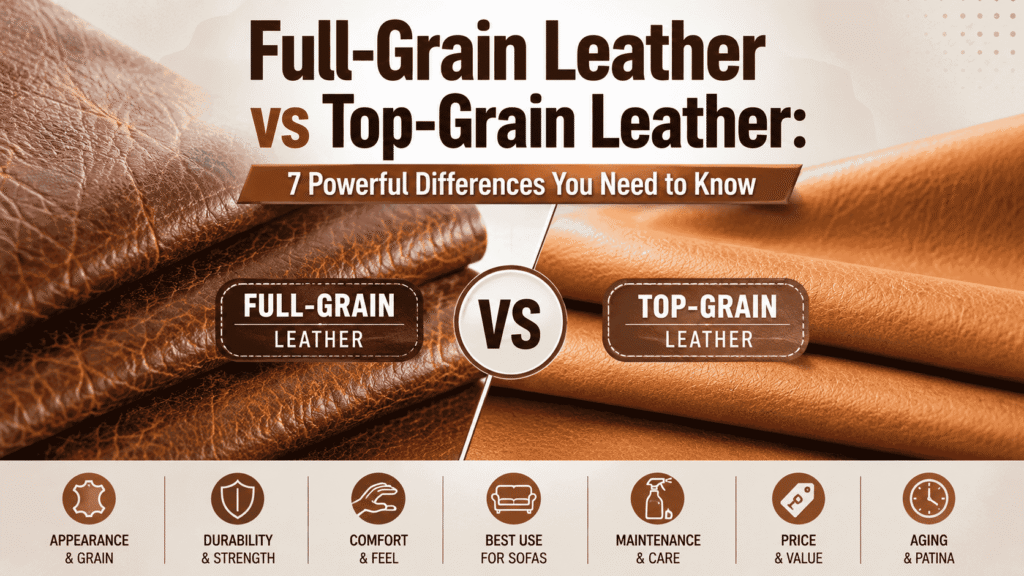
Full-Grain Leather vs Top-Grain Leather: 7 Key Differences
1. Natural Grain and Appearance
Full-grain leather shows the hide’s original character: natural markings, subtle grain variation, and an unmistakably organic look. Top-grain leather, by comparison, is more uniform because light surface correction smooths out inconsistencies. Neither is “flawed”—it”‘s a matter of whether you want raw authenticity or a cleaner, more polished appearance in your living room.
2. Durability and Strength
Both leather types are genuinely durable, since both use the strongest part of the hide — the outer layer, which has the tightest fiber structure and the most natural strength. Full-grain leather’s uncorrected surface tends to resist abrasion well over time, and because nothing has been sanded away, the fiber density stays fully intact. Top-grain leather holds up strongly to everyday wear too, thanks to its finish layer, which adds a degree of protection against scuffs, spills, and general handling.
It’s worth noting that leather grade alone doesn’t guarantee performance—full-grain leather isn’t indestructible, and claims like “full-grain never wears out” oversimplify things. A poorly tanned full-grain hide can still crack or dry out prematurely, just as a well-made top-grain leather can outlast a mediocre full-grain one. Tanning quality, finish, and frame construction all play a role in how long a sofa actually lasts, and this is why it pays to ask about the full production process rather than relying on the grain label as a shortcut for quality.
For heavy-use households, it’s also worth considering how each leather type responds to friction over years of daily sitting, especially in high-contact zones like armrests and seat edges. Full-grain leather tends to burnish slightly with repeated contact, which many buyers see as part of its charm. Top-grain leather generally maintains a more consistent look in these zones because the finish coat resists visible burnishing.
3. Softness and Comfort
This is one of the most misunderstood points in the full-grain vs. top-grain debate. Softness isn’t determined purely by grain type—it’s shaped by the tanning process and finishing technique. Some top-grain leathers feel noticeably softer right out of the box because of how they’re finished, while some full-grain leathers require a break-in period before they soften with use. If plush comfort is your top priority, ask about the tannage and finish specifically, not just whether it’s full-grain or top-grain.
4. Patina and Aging
“Patina” refers to the subtle sheen, color depth, and character that leather develops with age and use. Full-grain leather is well known for developing a rich, noticeable patina because its surface reacts naturally to oils, sunlight, and everyday contact. Top-grain leather can also develop a patina, though the degree depends heavily on the finish applied—a heavier pigmented finish will age more slowly and subtly than a lighter one. If you love the look of leather that gets better with age, this is a major factor to weigh.
5. Maintenance and Cleaning
Top-grain leather is usually easier to maintain day-to-day. Its more uniform, often protected surface tends to resist stains and shows less visible wear, which is convenient for busy households. Full-grain leather generally needs a bit more attention — periodic conditioning helps it stay supple, and because the surface is untreated, spills and marks can show more visibly if not addressed. Neither is high-maintenance in absolute terms, but if low-effort care is important to you, that’s worth factoring in.
For a full care routine that works for either leather type, see our Ultimate Guide to Sofa Cleaning at Home.
As a general rule of thumb, full-grain leather benefits from conditioning every four to six months to keep it supple and prevent drying, especially in homes with central heating or strong sunlight exposure. Top-grain leather typically needs less frequent conditioning because its finish layer already provides a degree of moisture and stain resistance. In both cases, quick action on spills—blotting rather than rubbing and avoiding harsh cleaning chemicals—goes a long way toward preserving the leather’s appearance for years.
6. Price and Value
Full-grain leather is typically positioned as the premium option, and it often does carry a higher price tag because of the selective hide grading and craftsmanship involved. That said, top-grain leather can offer excellent value—you’re still getting a genuine, durable, premium material at a comparatively accessible price point.
It’s a mistake to judge price by the label alone. Hide selection, tanning method, finishing quality, and overall upholstery construction all affect the final price and, more importantly, the quality you’re actually getting.
Is Full-Grain Leather Worth the Extra Money?
For buyers who want maximum natural character, long-term durability, and a leather that ages beautifully, yes—the extra cost is usually justified. But if your priority is a clean, consistent look with strong everyday performance at a better price, top-grain leather delivers excellent value without a meaningful compromise in quality.
7. Sofa Suitability
- Formal living rooms: Full-grain leather’s natural character suits a refined, statement piece.
- Family rooms and homes with children: Top-grain leather’s easier maintenance is a practical advantage.
- High-traffic spaces: Both perform well, though top-grain’s finish can be more forgiving of daily bumps.
- Luxury interiors: Full-grain leather is often the go-to for its authenticity and aging character.
- Everyday lounging: Top-grain leather’s softness and consistency make it comfortable for daily use.
- Long-term furniture ownership: Full-grain leather tends to age into something even more distinctive over the years.
Full-Grain Leather vs. Top-Grain Leather Comparison Table
| Factor | Full-Grain | Top-Grain |
|---|---|---|
| Natural surface | Untouched | Lightly corrected |
| Grain visibility | High | Moderate |
| Durability | Excellent | Excellent |
| Comfort | Good, softens with use | Often soft immediately |
| Patina | Strong | Moderate to strong |
| Maintenance | Moderate effort | Easier |
| Scratch visibility | More visible | Less visible |
| Appearance | Natural, varied | Uniform, refined |
| Price | Higher | Slightly lower |
| Longevity | Excellent | Excellent |
| Best use | Statement/luxury pieces | Everyday premium use |
| Luxury appeal | Very high | High |
| Family use | Good with care | Very practical |
| High-traffic use | Good | Very good |
Full-Grain Leather vs Top-Grain Leather for Sofas
Best for Luxury Sofas
If you want a sofa that feels one-of-a-kind, full-grain leather’s natural markings and rich patina make every piece unique—a strong pick for buyers who value authenticity over uniformity.
Best for Everyday Family Sofas
Top-grain leather is a practical premium choice: it looks polished, resists daily wear well, and doesn’t demand constant upkeep—ideal for households with kids, pets, or a busy lifestyle.
Best for High-Traffic Living Rooms
Both hold up well, but top-grain leather’s smoother, often protected finish can make daily spills and marks less noticeable, which matters in heavily used spaces.
Best for Modern Interiors
Top-grain leather’s clean, consistent finish complements minimalist and contemporary design better than the more textured, irregular look of full-grain.
Best for Traditional or Rustic Interiors
Full-grain leather’s natural grain and patina fit warm, traditional, or rustic interiors beautifully, adding character that develops further with time.
How to Tell Full-Grain Leather From Top-Grain Leather
Check the product description.
Look for precise terminology. Vague marketing language like “genuine leather” doesn’t tell you the grade—it’s a legal term that can apply to lower-quality leathers too. You want to see the words “full-grain” or “top-grain” explicitly.
Look at the surface.
Natural markings, slight texture variation, and an organic feel are good indicators of full-grain leather. A very smooth, uniform surface often points to top-grain. That said, appearance alone isn’t always definitive—some top-grain leathers are finished to look quite natural too.
Ask About Surface Correction
A direct question to the retailer—”Was the grain mechanically corrected?”—will usually get you a clear answer about which category the leather falls into.
Ask About the Finish
Finish type matters as much as grain type. According to the Leather Working Group’s terminology guide, leather finishes generally fall into these categories:
- Aniline — dyed with no or minimal surface coating, showing the most natural grain
- Semi-aniline — a light protective coating with a small color layer added
- Pigmented — a more substantial color coating for consistency and protection
- Coated leather with a synthetic surface layer for maximum durability
Ask for the leather specification.
When comparing sofas, ask for details on leather type, hide origin, tanning method, finish, thickness, and warranty. These specifics tell you far more than the “full-grain vs. top-grain” label alone.
Common Mistakes When Buying Leather Sofas
- Assuming “genuine leather” means premium leather—it’s often the lowest grade sold as real leather.
- Thinking “full-grain” always means the softest leather—softness depends on tanning and finishing, not grain type alone.
- Choosing based only on price — a cheap full-grain sofa can be lower quality than a well-made top-grain one.
- Ignoring the sofa’s frame and cushion construction—leather quality means little if the frame is weak.
- Assuming all top-grain leather is the same—correction levels and finishes vary widely between manufacturers.
- Not asking about the finish — the finish affects softness, patina, and maintenance as much as the grain grade does.
Full-Grain vs. Top-Grain Leather: Which One Is Better?
There’s no universal winner here—it depends on what you value most in a sofa.
Choose full-grain leather if you want:
- Maximum natural character
- A premium, authentic appearance
- Strong, noticeable patina over time
- A piece built for long-term ownership
- A distinctly luxury aesthetic
Choose top-grain leather if you want.
- A more uniform, polished appearance
- Premium leather without the highest price tag
- A refined, contemporary look
- Practical, low-maintenance everyday use
- Upholstery that’s easier to match and replace
Is Full-Grain Leather Better Than Top-Grain Leather?
Full-grain leather is generally the better choice for buyers who prioritize natural grain, character, and long-term premium appeal. Top-grain leather can be the better value for buyers who prefer a more uniform appearance and practical everyday performance.
The right choice ultimately depends on the specific sofa, the finish applied, the construction quality, and how you intend to use the piece—not the grain label in isolation.
A Quick Buying Checklist Before You Order
Before you commit to a leather sofa, run through this short checklist to make sure you’re getting what you’re paying for:
- Confirm the grain type in writing. Ask the retailer to specify “full-grain” or “top-grain” on the invoice or product spec sheet, not just in marketing copy.
- Ask about the tannage. Vegetable-tanned and chrome-tanned leathers age and feel differently — this matters as much as the grain grade.
- Request a leather swatch. A physical sample tells you far more about softness, thickness, and finish than photos ever will.
- Check the warranty terms. A retailer confident in their leather quality will usually back it with a meaningful warranty period.
- Inspect the frame and cushion fill separately. Even the best leather won’t compensate for a weak hardwood frame or low-density foam.
- Compare finish types. Aniline, semi-aniline, and pigmented finishes behave very differently in terms of stain resistance and natural look—make sure the finish matches your lifestyle.
- Ask about hide origin and thickness. European hides are often prized for consistency, while thickness (measured in millimeters) affects both durability and how the leather drapes on furniture frames.
Taking a few extra minutes on these points before you buy can save years of disappointment — and it ensures the leather grade you’re paying a premium for is actually the one you’re getting.
FAQs About Full-Grain Leather vs. Top-Grain Leather
Is full-grain leather better than top-grain leather? It’s better for buyers who want natural character and long-term patina. Top-grain is often the more practical, budget-friendly premium choice.
Which lasts longer, full-grain or top-grain leather? Both are highly durable when well made. Longevity depends more on tanning quality, finish, and construction than on grain type alone.
Is full-grain leather worth the extra money? For buyers who want an authentic, evolving leather that ages beautifully, yes. For those prioritizing value and consistency, top-grain may be the smarter buy.
Is top-grain leather good for a sofa? Yes—it’s one of the most popular choices for everyday, family-friendly sofas thanks to its durability and easy maintenance.
Does full-grain leather scratch easily? It can show surface marks more visibly than top-grain because it’s uncoated, though this is often part of its natural patina rather than damage.
Does top-grain leather develop a patina? Yes, though typically more subtly than full-grain, depending on the finish applied.
Which leather is easier to clean? Top-grain leather is generally easier to clean due to its more consistent, often protected surface.
Which leather is best for families? Top-grain leather is usually the more practical choice for households with children or pets.
Which leather is best for a luxury sofa? Full-grain leather is typically favored for stately, luxury pieces due to its natural character.
How can you tell if leather is full-grain or top-grain? Check the product description for exact terminology, examine the surface texture, and ask the retailer about surface correction and finish type.
Final Verdict
Both full-grain and top-grain leather are excellent choices for a sofa—the “better” option depends entirely on your priorities.
- Full-grain leather is best for natural character, a premium feel, and long-term luxury appeal.
- Top-grain leather is best for a refined appearance, everyday versatility, and strong overall value.
Neither is automatically the right choice for every home. Before you decide, look beyond the grain label and consider the finish, construction, and how the sofa fits your lifestyle.
Internal Links
- Leather Sofa Material Guide
- Ultimate Guide to Sofa Cleaning at Home
- Sofa Materials Explained
- Leather vs Fabric Sofa
- Leather vs Faux Leather
- Leather vs Velvet Sofa