
Introduction
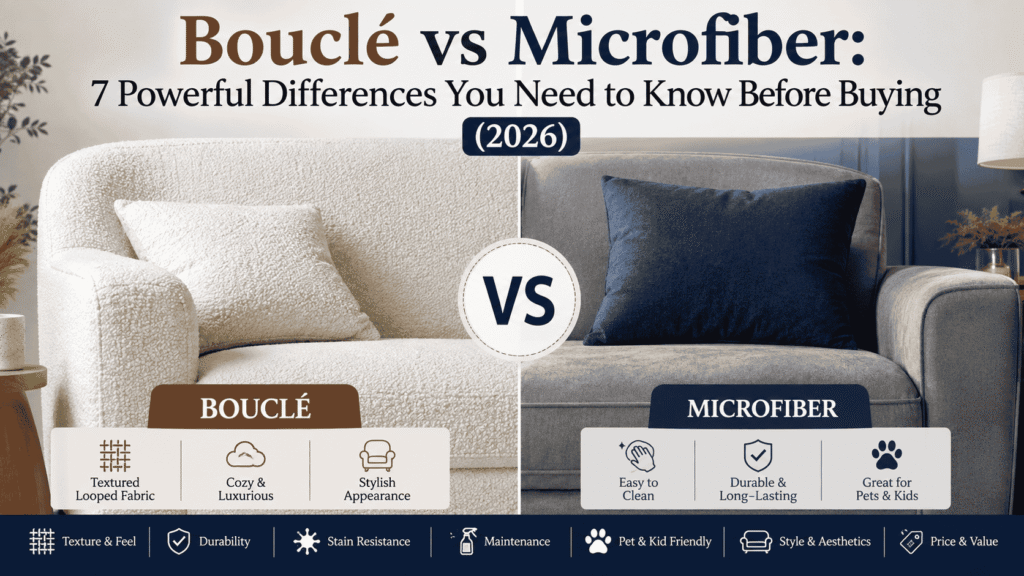
Choosing a sofa fabric may seem like a minor decision at first, but after three months, you might find that the couch either looks stunning but stains easily with the slightest touch, or it wipes clean in seconds but fails to provide the “wow” factor you were hoping for in your living room. That’s the real tension behind the bouclé vs. microfiber debate.
Bouclé has become the darling of interior design feeds — that nubby, looped, almost curly texture that instantly reads as expensive and cozy. Microfiber, meanwhile, has spent years earning its reputation as the practical workhorse of upholstery fabrics: soft, smooth, and built to survive real life with kids, pets, and takeout night.
Neither one is objectively “better.” They’re built for different priorities. This guide breaks down exactly how bouclé and microfiber compare across texture, durability, stain resistance, cleaning, pet- and kid-friendliness, style, and price—so you can match the fabric to your household instead of just your Pinterest board.
Table of Contents
Bouclé vs Microfiber at a Glance
| Feature | Bouclé | Microfiber |
|---|---|---|
| Texture | Nubby, looped, cozy | Smooth, soft |
| Comfort | Warm and plush | Soft and comfortable |
| Durability | Good, depends on construction | Generally very good |
| Stain Resistance | Moderate | Usually better |
| Cleaning | Requires more care | Relatively easy |
| Pet-Friendly | Can catch claws/hair | Generally easier to maintain |
| Kids | Moderate | Better for busy households |
| Appearance | Textured, luxurious | Clean and practical |
| Maintenance | Moderate–high | Low–moderate |
| Best For | Style + cozy interiors | Practical everyday use |
What Is Bouclé Sofa Fabric?
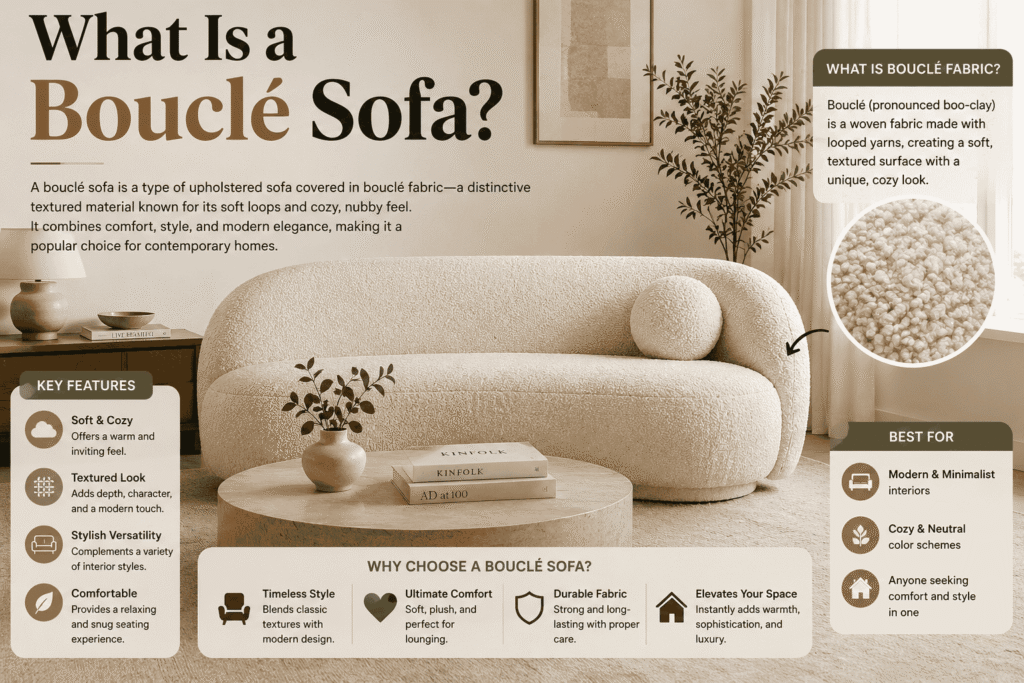
Bouclé isn’t a fiber — it’s a weaving technique. The word itself comes from the French term for “curled” or “looped,” and that’s exactly what defines the fabric: small, uneven loops of yarn woven or knitted into the surface, giving it a texture that looks almost hand-knit even when it’s produced on an industrial loom.
How Is Bouclé Made?
Bouclé is created using a specialty yarn that’s spun with looped, curled sections built right into the strand. When that yarn is woven into upholstery fabric, the loops sit proud of the surface instead of lying flat, which is what gives bouclé its signature nubby, textured hand-feel. The fiber content behind that texture varies — bouclé can be made from wool, cotton, polyester, or wool-poly blends — so two bouclé sofas can feel noticeably different depending on what’s actually woven into them.
That looped construction is also why bouclé has so much visual depth. Light catches each loop differently, so the fabric doesn’t read as a flat block of color the way a smooth weave does. It looks dimensional even in neutral tones like cream, oatmeal, or stone, which is a big part of why it photographs so well and why it’s become a staple in modern and Scandinavian-style interiors.
It’s worth noting that “bouclé” has become something of an umbrella term in furniture retail. Not every fabric marketed as bouclé is made the same way, and the loop size, density, and fiber blend can vary quite a bit from one manufacturer to the next. Some bouclé fabrics have tight, small loops that feel almost like a fine knit, while others have larger, looser loops with a chunkier, more sculptural look. This matters because loop size and density directly affect how the fabric performs — tighter, denser loops generally hold up better to everyday use than large, loose ones, which snag more easily.
Pros of Bouclé Sofa Fabric
- Luxurious, high-end appearance — bouclé has a designer, boutique-furniture look that’s hard to replicate with flat-woven fabrics.
- Genuinely comfortable texture — the looped surface feels soft and inviting, more like a cozy sweater than a typical upholstery fabric.
- Adds visual depth to a room — the texture creates shadow and dimension, so even a plain-colored sofa doesn’t look flat or boring.
- Pairs beautifully with modern and minimalist interiors — it’s become something of a signature fabric for contemporary, Scandinavian-inspired, and boho-luxe spaces.
Cons of Bouclé Sofa Fabric
- The looped surface needs a bit more care — loops can snag on jewelry, buttons, or rough fabrics like denim if you’re not careful.
- It can collect dust, lint, and pet hair in the texture more readily than a smooth weave, simply because there’s more surface area for particles to cling to.
- Cleaning can be more demanding—depending on the fiber content, some bouclé fabrics are more sensitive to certain cleaning products or aggressive scrubbing than others.
Related: Bouclé Sofa Material Guide
What Is Microfiber Sofa Fabric?
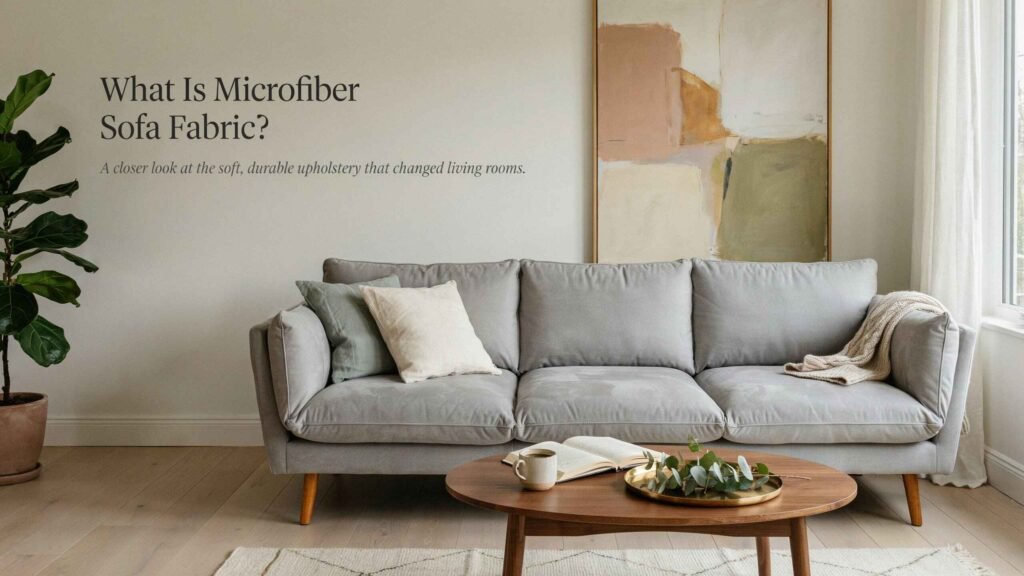
Microfiber is a fully synthetic fabric, typically made from polyester or a polyester-nylon blend, engineered specifically for durability and easy care. Unlike bouclé, which is defined by a weaving technique, microfiber is defined by the fiber itself — and that fiber is deliberately built to be finer than a strand of silk.
How Is Microfiber Made?
The defining trait of microfiber is in the name: the individual fibers are “micro,” meaning they’re a fraction of the diameter of a human hair. Manufacturers split and weave these ultra-fine synthetic fibers into a dense, tightly packed fabric. That density is the whole point—it’s what gives microfiber its smooth, almost suede-like hand-feel, and it’s also what makes the fabric so resistant to everyday wear and spills.
Because the weave is so tight, microfiber doesn’t allow liquids to soak through as quickly as a looser or more textured fabric would, which buys you valuable time to blot up a spill before it sets in. That same density also makes the surface feel soft underfoot (or underhand) without being fragile.
Not all microfiber is created equal, either. Higher-quality microfiber uses finer, more densely packed fibers and a tighter overall weave, which translates into a smoother feel, better stain resistance, and a longer lifespan. Lower-quality microfiber can feel thinner and more synthetic, and it tends to pill or flatten faster under regular use. When comparing microfiber sofas, it’s worth checking the fabric’s weight and weave density rather than assuming all “microfiber” listings perform the same.
Pros of Microfiber
- Genuinely easy everyday maintenance — most spills can be blotted up before they become a stain, and the fabric generally tolerates light cleaning products well.
- Soft, comfortable feel—despite being synthetic, well-made microfiber doesn’t feel plasticky; it has a smooth, suede-like texture.
- Good resistance to everyday wear — the tight weave holds up well to friction from regular sitting, sliding, and general use.
- Practical for busy households—it’s a reliable, low-drama choice for families, shared living spaces, and high-traffic rooms.
Cons of Microfiber
- Less textured and dimensional than bouclé — microfiber is smooth and clean-looking, but it doesn’t have the same tactile, sculptural quality.
- Can show certain marks depending on color and finish—lighter colors and some finishes can develop watermarks or “watermarking” from pressure or moisture if not cleaned correctly.
- May not deliver the same high-end visual texture—it’s practical rather than statement-making, which matters if you want your sofa to be a design focal point.
Related: Microfiber Sofa Material Guide
Bouclé vs. Microfiber: 7 Differences That Actually Matter
1. Texture and Feel
This is the most immediately obvious difference between the two fabrics, and it’s often what decides the debate before any of the practical factors even come into play.
Bouclé’s looped, nubby surface has real tactile presence—it feels warm, textured, and a little bit like sinking into a chunky-knit sweater. Microfiber, by contrast, is smooth and soft in a completely different way; it glides under your hand rather than catching on it, with a finish that’s often compared to suede or brushed velvet.
Which one feels “better” genuinely comes down to personal preference. If you gravitate toward tactile, layered materials, bouclé will feel more luxurious. If you prefer a clean, smooth surface, microfiber will feel more comfortable.
Winner: Depends on personal preference.
It’s also worth thinking about how each texture interacts with clothing and skin over time. Bouclé’s loops can occasionally catch on rougher fabrics like raw denim, wool sweaters with loose threads, or jewelry with clasps and prongs—usually not enough to cause real damage, but enough to notice. Microfiber, being smooth and tightly woven, doesn’t have this issue at all, which is part of why it’s such a popular choice for pieces that get sat on and slid across constantly, like sectionals and recliners.
2. Durability and Everyday Wear
Durability isn’t just about the fiber — it’s about how the fabric holds up to repeated sitting, friction, and daily use over months and years.
Microfiber’s dense, tightly woven construction is specifically engineered to resist abrasion, which is why it’s a go-to fabric for family rooms, rental furniture, and high-traffic spaces. It tends to hold its shape and surface quality well under regular use.
Bouclé’s durability depends heavily on its construction and fiber content. A well-made, tightly looped bouclé in a durable fiber blend can hold up very well, but the loops themselves are more exposed to friction and snagging than a flat weave, which means quality varies more from one bouclé sofa to the next. In short: fabric quality matters just as much as fabric type here.
If you want an objective way to compare durability between two specific fabrics, look for a Martindale rub count (common in the UK/Europe) or a Wyzenbeek double-rub count (common in the US) on the fabric spec sheet. <cite index=”9-1″> his test measures a fabric’s resilience to wear and tear by rubbing it against a series of progressively rougher test patches until visible wear appears</cite>, and <cite index=”13-1″>it helps you match a fabric’s durability to your actual lifestyle, whether you live in a quiet home or one bustling with kids and pets</cite>. You can read more about how rub counts work here.
Winner: Microfiber, for practical everyday use.
One factor that’s easy to overlook is how each fabric ages visually. Microfiber tends to age gracefully in high-use areas because there’s no raised texture to flatten or wear down unevenly—any change tends to be gradual and uniform. Bouclé, because of its raised loop structure, can show wear patterns more visibly in high-friction spots, like the front edge of a seat cushion or the armrests, where loops may flatten or thin out faster than the rest of the sofa. This isn’t a dealbreaker, but it’s a reason to consider a durable, tightly looped bouclé if the sofa will see frequent use.
3. Stain Resistance
Spills happen — the real question is how each fabric handles them.
Microfiber’s tight weave slows down liquid absorption, which gives you a crucial window to blot up spills before they set into the fibers. Many microfiber sofas also perform noticeably well against food and drink stains when treated promptly.
Bouclé is more absorbent by nature, especially in lighter colors, simply because the looped surface has more texture for liquid to settle into. That doesn’t mean bouclé is impossible to keep clean — it just means spills need to be addressed quickly, and lighter-colored bouclé sofas in particular deserve a bit of extra vigilance.
Winner: Microfiber, for most busy households.
A practical tip that applies to both fabrics: always blot, never rub. Rubbing a fresh spill — especially on bouclé — can push liquid deeper into the loops and spread the stain rather than lifting it. Blotting gently with a clean, absorbent cloth from the outside of the spill inward gives both fabrics the best chance of avoiding a permanent mark.
4. Cleaning and Maintenance
Day-to-day maintenance is where the practical differences really show up.
Both fabrics benefit from routine vacuuming to remove dust and debris, but microfiber generally tolerates spot cleaning and mild cleaning solutions more easily. Bouclé’s textured surface can trap more dust and pet hair, and depending on the fiber blend, it may be more sensitive to aggressive scrubbing, which can flatten or damage the loops.
Whichever fabric you choose, always check the manufacturer’s cleaning code (the small tag usually found under a cushion) before using any product—it will tell you whether water-based cleaners, solvent-based cleaners, or vacuuming-only is recommended. <cite index=”3-1″>A “W” means water-based cleaner, “S” means solvent-based cleaner, “WS” or “SW” means either method, and “X” means vacuum only</cite>, and it’s worth testing any cleaner in a hidden spot first. This guide breaks down each cleaning code in more detail. There’s also an important distinction to keep in mind: routine maintenance (vacuuming, quick spot-cleaning) is very different from deep cleaning, and treating every spill like it needs a deep clean can actually do more harm than good on delicate fabrics.
Winner: Microfiber.
For more detailed fabric-care techniques, The Spruce has helpful general guidance on cleaning and maintaining upholstery fabric.
5. Pet and Kid Friendliness
If you share your home with pets or kids, this comparison often matters more than anything else on the list.
Microfiber tends to be the more forgiving option for both. Pet hair is easier to vacuum or lint-roll off a smooth surface, there’s less risk of claws snagging on loops, and the tighter weave holds up better against crumbs, sticky fingers, and frequent spills. It’s a fabric built for daily cleaning without special treatment.
Bouclé can absolutely work in homes with pets and kids, but it requires more intentional care. Cat claws in particular can catch on the loops, and pet hair tends to embed itself in the textured surface more than it would on a smooth fabric. If you love the look of bouclé but have an active household, it’s worth considering it for a lower-traffic room or choosing a durable, tightly-constructed bouclé and staying consistent with maintenance. Good Housekeeping has a helpful general guide to choosing pet-friendly upholstery fabrics if you want to compare more fabric types beyond bouclé and microfiber.
Winner: Microfiber for practicality; bouclé for style-focused spaces with appropriate care.
6. Style and Interior Design
This is bouclé’s home turf. Its dimensional, sculptural texture has become closely associated with modern, minimalist, and Scandinavian-inspired interiors, as well as cozy-luxury and boho-modern aesthetics. Bouclé sofas tend to work as a statement piece—the texture alone does a lot of the visual work, especially in neutral color palettes where the loops create shadow and depth instead of flat color.
Microfiber leans more practical than statement-making. It comes in a wide range of colors and finishes and works well in almost any interior style, but it doesn’t carry the same instantly recognizable, design-forward look that bouclé has built for itself.
Winner: Bouclé, for visual texture and statement style.
That said, style is ultimately a matter of the whole room, not just the fabric. A microfiber sofa in a well-chosen color, paired with textured throw pillows, a chunky knit blanket, and layered lighting, can hold its own visually against a bouclé piece. Bouclé simply does more of that textural work on its own, which is why it’s popular for statement pieces like accent chairs and sofas in minimalist rooms that otherwise have very little visual texture elsewhere.
7. Price and Overall Value
Price comparisons between bouclé and microfiber aren’t always straightforward, because both fabrics span a wide range of quality tiers. What matters more than the fabric name is the construction quality behind it.
A cheaply made sofa in either fabric will show wear faster, regardless of what it’s called on the tag. When comparing value, factor in the initial purchase price alongside fabric quality, frame and cushion construction, expected maintenance costs over time, and how long the fabric is likely to look good under your specific household’s usage. The cheapest option upfront isn’t always the best value if it needs replacing — or reupholstering — within a couple of years.
Winner: Depends on your priorities and the specific sofa’s construction quality.
When comparing two sofas side by side, it helps to ask a few concrete questions: What’s the frame made of—solid wood or engineered wood/particleboard? What’s inside the cushions — high-density foam, down blend, or a cheaper filling that will flatten quickly? Is the fabric a full upholstery-grade weight, or a lighter-weight version cut to hit a lower price point? A mid-priced sofa with strong construction and a durable fabric will almost always outlast a cheaper sofa in either bouclé or microfiber, so it pays to look past the fabric name on the tag.
Bouclé vs. Microfiber: Pros and Cons
Bouclé Pros
- Distinctive, dimensional texture
- Cozy, inviting appearance
- Premium, designer-looking aesthetic
- Genuinely comfortable to sit on and touch
Bouclé Cons
- More demanding maintenance routine
- Looped surface needs careful, gentler cleaning
- Can be less practical for rough, heavy everyday use
Microfiber Pros
- Smooth, soft, and comfortable
- Practical for everyday living
- Easier spot-cleaning and maintenance
- A reliable choice for busy, high-traffic households
Microfiber Cons
- Less textured, dimensional appearance
- Can read as more casual than luxurious
- Performance and feel vary noticeably by fabric quality.
Which Is Better for Families With Kids?
For most families, microfiber is the more practical everyday choice. Kids mean spills, food stains, crayon marks, and general wear—all situations where a fabric that resists absorption and cleans up quickly has a clear advantage. Microfiber’s tight weave buys you time to catch spills before they set, and it generally tolerates more frequent cleaning without showing damage.
Bouclé isn’t off the table for families, but it works best in lower-traffic rooms or households willing to stay on top of maintenance and choose a durable, well-constructed version of the fabric.
Recommended: Microfiber for most families.
Which Is Better for Homes With Pets?
Pets introduce two specific challenges: claws and hair. Cat claws can catch on bouclé’s loops, and pet hair tends to embed itself in textured surfaces more stubbornly than smooth ones. Frequent vacuuming helps with both fabrics, but microfiber’s smooth surface makes hair removal and stain management noticeably simpler.
Recommended: Microfiber for practicality, especially in high-use rooms with pets.
Which Is More Comfortable: Bouclé or Microfiber?
Comfort here is genuinely subjective. Bouclé offers a warmer, more tactile, textured sitting experience—some people describe it as feeling like being wrapped in a soft sweater. Microfiber offers a smooth, soft, consistent feel that many find equally comfortable, just in a different way.
If you can, sit on both in person before deciding. Comfort preference tends to come down to whether you like texture under your hands and legs or a smooth, even surface.
Which Sofa Fabric Is Easier to Clean?
In simple terms:
- Microfiber → easier for everyday maintenance and quick spot-cleaning.
- Bouclé → requires more attention to its textured, looped surface, especially for embedded dust, pet hair, and spills.
Regardless of which fabric you choose, always follow the sofa manufacturer’s specific cleaning instructions and cleaning code—using the wrong product or technique can cause more damage than the original spill.
Bouclé vs. Microfiber: Which One Should You Choose?
Choose Bouclé If:
- You prioritize style and visual texture.
- You love the look and feel of textured, dimensional fabrics.
- You want a cozy, designer-inspired appearance in your space.
- The sofa will receive moderate, relatively careful use.
Choose Microfiber If:
- You prioritize easy, low-effort maintenance
- You have young children.
- You have pets, especially cats.
- The sofa will see heavy, everyday use.
- You want a dependable, practical fabric over a statement one.
Final Verdict: Bouclé vs. Microfiber
There’s no single winner here—the “right” choice depends entirely on your household and priorities. Bouclé delivers style, texture, and cozy luxury, making it a great fit for design-focused spaces that get moderate, thoughtful use. Microfiber delivers practicality, easy maintenance, and dependable everyday performance, making it the stronger choice for busy households with kids, pets, or heavy daily traffic.
Think about the room the sofa will live in, who (and what) will be using it daily, and how much time you genuinely want to spend on maintenance—then let that guide your decision rather than trends alone.
Frequently Asked Questions About Bouclé vs. Microfiber
Is bouclé better than microfiber for a sofa? Neither fabric is universally “”better”—bouclé wins on style and texture, while microfiber wins on practicality and easy maintenance. The right choice depends on your household’s needs.
Is microfiber easier to clean than bouclé? Yes, generally. Microfiber’s tight weave resists liquid absorption and allows for quicker spot-cleaning, while bouclé’s looped texture requires more careful, attentive maintenance.
Is bouclé good for homes with pets? It can work, but it requires more care. Pet claws can catch on the loops, and pet hair tends to embed in the textured surface more than it would on a smooth fabric like microfiber.
Is microfiber good for families with kids? Yes, microfiber is generally considered one of the more practical fabric choices for families, thanks to its stain resistance and easy day-to-day cleaning.
Which lasts longer, bouclé or microfiber? It depends heavily on the specific fabric’s construction and fiber quality. Well-made versions of either fabric can last for years; a poorly constructed version of either will wear out faster, regardless of fabric type.
Is bouclé difficult to maintain? It’s more demanding than microfiber, but not unmanageable. Routine vacuuming, prompt spill attention, and following the manufacturer’s cleaning code go a long way.
Which sofa fabric feels softer? This is subjective — bouclé feels textured and cozy, like a knit sweater, while microfiber feels smooth and suede-like. Many people find both comfortable in different ways.
Which is better for everyday sofa use, bouclé or microfiber? Microfiber is generally the better fit for heavy, everyday use thanks to its durability and easy maintenance, while bouclé shines in style-focused spaces with moderate use.