
Introduction
Choosing the right upholstery can make a major difference in how your sofa looks, feels, and performs over time. When comparing full-grain leather vs. polyester, you are essentially choosing between a premium natural material and a versatile synthetic fabric. Both can work well for sofas, but they offer very different advantages.
Full-grain leather is known for its natural grain, durability, premium appearance, and ability to develop character as it ages. Polyester, on the other hand, is popular because it is versatile, widely available, generally affordable, and offered in many colors, textures, and patterns.
So, which one is better for your sofa?
The answer depends on your budget, lifestyle, cleaning preferences, pets, children, interior style, and how long you expect to keep the sofa. In this guide, we compare full-grain leather vs. polyester across seven important factors so you can make a confident buying decision.
Table of Contents
Full-Grain Leather vs Polyester at a Glance
| Feature | Full-Grain Leather | Polyester |
|---|
| Material type | Natural animal hide | Synthetic fiber |
| Durability | Excellent when properly cared for | Good to excellent depending on quality |
| Comfort | Softens and adapts with use | Depends on weave and construction |
| Appearance | Natural and premium | Wide range of styles |
| Maintenance | Requires appropriate leather care | Often simple to maintain |
| Color selection | More limited | Extremely wide |
| Scratch resistance | Can scratch | Can resist some everyday wear but may snag |
| Price | Usually higher | Usually more affordable |
| Aging | Can develop patina | Usually retains its original appearance |
| Best for | Luxury and long-term use | Practical everyday upholstery |
There is no universal winner. The better material depends on what you value most.
What Is Full-Grain Leather?
Full-grain leather is leather made from the outer layer of an animal hide while retaining its natural grain surface. Unlike heavily corrected leather, the surface is generally not extensively sanded or buffed to remove natural markings.
Because the grain remains visible, every piece can have its texture and appearance. Natural variations such as small scars, wrinkles, or grain differences can be part of the material rather than defects.
Full-grain leather is commonly associated with premium furniture because it combines a distinctive appearance with strong natural fibers.
How Is Full-Grain Leather Made?
The basic process involves preparing and tanning animal hides before they are finished for their intended use.
The natural surface is preserved as much as practical, which allows the leather to maintain its characteristic grain.
The final performance can still vary depending on:
- Hide quality
- Tanning method
- Finishing process
- Thickness
- Manufacturing quality
- Maintenance
This means that simply seeing the words “full-grain leather” does not tell you everything about the finished sofa.
Why Is Full-Grain Leather Considered Premium?
Full-grain leather is valued for several reasons:
- Natural grain appearance
- Strong fiber structure
- Distinctive texture
- Premium visual appeal
- Potentially long service life
- Ability to develop character with age
It is particularly attractive to buyers who want a sofa that becomes more distinctive over time rather than looking exactly the same year after year.
Does Full-Grain Leather Develop a Patina?
Yes, properly maintained leather can develop a patina.
A patina is the gradual change in appearance that occurs as leather is exposed to use, light, oils, and normal handling. Depending on the leather and finish, the patina can make the sofa look richer and more individual over time.
That aging process is one of the biggest differences between leather and many synthetic upholstery fabrics.
What Is Polyester Sofa Fabric?
Polyester is a synthetic fiber widely used in furniture upholstery. It can be manufactured into many different types of fabrics, including smooth woven materials, textured fabrics, microfiber-like constructions, and patterned upholstery.
Its versatility is one reason polyester is so common in sofas.
Polyester can be combined with other fibers or treated with different finishes, so two polyester sofas can feel and perform quite differently.
How Is Polyester Made?
Polyester is generally produced from polymer-based materials that are processed into fibers. These fibers can then be spun and manufactured into fabrics.
According to Textile Exchange, polyester is the most widely used synthetic fiber and is valued for characteristics such as strength, durability, crease resistance, and quick drying. [External link: Textile Exchange — Polyester]
Because polyester can be engineered into many different fabric constructions, its performance depends heavily on the particular upholstery product.
Why Is Polyester Popular for Sofas?
Polyester is popular because it provides a combination of the following:
- Affordability
- Design flexibility
- Color variety
- Texture variety
- Practical everyday performance
- Easy-care options
It is especially useful for shoppers who want a specific color or style without paying the premium often associated with high-end leather.
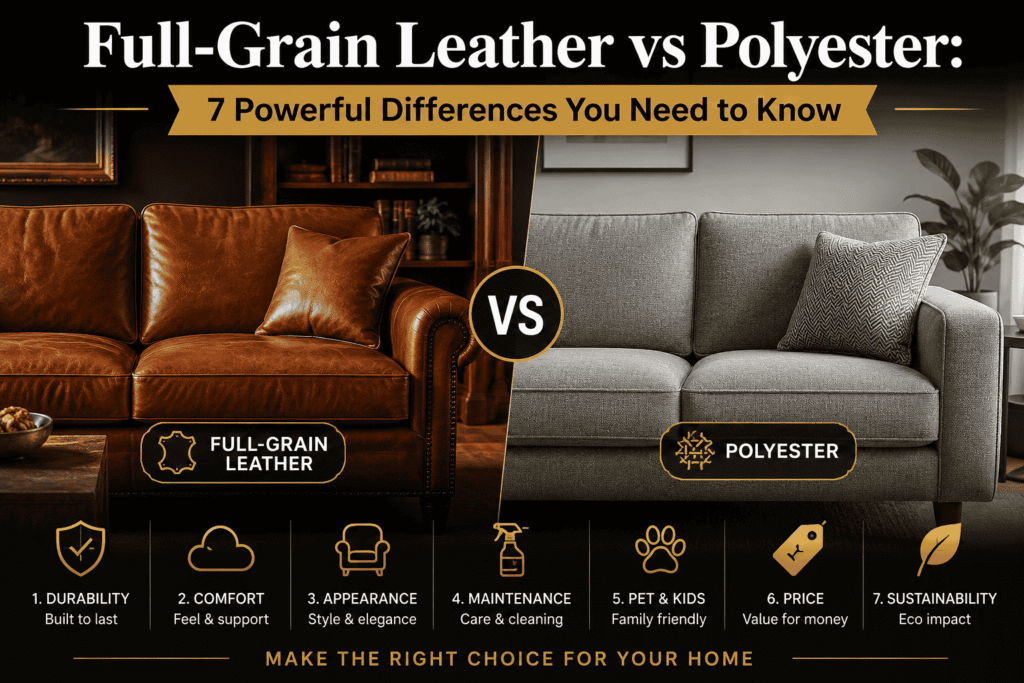
Full-Grain Leather vs Polyester: 7 Key Differences
The most important differences become easier to understand when you compare these materials factor by factor.
1. Durability and Lifespan
Durability is one of the first things to consider when choosing sofa upholstery.
Full-grain leather has a strong natural fiber structure and can provide excellent durability when the leather and sofa are properly manufactured and maintained. Its surface can also develop a worn-in appearance rather than simply looking like an old fabric.
However, leather is not indestructible. Sharp objects, pet claws, excessive dryness, and improper cleaning products can damage its surface.
Polyester can also be highly durable. Its performance depends on factors such as fiber quality, fabric construction, abrasion resistance, stitching, and the overall quality of the sofa.
A high-quality polyester upholstery fabric may perform very well in a busy living room, while a low-quality polyester fabric may show wear much sooner.
Which lasts longer?
There is no single lifespan that applies to every sofa.
A high-quality full-grain leather sofa can be an excellent long-term investment, while a well-made polyester sofa can also provide many years of service.
- The upholstery material is just one factor to consider when evaluating a sofa.
- Consider the frame, suspension, cushions, stitching, upholstery construction, and manufacturer’s warranty as well.
Winner for long-term premium use: Full-grain leather
2. Comfort and Feel
Comfort is subjective, but the physical feel of these materials is noticeably different.
Full-grain leather can feel firm and smooth when new and may become softer with regular use. Its feel can also vary considerably depending on thickness, tanning, finish, and construction.
Polyester can range from smooth and soft to textured and heavily woven. Some polyester upholstery has a soft, fabric-like feel, while other versions can feel more structured.
The cushion underneath the upholstery is also extremely important.
A beautifully upholstered sofa can still be uncomfortable if the cushions have poor support.
Which feels better?
Choose full-grain leather if you prefer a natural material that can change and soften with use.
Choose polyester if you prefer the traditional feel and variety of fabric upholstery.
Winner: Depends on personal preference
3. Appearance and Style
Appearance is another major difference in the full-grain leather vs. polyester debate.
Full-grain leather has a naturally distinctive appearance. Grain variations and markings can give each sofa a unique character.
It works particularly well with:
- Traditional interiors
- Contemporary rooms
- Industrial spaces
- Luxury interiors
- Minimalist designs
Polyester offers much more flexibility in terms of colors, patterns, textures, and fabric styles.
You can find polyester upholstery designed to look like the following:
- Soft and casual
- Modern
- Textured
- Neutral
- Bold
- Patterned
- Contemporary
Which looks more luxurious?
Full-grain leather generally has a stronger premium and natural appearance.
Polyester wins when you want maximum flexibility in colors and upholstery designs.
Winner for luxury appearance: Full-grain leather
Winner for design variety: Polyester
4. Cleaning and Maintenance
Maintenance is an important consideration because sofas receive frequent contact with people, food, drinks, pets, and everyday dust.
Full-grain leather can be relatively straightforward to clean when it has an appropriate finish. Surface dust and minor spills can often be addressed with suitable cleaning methods.
However, leather requires more care than simply wiping it with any household cleaner.
Avoid using random chemicals or harsh cleaners because they can damage the leather’s finish.
A proper leather care routine may include:
- Regular dusting
- Gentle surface cleaning
- Appropriate leather conditioner when recommended
- Immediate attention to spills
- Protection from excessive heat and direct sunlight
Polyester is often easier for everyday household care, but the exact cleaning method depends on the fabric and manufacturer’s instructions.
Some polyester upholstery may be removable and washable, while other sofas require professional cleaning.
Which is easier to maintain?
For many households, polyester offers simpler routine maintenance.
Full-grain leather requires more attention to the condition of the material itself.
Winner for everyday convenience: Polyester
For more sofa-cleaning advice, internally link this section to your Sofa Cleaning Guide or Ultimate Guide to Sofa Cleaning at Home.
5. Resistance to Pets, Kids, and Everyday Use
If you have children or pets, upholstery needs to handle more than normal sitting.
Food, drinks, muddy paws, pet hair, toys, and accidental spills can all affect a sofa.
Full-Grain Leather for Families
Leather has a smooth surface that does not have the same type of woven structure as fabric. This can make surface debris and pet hair easy to remove.
However, sharp claws can scratch leather.
Young children can also create problems through spills, markers, sharp objects, or rough use.
Polyester for Families
Polyester is a practical option for many busy households because it is available in numerous upholstery constructions and price points.
However, not every polyester fabric performs identically.
Some fabrics can attract or hold pet hair, while others may resist it better. Some can also be more vulnerable to snagging or pilling depending on construction.
Always check the manufacturer’s cleaning and durability information before buying.
Which is better for pets?
If your biggest concern is pet hair and simple surface cleanup, leather can be attractive.
If scratches are your biggest concern, a suitable polyester upholstery fabric may be preferable.
Winner: Depends on your pets and household
6. Price and Long-Term Value
Price is often where the difference becomes most obvious.
Full-grain leather is generally positioned toward the premium end of the upholstery market. You’re paying not only for the material but also for its natural characteristics and the construction of the finished furniture.
Polyester is available across a much broader range of prices.
This makes it easier to find a polyester sofa that fits a limited budget.
But a purchase price is not the same as long-term value.
For example, consider:
- Purchase price
- Expected service life
- Maintenance requirements
- Repairability
- Warranty
- Replacement cost
- Overall construction
A cheaper sofa that needs replacing quickly may not necessarily be the better financial decision.
Likewise, an expensive leather sofa is not automatically a better investment if its frame and construction are poor.
Which is better value?
Polyester generally wins for lower upfront cost.
Full-grain leather can provide strong long-term value for buyers who prioritize durability and longevity.
Winner for budget: Polyester
Winner for premium long-term investment: Full-grain leather
7. Sustainability and Environmental Considerations
Sustainability is more complicated than simply labeling one material “better.”
Full-grain leather comes from animal hides, and its environmental impact involves factors such as livestock production, tanning, chemical use, transportation, product lifespan, and disposal.
Its durability can be an advantage because a long-lasting product may not need to be replaced as frequently.
Polyester is a synthetic material. Conventional polyester is largely produced from fossil-fuel-derived raw materials. Textile Exchange also highlights recycled polyester as an important area within the industry’s move toward more circular systems.
This means the sustainability picture depends on more than the material name.
When comparing products, consider:
- Material source
- Manufacturing practices
- Product durability
- Recycled content
- Certifications
- Repairability
- Expected lifespan
- End-of-life options
For reliable information about polyester and textile sustainability, link to Textile Exchange rather than relying on unsupported environmental claims.
Winner: No simple winner
Full-Grain Leather vs Polyester: Detailed Comparison
| Buying Factor | Full-Grain Leather | Polyester |
|---|
| Natural appearance | Excellent | Moderate |
| Luxury feel | Excellent | Good |
| Color selection | Moderate | Excellent |
| Durability | Excellent | Good–Excellent |
| Routine maintenance | Moderate | Easy–Moderate |
| Pet hair cleanup | Easy | Depends on fabric |
| Scratch resistance | Moderate | Depends on fabric |
| Stain performance | Depends on finish | Depends on finish |
| Initial price | High | Low–Moderate |
| Aging | Develops character | Usually remains more consistent |
| Style flexibility | Good | Excellent |
| Long-term appeal | Excellent | Good |
| Budget flexibility | Limited | Excellent |
Pros and Cons of Full-Grain Leather
Pros
Premium Appearance
Full-grain leather provides a natural appearance that can make a sofa look sophisticated and high-end.
Excellent Durability
Quality leather can withstand years of regular use when properly cared for.
Unique Character
Natural grain patterns and markings give each hide a distinctive appearance.
Develops Patina
Rather than simply appearing worn, properly maintained leather can develop a richer appearance over time.
Long-Term Potential
A well-made leather sofa can remain useful and attractive for many years.
Cons
Higher Initial Cost
Full-grain leather usually costs more than polyester upholstery.
Can Scratch
Pet claws and sharp objects can damage the surface.
Requires Appropriate Care
Leather should be cleaned and maintained using products suitable for the specific finish.
Fewer Fabric-Like Designs
If you want thousands of colors, patterns, and woven textures, polyester generally provides more options.
Pros and Cons of Polyester
Pros
More Affordable Options
Polyester is available at many price levels, making it accessible to more buyers.
Excellent Design Variety
It can be produced in countless colors, textures, patterns, and finishes.
Practical for Everyday Furniture
Many polyester upholstery fabrics are designed to handle regular household use.
Easy-Care Options
Depending on construction and manufacturer’s instructions, polyester can be relatively easy to maintain.
Recycled Options Exist
Recycled polyester is available and can be part of a more circular textile approach.
Cons
Quality Varies
Not all polyester upholstery fabrics perform equally.
May Pill or Wear
Certain fabric constructions can develop pilling or visible wear with heavy use.
Synthetic Material
Conventional polyester is a petroleum-derived synthetic fiber.
May Hold Hair or Odors
Depending on its weave and surface texture, some polyester upholstery can hold pet hair or odors more readily than smooth materials.
Which Is Better for Different Types of Buyers?
The best material depends heavily on your lifestyle.
Best for Luxury Homes: Full-Grain Leather
If appearance and premium feel are your highest priorities, full-grain leather is an excellent option.
Its natural grain and aging characteristics can give a living room a sophisticated appearance.
Best for Budget-Conscious Buyers: Polyester
If you want attractive upholstery without spending as much, polyester offers a large selection of affordable choices.
You can also replace a polyester sofa more easily without the financial commitment associated with premium leather.
Best for Families With Children: It Depends
Families should consider both materials.
Leather can make surface cleanup convenient, but scratches and damage from sharp objects are concerns.
Polyester can offer practical everyday performance, but stain resistance depends on the particular fabric.
The best choice is the specific upholstery construction that matches your household.
Best for Homes With Pets: Depends on the Pet
For pets that shed heavily, a smooth leather surface may be convenient.
For pets that scratch furniture, a durable polyester upholstery fabric may be worth considering.
Your pet’s behavior matters more than simply choosing a material based on its name.
Best for High-Traffic Living Rooms: Quality Matters Most
Both materials can work in high-use rooms.
Instead of choosing solely between leather and polyester, look for:
- Durable upholstery
- Strong stitching
- High-quality cushions
- A solid frame
- Appropriate warranty coverage
- Manufacturer durability information
Best for Long-Term Investment: Full-Grain Leather
If you plan to keep your sofa for many years and appreciate natural aging, full-grain leather is usually the more compelling option.
However, make sure the entire sofa is well constructed.
How to Choose Between Full-Grain Leather and Polyester
Still unsure?
Use this simple decision guide.
Choose Full-Grain Leather If You:
- Want a premium sofa
- Prefer natural materials
- Value long-term durability
- Like leather’s aging process
- Want a sophisticated appearance
- Are comfortable with a higher initial price
- Don’t mind regular leather care
Choose Polyester If You:
- Have a smaller budget
- Want maximum color choices
- Prefer fabric upholstery
- Want many texture options
- Need practical everyday furniture
- Want a wide range of price points
- Prefer simpler routine maintenance
5 Questions to Ask Before Buying Either Sofa
Before choosing between full-grain leather and polyester, ask these five questions.
1. What Is the Upholstery Quality?
Don’t stop at the material name.
Ask about the specific upholstery construction, durability information, and manufacturer specifications.
2. How Will the Sofa Be Used?
A sofa for occasional guest use has different requirements from one used every day by a family.
3. What Are the Care Instructions?
Always check the manufacturer’s recommended cleaning method.
This is particularly important because different finishes and fabric constructions require different care.
4. What Is the Sofa’s Construction?
Look at more than upholstery.
Check:
- Frame construction
- Suspension
- Cushion filling
- Stitching
- Legs
- Warranty
A great upholstery material cannot completely compensate for poor furniture construction.
5. What Warranty Is Included?
A warranty can provide useful information about the manufacturer’s confidence in its product.
Read the terms carefully and check what is actually covered.
Full-Grain Leather vs. Polyester: Which One Should You Choose?
So, which is better in the full-grain leather vs. polyester comparison?
There is no single answer for every buyer.
Choose full-grain leather if your priorities are premium appearance, natural character, durability, and long-term ownership.
Choose polyester if your priorities are affordability, design flexibility, fabric variety, and practical everyday use.
For many luxury-focused buyers, full-grain leather is worth the additional investment. For budget-conscious families and shoppers who want more design choices, polyester can be the smarter option.
The most important point is to judge the entire sofa, not just its upholstery.
A well-built polyester sofa can be a better purchase than a poorly constructed leather sofa.
Frequently Asked Questions
Is full-grain leather better than polyester for a sofa?
Full-grain leather is generally better for buyers who prioritize premium appearance, natural character, and long-term durability. Polyester may be better for buyers who prioritize affordability, color variety, and fabric options.
Is polyester more durable than leather?
Not necessarily. Durability depends on the quality and construction of both materials. High-quality full-grain leather can be extremely durable, while quality polyester upholstery can also perform well under everyday use.
Which is easier to clean, leather or polyester?
Leather can be easy to wipe when its surface finish allows it, but it requires appropriate leather care. Polyester often provides simpler routine maintenance, although cleaning requirements vary by fabric.
Is full-grain leather good for families with children?
Yes, it can be a good option, particularly when easy surface cleanup is important. However, children can cause scratches, stains, and other damage, so the household’s habits should be considered.
Is polyester good for sofas with pets?
Yes. Polyester can be a practical choice for pet owners, but the specific fabric construction matters. Look for upholstery designed for frequent use and follow the manufacturer’s care instructions.
Does full-grain leather last longer than polyester?
High-quality full-grain leather can provide excellent long-term durability. However, polyester lifespan varies significantly depending on fabric quality, construction, usage, and maintenance.
Which is more expensive, full-grain leather or polyester?
Full-grain leather sofas are generally more expensive than polyester sofas. Polyester is available across a wider range of price points.
Is polyester a good material for a sofa?
Yes. Polyester is a popular upholstery material because it is versatile, widely available, and offered in many colors, textures, and price ranges.
Does full-grain leather get better with age?
Properly maintained full-grain leather can develop a patina as it ages, giving it a distinctive appearance. The exact aging process depends on the leather and finish.
Which sofa material is better for long-term use?
If longevity and premium aging are the main priorities, full-grain leather is a strong choice. If affordability and easy replacement are more important, polyester may make more sense.
Final Verdict
The full-grain leather vs. polyester decision ultimately comes down to your priorities.
Full-grain leather stands out for its premium appearance, natural grain, durability, and ability to develop character over time. Polyester stands out for its affordability, design variety, and practical upholstery options.
If you want a sofa that feels like a long-term investment and fits a luxury interior, full-grain leather is worth considering.
If you want a versatile, affordable sofa with plenty of color and texture choices, polyester may be the better fit.
Before purchasing, compare the upholstery quality, sofa construction, warranty, care requirements, and expected usage. Choosing based on the complete product—not just the material label—will help you get better value from your sofa.
Related Reading
- Linen Sofa Material
- Polyester Sofa Material
- Fabric Sofa Material
- How to Choose the Right Sofa Material
- Velvet Sofa Material
- Cotton Sofa Material
- Microfiber Sofa Material
- Chenille Sofa Material
- Leather Sofa Material
- Linen vs Cotton
- Velvet vs Polyester
- Leather vs Fabric Sofa
- Full-Grain Leather
External Links — Recommended Sequence
- Leather Naturally — leather characteristics and production
- American Leather Chemists Association — leather science and tanning
- Alliance for European Flax-Linen & Hemp — flax and linen information
- Textile Exchange — textile sustainability and natural fibers
- Consumer Reports — furniture buying guidance
- Good Housekeeping — furniture and sofa cleaning guidance