
Introduction
Choosing the right sofa material is one of the most important decisions you’ll make when furnishing your living room, and the debate between full-grain leather and faux leather is central to that choice. Both materials look stunning in showroom photos, but they behave very differently in reality. Both materials look stunning in showroom photos, but they behave very differently once they enter real, everyday life: kids jumping on cushions, pets curling up for naps, spilled coffee, sunlight streaming through the window, and years of daily use.
Full-grain leather is a natural animal hide prized for its authenticity, strength, and the way it ages into a rich patina. Faux leather, on the other hand, is a synthetic material engineered to mimic the look of leather at a fraction of the cost, with easier day-to-day maintenance. Neither is “better” in every situation — the right choice depends on your budget, lifestyle, and how long you expect your sofa to last.
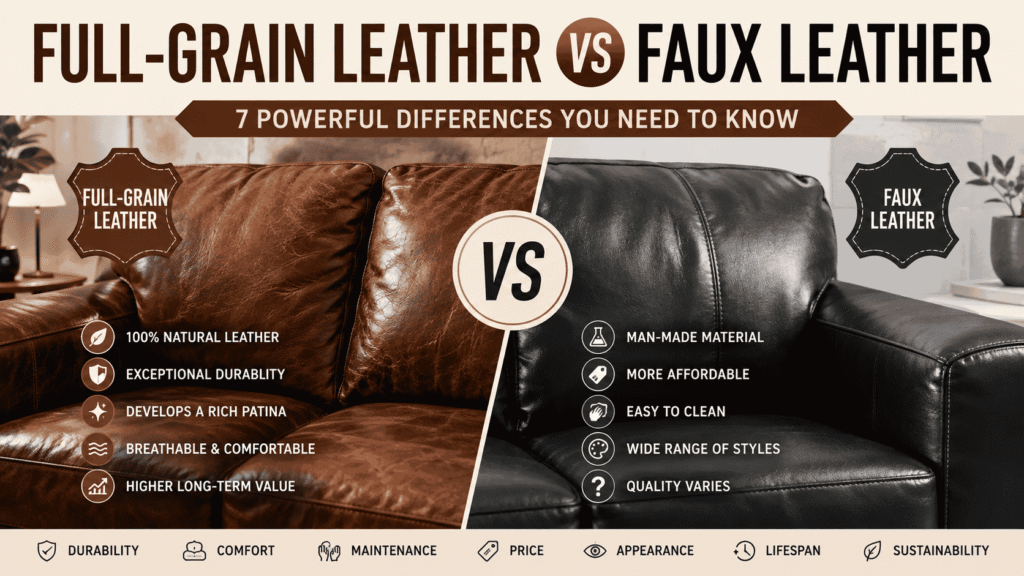
In this guide, we’ll break down the seven biggest differences between full-grain leather and faux leather — covering durability, appearance, comfort, maintenance, price, and sustainability — so you can make a confident, informed decision.
Table of Contents
Full-Grain Leather vs Faux Leather at a Glance
Before we go section by section, here’s a quick snapshot comparing the two materials.
| Feature | Full-Grain Leather | Faux Leather |
|---|---|---|
| Material | Natural animal hide | Synthetic material (PU/PVC) |
| Appearance | Natural grain, unique markings | Manufactured, uniform finish |
| Durability | Excellent | Moderate to good |
| Lifespan | Very long (decades with care) | Generally shorter |
| Comfort | Improves and softens with age | Consistent feel over time |
| Maintenance | Moderate — conditioning needed | Relatively easy — wipe clean |
| Price | Higher upfront cost | Lower upfront cost |
| Aging | Develops a rich patina | May peel or crack over time |
| Sustainability | Depends on sourcing and tanning process | Depends on synthetic type and production |
| Best For | Long-term, premium furniture investment | Budget-conscious, low-maintenance buyers |
What Is Full-Grain Leather?
How Full-Grain Leather Is Made
Full-grain leather is the topmost, outermost layer of an animal hide — the layer that includes the natural grain pattern exactly as it existed on the living animal. Unlike other leather grades, full-grain leather is not sanded, buffed, or heavily corrected to remove imperfections. Tanners intentionally leave the surface intact because that natural grain is what gives full-grain leather its strength, breathability, and distinctive character.
Because the surface isn’t sanded down, every hide looks slightly different — small scars, wrinkles, and texture variations are part of the material rather than flaws to be hidden.
Key Characteristics of Full-Grain Leather
- Natural texture — you can see and feel the authentic grain of the hide.
- Unique markings — no two pieces of furniture are ever perfectly identical.
- Strength—the tightly woven fiber structure near the hide’s surface makes it highly resistant to tearing.
- Breathability — as a natural material, it allows air to pass through, which helps regulate temperature.
- Patina development — over years of use, oils from skin contact and exposure to light give the leather a deeper, richer tone.
Why Full-Grain Leather Is Considered Premium
Full-grain leather sits at the top of the leather-quality hierarchy because it retains the hide’s full natural structure. That structure is what allows it to age gracefully rather than degrade—scuffs and light scratches often blend into the patina rather than standing out as damage. This is why full-grain leather is the material of choice for heirloom-quality furniture that’s meant to be passed down, not replaced in five years.
What Is Faux Leather?
How Faux Leather Is Made
Faux leather — also called synthetic leather, vegan leather, or leatherette — is manufactured rather than harvested from animal hides. It typically starts with a fabric or fiber backing (often a polyester or cotton blend) onto which a plastic coating is applied and embossed to mimic the look and texture of real leather grain.
Common Types of Faux Leather
- PU Leather (Polyurethane) — a flexible, breathable plastic coating bonded to a fabric backing; generally considered the higher-quality faux leather option.
- PVC Leather (Polyvinyl Chloride) — a thicker, more rigid plastic coating; historically less breathable but very water-resistant.
- Vegan Leather—a marketing term for any animal-free leather alternative, which may be plastic-based or, increasingly, made from plant materials like cork, cactus, or pineapple fiber.
- Synthetic/Bonded Leather — made from scraps of leftover leather fibers bonded together with adhesive and coated in polyurethane; it is typically the lowest-durability option in the faux leather category.
Why Furniture Manufacturers Use Faux Leather
- Lower production cost, which translates to a lower price for the buyer.
- Consistent appearance — every roll of material looks the same, with no natural variation to account for during manufacturing.
- Easier cleaning, since the non-porous surface resists absorbing spills.
- Wide range of colors and finishes, since dye and texture are applied artificially rather than limited by the hide’s natural tone.
Full-Grain Leather vs. Faux Leather: 7 Powerful Differences
This is the core of the full-grain leather vs. faux leather comparison—the seven factors that matter most when you’re deciding between real and synthetic leather for your sofa.
Difference 1: Material and Construction
At the most basic level, this comparison comes down to natural hide vs. synthetic construction. Full-grain leather is a single, continuous piece of animal hide with its natural grain intact. Faux leather is a composite: a fabric backing layered with a plastic coating that’s embossed to resemble a grain pattern.
This construction difference affects almost everything else on this list. A natural hide has fibers running in three dimensions, giving it inherent strength and elasticity. A synthetic coating, by contrast, is a surface layer—strong in some ways, but fundamentally different in how it wears, stretches, and ages.
Related searches this section covers: full-grain leather vs. faux leather material, genuine leather vs. faux leather, and natural leather vs. synthetic leather.
Difference 2: Durability and Strength
When it comes to full-grain leather durability, this material is widely regarded as one of the toughest upholstery options available. Its dense fiber structure resists punctures, tears, and everyday abrasion—which is why full-grain leather sofas are common in high-traffic homes, offices, and commercial spaces expected to perform for many years.
Faux leather durability varies significantly by quality tier. Higher-grade PU faux leather can hold up reasonably well to daily use, but most faux leathers are more vulnerable to the following:
- Cracking under stress or repeated flexing (like a favorite recliner spot)
- Fading or discoloration from UV exposure
- Peeling once the plastic coating separates from its fabric backing
For buyers prioritizing long-term structural integrity, full-grain leather generally has the advantage — especially in busy households with kids, guests, or heavy daily use.
Difference 3: Appearance and Aging
Full-Grain Leather
- Natural grain with visible texture
- Unique markings — every sofa has its own character
- Develops a patina that deepens and richens with age
- Small scuffs often blend in rather than stand out.
Faux Leather
- Uniform, consistent appearance from day one
- Manufactured grain pattern (may look slightly repetitive up close)
- Doesn’t age the way natural leather does—it may simply look worn rather than “improved.”
- The surface can crack or peel as the coating breaks down over time.
Buyer takeaway: Ask yourself whether you want a sofa that develops character and story over the years, or one that maintains the same polished, uniform look for as long as the material holds up.
Difference 4: Comfort and Feel
Comfort is subjective, but there are real, measurable differences here. Full-grain leather is breathable, so it tends to feel cooler in summer and warms more naturally to body temperature in winter compared to plastic-coated materials. It also softens gradually with use, meaning the sofa you sit on ten years from now will likely feel more supple than the one you brought home on day one.
Faux leather delivers a more consistent feel — it won’t change much over time, which some buyers actually prefer because it means no surprises. However, lower-quality PVC-based faux leathers can feel stiffer and less breathable, which may become noticeable during long periods of sitting, especially in warmer climates.
Since a sofa is something you’ll interact with daily, material feel is worth testing in person if possible.
Difference 5: Maintenance and Cleaning
Full-Grain Leather
- Regular dusting to prevent buildup in the grain
- Occasional use of a proper leather cleaner (avoid generic household cleaners)
- Periodic conditioning to keep the hide supple and prevent drying or cracking
- Protection from prolonged direct sunlight and excessive heat, which can dry out the material
Faux Leather
- Routine wiping with a damp cloth
- Mild soap-and-water solutions work well for most spills.
- Avoid harsh chemicals or solvents, which can strip or damage the plastic coating.
- Preventing prolonged sun exposure still matters, as UV light accelerates cracking.
In short, faux leather is generally the lower-maintenance option day-to-day, while full-grain leather requires a bit more routine care — but that care is also part of what preserves its long-term durability and appearance.
Difference 6: Price and Long-Term Value
There’s no getting around it: full-grain leather costs significantly more upfront than faux leather. But price alone doesn’t tell the whole story. To understand true value, it helps to think in terms of cost per year of ownership rather than just the sticker price.
| Cost Factor | Full-Grain Leather | Faux Leather |
|---|---|---|
| Initial purchase price | Higher | Lower |
| Expected lifespan | 15–25+ years with care | 3–10 years, depending on quality |
| Maintenance costs | Occasional conditioner/cleaner | Minimal ongoing cost |
| Replacement frequency | Rare | More frequent |
A full-grain leather sofa that lasts two decades may ultimately cost less per year than a budget faux-leather sofa that needs replacing every five to seven years—but that math only works out if you actually keep the sofa long-term. If you tend to redecorate frequently or want flexibility without a large upfront investment, faux leather may represent better practical value for your situation.
Difference 7: Sustainability and Ethical Considerations
This is a nuanced topic, and it’s worth approaching without assuming either material is automatically the “greener” choice.
Full-Grain Leather
- Derived from animal hide, it is in many supply chains a byproduct of the meat industry rather than the primary product.
- Tanning processes (particularly chrome tanning) can have meaningful environmental impacts if not properly managed.
- Sourcing and certification matter a great deal—look for tanneries certified by recognized environmental compliance auditors within the leather industry.
Faux Leather
- Most conventional faux leather is petroleum-derived (PU and PVC are both plastics).
- Manufacturing processes and, importantly, end-of-life disposal matter—most faux leather is not biodegradable and can persist in landfills
- Being labeled “vegan” does not automatically make a material environmentally superior; it simply means no animal-derived ingredients were used.
Independent research organizations publish data on the environmental footprint of both natural and synthetic textile materials and are worth reviewing directly if sustainability is a major factor in your decision—rather than depending solely on promotional statements made by one manufacturer.
Full-Grain Leather vs. Faux Leather: Detailed Comparison Table
For a side-by-side reference covering every major attribute, here’s the full breakdown:
| Attribute | Full-Grain Leather | Faux Leather |
|---|---|---|
| Material | Natural hide | Synthetic (PU/PVC) |
| Durability | Excellent | Moderate |
| Lifespan | 15–25+ years | 3–10 years |
| Appearance | Natural, unique | Uniform, manufactured |
| Texture | Authentic grain | Embossed pattern |
| Comfort | Softens with age | Consistent |
| Breathability | High | Low to moderate |
| Maintenance | Moderate | Low |
| Cleaning | Leather-specific products | Mild soap and water |
| Water Resistance | Moderate (needs protection) | Good (especially PVC) |
| Scratch Resistance | Good; marks often blend in | Variable; can show clearly |
| Pet Friendliness | Good, with some care | Good for cleanup, less for claws |
| Child Friendliness | Good, ages well with wear | Good, easy to wipe |
| Price | Higher | Lower |
| Aging | Develops patina | May crack/peel |
| Patina | Yes | No |
| Sustainability | Depends on sourcing | Depends on material type |
| Repairability | Good (can be re-conditioned/repaired) | Limited (harder to repair coating) |
| Luxury Appeal | High | Moderate |
| Best Use Case | Long-term, premium investment pieces | Budget-friendly, low-maintenance homes |
This table is especially useful if you’re researching if full-grain leather is better than faux leather, comparing a full-grain leather or faux leather sofa for a specific room, or simply trying to identify the best leather for sofa use in your home.
Pros and Cons of Full-Grain Leather
Pros
- Exceptional durability and tear resistance
- Natural, authentic appearance
- Develops a rich patina over time
- Premium look and feel
- Long service life — often decades
- Can offer strong long-term value despite higher upfront cost
Cons
- Higher price point
- Requires appropriate ongoing care (conditioning, cleaning)
- Can show scratches and marks (though these often blend into the patina)
- Natural variations in grain and markings may not appeal to buyers who prefer uniformity.
Pros and Cons of Faux Leather
Pros
- More affordable upfront
- Easy to clean and maintain
- Consistent, predictable appearance
- Available in a wide range of colors and finishes
- Well-suited to budget-conscious buyers
Cons
- Usually a shorter lifespan than premium natural leather
- Lower-quality products can crack or peel over time.
- Less natural feel and breathability
- Entirely synthetic composition
- Quality can differ greatly depending on the manufacturer and the specific product range.
Which Is Better for a Sofa?
There isn’t a single universal answer—the right material depends on your priorities.
Choose Full-Grain Leather If You:
- Want a premium, heirloom-quality sofa
- Prioritize long-term durability and longevity
- Appreciate natural materials with authentic character
- Like the idea of a material that develops patina and improves with age
- Are willing to invest more upfront for lower long-term replacement costs
Choose Faux Leather If You:
- Have a tighter furniture budget
- Want a low-maintenance, easy-clean surface
- Prefer a consistent, uniform appearance
- Want more flexibility in color and style options
- Don’t need the sofa to be a decades-long investment piece
Full-Grain Leather vs. Faux Leather for Families
Families with young children face a specific set of practical demands: frequent spills, crayon marks, sticky fingers, and near-constant use of the living room sofa.
- Everyday spills — Faux leather’s non-porous surface makes quick spill cleanup simple, which is a real advantage for households with young kids.
- Heavy traffic—Full-grain leather holds up remarkably well to years of daily sitting, jumping, and general wear and tends to look better with age rather than simply “worn out.”
- Cleaning requirements — Faux leather generally requires less specialized cleaning knowledge, while full-grain leather benefits from occasional conditioning to stay in top shape.
- Long-term wear — If you expect to keep the sofa through your children’s early years and beyond, full-grain leather’s durability may pay off; if you expect your needs (and mess levels) to change frequently, faux leather’s lower replacement cost may be more practical.
Neither material is universally “best” for families—it depends on which characteristics matter most in your specific household.
Full-Grain Leather vs. Faux Leather for Pet Owners
Pet owners have their own unique considerations:
- Scratching and claw marks — Full-grain leather can show claw marks, though minor scuffs often blend into the natural grain and patina over time. Faux leather can also show scratches, sometimes more visibly since the surface coating can tear or peel where scratched.
- Shedding—Both materials are relatively easy to clean pet hair from compared to fabric upholstery since hair doesn’t embed itself into the surface.
- Cleaning accidental spills or accidents — Faux leather’s water-resistant surface can make cleanup slightly more forgiving for everyday messes.
- Surface damage over time — Homes with larger or more active pets may find that lower-cost faux leather shows wear faster, while a well-maintained full-grain leather sofa tends to age more gracefully even with pet-related wear and tear.
How to Identify High-Quality Full-Grain Leather
If you’ve decided full-grain leather is the right direction, use this checklist when shopping:
- Check the product description carefully — look specifically for the term “full-grain,” not just “genuine leather,” which can refer to lower leather grades.
- Look for genuine material specifications — reputable retailers list hide origin, tanning process, and grade.
- Examine natural grain variation — authentic full-grain leather should show slight, natural imperfections rather than a perfectly uniform surface.
- Check the leather thickness — thicker cuts generally indicate higher durability.
- Ask about the leather’s finish—aniline and semi-aniline finishes preserve more of the natural grain than heavily pigmented finishes.
- Review manufacturer information — established brands with transparent sourcing are generally more trustworthy.
- Check the warranty — a strong warranty is often a signal of manufacturer confidence in the material’s durability.
- Look for transparent material descriptions — avoid listings that use vague terms like “leather-look” without clarifying whether the material is genuine.
How to Identify Quality Faux Leather
Faux leather quality varies widely, so it pays to look closely before buying.
- PU vs. PVC—PU is generally more breathable and flexible; PVC is typically more water-resistant but less breathable.
- Surface texture — higher-quality faux leather has a more realistic, less repetitive grain pattern.
- Backing material — a woven fabric backing tends to be more durable than a non-woven or paper backing.
- Thickness — thicker coatings generally resist cracking better over time.
- Stitching quality — tight, even stitching is a good sign of overall manufacturing quality.
- Warranty — look for manufacturers willing to stand behind their product for a reasonable period.
- Manufacturer specifications—clear labeling of PU vs. PVC vs. bonded leather helps set realistic expectations.
- Reviews — real customer feedback on long-term wear is often more reliable than marketing copy.
- Expected lifespan—ask directly or research the typical lifespan for the specific product line before purchasing.
Common Mistakes When Choosing Between Full-Grain and Faux Leather
- Choosing only by price — the cheapest option upfront isn’t always the most cost-effective over the sofa’s full lifespan.
- Assuming all faux leather is the same—quality varies enormously between PU, PVC, and bonded leather products.
- Ignoring the sofa’s expected lifespan — think about how long you actually plan to keep the piece before deciding.
- Forgetting about maintenance — factor in the realistic time and cost of caring for full-grain leather before committing.
- Confusing “leather-look” with genuine leather — always check the actual material specification, not just marketing language.
- Ignoring the warranty—warranty terms often reveal a lot about expected product durability.
- Buying without checking the material specification — always confirm whether you’re purchasing full-grain, top-grain, genuine (lower-grade), or faux leather before finalizing your purchase.
FAQs About Full-Grain Leather vs. Faux Leather
Is full-grain leather better than faux leather? Full-grain leather generally outperforms faux leather in durability, longevity, and natural appearance, but faux leather offers easier maintenance and a lower upfront price. The “better” choice depends on your budget and priorities.
Does full-grain leather last longer than faux leather? Yes, typically. With proper care, full-grain leather can last 15–25+ years, while most faux leather sofas have a functional lifespan of roughly 3–10 years depending on quality.
Is faux leather good for sofas? Yes, especially for budget-conscious buyers or households that prioritize easy cleaning. Higher-quality PU faux leather can offer solid performance for several years.
Does faux leather peel? Lower-quality faux leather can peel or crack over time, particularly with sun exposure, dryness, or heavy use. Higher-quality faux leather is more resistant but not entirely immune.
Does full-grain leather crack? Full-grain leather can dry out and crack if it isn’t conditioned periodically or if it’s exposed to excessive heat and sunlight, but with proper maintenance it’s generally resistant to cracking for many years.
Which is easier to clean, full-grain or fake leather? Faux leather is generally easier to clean day-to-day, since its non-porous surface resists spills. Full-grain leather requires leather-specific cleaning products and periodic conditioning.
Is full-grain leather worth the extra money? For buyers planning to keep their sofa long-term, full-grain leather’s durability and lifespan often justify the higher upfront cost. For buyers who redecorate frequently, the premium may not be worth it.
Which is better for pets, full-grain leather or faux leather? Both have trade-offs. Full-grain leather tends to age gracefully around minor scuffs, while faux leather offers more forgiving spill cleanup. Neither is scratch-proof against determined pets.
Is faux leather more environmentally friendly than real leather? Not necessarily. Faux leather is typically petroleum-based and less biodegradable, while full-grain leather’s environmental impact depends heavily on tanning processes and sourcing. Neither material has a clear, universal sustainability advantage.
Which leather type is best for a long-lasting sofa? Full-grain leather is generally the top choice for maximum longevity, assuming it receives regular, appropriate care.
Final Verdict: Full-Grain Leather vs. Faux Leather
When it comes down to full-grain leather vs. faux leather, the decision really comes down to two different value propositions:
- Full-grain leather delivers a premium feel, exceptional durability, long-term longevity, and natural aging that many buyers find genuinely appealing over time.
- Faux leather delivers affordability, easy maintenance, and a consistent appearance that suits budget-conscious households and those who prioritize convenience.
Rather than declaring one material universally superior, the smartest approach is to match the material to your household’s real-world priorities—budget, lifestyle, expected ownership length, and how much ongoing maintenance you’re realistically willing to do. Whichever direction you choose, understanding these seven core differences will help you buy with confidence and avoid surprises down the road.
Internal Links
- Sofa Materials Explained — anchor: different sofa materials
- Leather Sofa Material — anchor: leather sofa material
- Leather vs Fabric Sofa — anchor: leather vs fabric sofas
- Leather vs Velvet Sofa — anchor: leather vs velvet
- Leather vs Chenille — anchor: leather vs chenille
- Full-Grain vs Top-Grain Leather — anchor: full-grain vs top-grain leather
- Sofa Cleaning Guide — anchor: how to clean a sofa
- How to Choose the Right Sofa Material — anchor: choose the right sofa material
External Links
- Leather Naturally — leather terminology and material education
- Leather Working Group — environmental compliance certification for tanneries
- Textile Exchange — sustainability research on natural and synthetic textiles
- U.S. Environmental Protection Agency — environmental impact and materials data
- Consumer Reports — independent furniture care and cleaning guidance
- The Spruce — home-care and maintenance guidance