
1. Introduction
How to Clean a Fabric Sofa Naturally: Easy DIY Methods That Work — this is what thousands of homeowners search for every day, and for good reason. Your fabric sofa quietly becomes the most trafficked piece of furniture in your home, accumulating stains, embedded odors, and layers of dust over time without anyone noticing until the damage is already visible.
Whether it is a coffee spill that dried overnight, pet hair woven deep into the cushions, or that mystery smell that just will not leave — these are the everyday realities of owning a fabric sofa. While commercial cleaning sprays promise quick fixes, many of them contain synthetic compounds that gradually weaken fabric threads, trigger allergies, or leave behind a chemical residue that sits in your living space long after the bottle is empty.
There is a smarter path. Natural cleaning methods use ingredients already sitting in your kitchen to achieve results that are gentle on fabric, safe for your household, and easy on your wallet. This guide walks you through every step of the process — from preparation to deep cleaning — with practical techniques that genuinely work.
Table of Contents
Why Choose Natural Sofa Cleaning Methods?
Before diving into the how-to, it helps to understand why natural cleaning deserves your attention. This is not simply about avoiding chemicals — it is about making a choice that benefits your health, your furniture, and your budget all at once.
No Harsh Chemical Residue
Store-bought fabric cleaners often contain surfactants, optical brighteners, and synthetic fragrances that leave an invisible film on upholstery. Over time, these residues attract more dirt and cause fabric to look dull. Natural solutions clean without leaving anything harmful behind. According to the Environmental Working Group’s Cleaning Guide, many household cleaners contain ingredients linked to respiratory irritation and skin sensitisation — a risk that kitchen-based alternatives completely sidestep.
Genuinely Safe Around Children and Pets
Children roll on sofas. Pets sleep on them. If a cleaning product is not something you would feel comfortable with a toddler touching an hour after application, it probably should not be on your furniture. Ingredients like baking soda, white vinegar, and diluted dish soap carry no such concern.
Saves Money Without Sacrificing Results
A box of baking soda and a bottle of white vinegar cost a fraction of what you would spend on a specialist upholstery cleaner. For routine maintenance and even moderate stain removal, natural solutions keep up with — and often outperform — their expensive counterparts.
Kinder to the Environment
Every spray bottle of chemical cleaner that goes down your drain contributes to water system pollution. Opting for biodegradable, food-grade ingredients means your cleaning routine leaves a much lighter environmental footprint.
Preserves Fabric Lifespan
Aggressive cleaners can strip natural dyes, loosen weave structures, and cause premature fading. Natural cleaning solutions are pH-balanced enough to lift dirt without compromising the integrity of your fabric. If you want to compare sofa materials and how they respond to cleaning, our guide on the best fabric sofas breaks down durability by material type.
What to Check Before You Begin Cleaning
Rushing straight into cleaning without preparation is one of the most common mistakes people make. A few minutes of assessment before you start can prevent permanent damage.
Understand Your Sofa’s Care Label
Every upholstered sofa carries a care label, usually tucked under a cushion or attached to the frame. The cleaning code printed on it tells you exactly what methods are safe to use:
- W — Water-based cleaners are safe to use
- S — Solvent-based cleaners only; water may cause damage
- WS — Both water and solvent-based solutions are permitted
- X — Vacuum only; no liquid of any kind should be applied
Natural water-based solutions are appropriate for W and WS codes. If your sofa carries an S or X code, stick to dry cleaning methods such as baking soda treatment alone.
Always Patch Test First
Even the gentlest natural solution can react unexpectedly with certain dyes or fabric finishes. Before applying any cleaner to a visible area, dab a small amount onto an inconspicuous spot — the back of a cushion or the underside of a seat panel — and wait five to ten minutes. Look for any colour shift, texture change, or watermark before proceeding.
Know What Your Sofa Is Made Of
Different fabric types absorb moisture and respond to cleaning agents differently:
- Cotton — absorbs liquid quickly; avoid over-wetting
- Linen — delicate and prone to watermarks; use minimal moisture
- Polyester blends — more resistant to staining and better at drying quickly
- Microfibre — picks up water marks easily; use dry-cleaning methods when possible
Supplies You Will Need
You do not need a cupboard full of products to clean your sofa effectively. These eight items cover virtually every situation:
- Baking soda — draws out odours and loosens dry dirt from fabric fibres
- White vinegar — breaks down stain molecules and kills odour-causing bacteria
- Lemon juice — adds brightening power and a naturally fresh scent
- Mild dish soap — cuts through grease and general grime without stripping fabric
- Warm water — activates and dilutes other ingredients
- Spray bottle — allows even, controlled application
- Microfibre cloths — soft enough to clean without abrading fabric
- Vacuum cleaner with upholstery attachment — essential for dry debris removal
Step-by-Step: How to Clean a Fabric Sofa Naturally
Work through these steps in order for the most thorough and damage-free result.
Step 1 — Remove All Loose Debris with a Vacuum
Attempting to clean a sofa that still has crumbs, dust, and pet hair on its surface is counterproductive — liquids will simply push that debris deeper into the fabric. Use your vacuum’s upholstery attachment and work methodically across:
- Each seat cushion, top and sides
- The backrest panels
- Armrests and the frame along the base
- All creases and crevices where cushions meet the frame
Remove loose cushions and vacuum underneath them as well — this is where crumbs and debris tend to accumulate most.
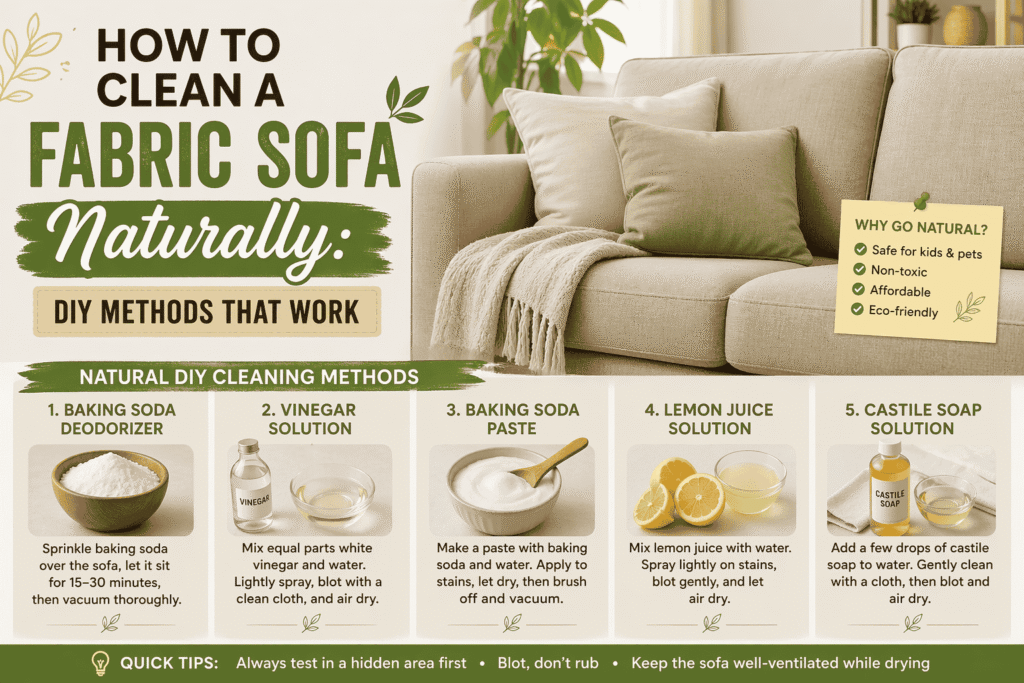
Step 2 — Deodorise Using Baking Soda
Sprinkle a generous, even layer of baking soda across the entire upholstered surface of your sofa. Pay extra attention to areas where people sit most often, as these tend to hold the most trapped moisture and odour.
Leave the baking soda in place for at least 20 minutes. For persistent smells — such as pet odour or cigarette smoke — allow it to sit for a full hour or even overnight before vacuuming it away thoroughly. This dry treatment is completely safe for every fabric type and requires no patch test.
Step 3 — Mix Your Natural Cleaning Solution
In a clean spray bottle or bowl, combine the following:
- 1 cup warm water
- 1 tablespoon white vinegar
- 1 teaspoon mild dish soap
Stir or swirl gently — you want the ingredients combined, not foamy. Excessive foam makes rinsing harder and can leave residue behind. This solution works for most general cleaning and moderate staining on W or WS coded fabrics.
Step 4 — Spot Clean Stained Areas With Care
Dampen — do not soak — a microfibre cloth with your cleaning solution. Press it gently against the stained area and use a dabbing or blotting motion rather than rubbing. Scrubbing aggressively pushes the stain deeper into the fabric and can cause permanent discolouration or surface pilling.
Always work from the outer edge of a stain inward toward the centre. This prevents the stain from spreading outward as you clean. Use a fresh section of your cloth regularly so you are lifting the stain rather than redistributing it.
Step 5 — Wipe Down and Air Dry Completely
Once you have treated all stained areas, go over the cleaned sections with a cloth dampened in plain water to lift any soap residue. Then allow the sofa to air dry fully — ideally near an open window or with a fan running nearby.
Do not use a hair dryer or sit on the sofa until it is completely dry. Heat can set any remaining stain, and sitting on damp fabric encourages mould and mildew to develop inside the cushioning.
Natural Cleaners for Different Types of Stains
Different stains need different approaches. Using the wrong method can set a stain permanently, so matching your technique to the stain type matters.
Food and Drink Stains
Act as quickly as possible. Blot up the excess liquid first — do not rub. Then apply a diluted vinegar and water solution (equal parts) and dab until the stain lifts. For darker stains like red wine or tomato sauce, a paste of baking soda and a few drops of water applied directly to the spot can help draw the colour out before you apply liquid cleaner.
Grease and Oil Marks
Sprinkle dry baking soda directly onto the grease stain and leave it untouched for 15 to 20 minutes. The baking soda will absorb a significant amount of the oil before you even introduce any liquid. Brush it away gently, then apply a small amount of undiluted dish soap directly to the area using a cloth, working it in with light dabbing before blotting clean. For more guidance on treating stubborn upholstery marks, explore our article on professional sofa cleaning tips.
Pet Stains and Associated Odours
Pet accidents require a two-stage approach. First, blot up as much of the liquid as possible using a clean towel with firm downward pressure. Then apply a 50/50 white vinegar and water spray directly onto the area and blot again. Vinegar neutralises the ammonia in urine that causes the persistent smell. Once the area dries, apply baking soda, leave for several hours, and vacuum away.
The ASPCA recommends avoiding steam cleaning on pet stains, as heat can permanently bond odour proteins into the fabric fibres.
Ink and Stubborn Marks
Ink stains are notoriously tricky on fabric. Apply a small amount of isopropyl rubbing alcohol to a cotton swab and dab — never rub — the stained area. Work from the outside in, and use a fresh swab frequently to avoid spreading the ink. Always patch test rubbing alcohol first, as it can affect certain dyes. Once the ink has lifted, clean the area with your standard vinegar solution to remove any alcohol residue.
How to Naturally Eliminate Sofa Odours
A sofa that looks clean but smells stale is still an unpleasant presence in your home. These methods address the source of odours rather than simply masking them:
- Baking soda treatment — the most effective dry method for neutralising embedded smells; leave overnight for maximum benefit
- Diluted vinegar mist — lightly misting the sofa surface and allowing it to air dry kills odour-causing bacteria without leaving a vinegar smell behind once it evaporates
- Natural ventilation — open windows and allow air to circulate around the sofa for several hours; sunlight is also a natural deodoriser and mild antibacterial agent
- Essential oils — add two or three drops of lavender, tea tree, or eucalyptus oil to your cleaning spray for a lasting natural fragrance with additional antibacterial properties
Common Mistakes That Can Damage Your Sofa
Even with the best intentions, certain cleaning habits can do more harm than good. Avoid these errors:
- Over-wetting the fabric — too much liquid soaks into the cushion filling, promoting mildew growth and leaving watermarks on the surface
- Scrubbing instead of blotting — rubbing forces stain particles deeper into the weave and can cause permanent discolouration
- Using undiluted vinegar directly — full-strength vinegar is acidic enough to affect some fabric dyes; always dilute before applying
- Skipping the patch test — even natural ingredients can react unexpectedly with specific fabric treatments or dyes
- Ignoring the care label — applying water-based solutions to an S-coded sofa can cause irreversible damage
- Drying with heat — a hair dryer or placing the sofa near a radiator can set stains and shrink certain fabric types
How Frequently Should You Clean Your Sofa?
Establishing a regular maintenance routine is far less effort than attempting to deep clean a heavily soiled sofa. A simple schedule keeps things manageable:
- Weekly — vacuum all surfaces to prevent dust, crumbs, and pet hair from embedding into the fabric
- Every 3 to 6 months — complete a full natural deep clean using the step-by-step method above
- Immediately after spills — blot and treat any stain as soon as it happens; stains that are allowed to dry become significantly harder to remove
If you have a busy household with children or pets, increasing your deep cleaning frequency to every two to three months is a sensible adjustment. You can also explore our roundup of the easiest sofas to maintain if you are considering an upgrade to a more cleaning-friendly design.
When DIY Is Not Enough: Knowing When to Call a Professional
Natural home cleaning handles the vast majority of everyday sofa problems effectively. There are, however, situations where professional intervention is the more sensible choice:
- Stains that have been set for a long time and no longer respond to cleaning attempts
- Visible mould or mildew that has penetrated below the surface fabric
- Antique or heirloom upholstery where any cleaning risk is unacceptable
- High-value sofas that warrant specialist care rather than DIY experimentation
- Odours that persist after multiple thorough natural cleaning attempts
Professional upholstery cleaners use hot water extraction equipment and enzyme-based treatments that go significantly deeper than any home method can reach.
Smart Habits to Keep Your Sofa Cleaner for Longer
Reducing how quickly your sofa gets dirty is just as valuable as knowing how to clean it. These practical habits make a real difference:
- Use washable slipcovers on frequently used sofas — they absorb daily wear and are easily laundered
- Flip and rotate cushions regularly to distribute wear patterns and prevent uneven compaction
- Keep a no-food-on-the-sofa rule, or at minimum use trays to contain spills
- Place a pet blanket over your sofa’s preferred pet spot rather than trying to keep animals off entirely
- Vacuum weekly before dirt has a chance to embed into the fabric
- Apply a fabric protector spray (look for water-based, non-toxic formulas) after deep cleaning to create a barrier against future stains
Conclusion
A clean sofa does not require expensive products, harsh chemicals, or professional services for routine maintenance. Armed with baking soda, white vinegar, a good microfibre cloth, and the step-by-step process in this guide, you have everything needed to keep your fabric sofa looking and smelling its best.
The key lies in consistency — regular vacuuming, prompt stain treatment, and periodic deep cleaning prevent small problems from becoming permanent ones. Natural methods are gentle enough to preserve your sofa’s fabric, effective enough to tackle real cleaning challenges, and accessible enough to make regular maintenance genuinely achievable.
Take good care of your sofa naturally, and it will serve your home comfortably for many years ahead. For more expert guidance on choosing, maintaining, and getting the most from your furniture, visit SofasExpert.com — your comprehensive resource for sofa advice.
What is the single most effective natural cleaner for a fabric sofa?
A combination of white vinegar, warm water, and a small amount of mild dish soap handles most stain types and general dirt effectively. For odour removal alone, baking soda applied dry and left to sit overnight is hard to beat.
Is white vinegar safe to use on every type of fabric sofa?
Diluted white vinegar is safe for most fabric sofas coded W or WS. However, it should never be used on S or X coded fabrics, and a patch test is always recommended before full application. Avoid using it undiluted, as its acidity can affect certain fabric dyes.
How do I get rid of a persistent bad smell from my sofa naturally?
Cover the entire sofa surface with baking soda and leave it for several hours or overnight before vacuuming. Follow this with a light misting of diluted white vinegar and allow it to air dry completely. For ongoing freshness, add a few drops of essential oil to your cleaning spray or keep the room well-ventilated.
How long should I expect a fabric sofa to take to dry after cleaning?
With natural cleaning methods — which use minimal liquid — drying typically takes between four and eight hours in a well-ventilated room. Opening windows and running a fan will speed this up considerably. Always ensure the sofa is fully dry before using it or replacing cushion covers, as damp fabric inside cushions can develop mildew.
Can baking soda damage fabric or cause discolouration?
When used dry — sprinkled on and vacuumed off — baking soda is completely harmless to fabric. It does not contain bleaching agents or abrasives. The only caution is to vacuum it away thoroughly, as residual powder can attract moisture if left in the fabric long-term.