
Introduction
When people say “leather sofa,” they usually don’t realize that “leather” is actually an umbrella term covering several very different grades of material — and full-grain leather sits at the very top of that hierarchy. Understanding the difference between generic leather (which can mean top-grain, genuine, bonded, or faux leather) and true full-grain leather is one of the most important steps in buying a sofa that will actually hold up for decades.
This guide breaks down every angle of the leather vs. full-grain leather comparison — quality, durability, feel, cost, aging, and long-term value — so you know exactly what you’re paying for the next time a salesperson tells you a sofa is “genuine leather.”
Table of Contents
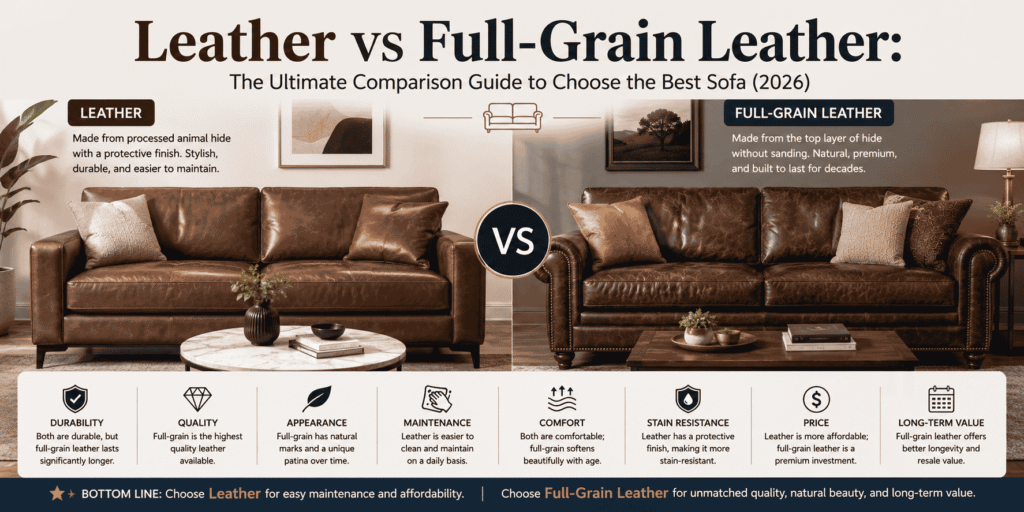
Leather vs Full-Grain Leather at a Glance
Leather (as a general market term) can refer to any hide-based or leather-like material, including top-grain, genuine, bonded, or faux leather, each processed differently and priced accordingly.
Full-grain leather is the highest, unaltered layer of the hide, with the natural grain, markings, and fiber structure left completely intact.
Full-grain leather generally lasts the longest, develops the richest patina, and costs the most; general “leather” sofas can range from budget-friendly to premium depending on which grade is actually used.
Who Should Choose Full-Grain, and Who Should Choose Standard Leather?
Full-grain leather suits buyers who want a sofa built to last a lifetime, who appreciate natural imperfections and a leather that improves with age, and who are willing to pay a premium upfront for long-term value. Standard leather grades (top-grain, genuine, or faux) suit budget-conscious buyers, renters, or anyone who wants the leather look without the full-grain price tag, and who doesn’t mind a shorter lifespan or a more uniform, less “natural” surface.
| Factor | General Leather | Full-Grain Leather |
|---|---|---|
| Look | Uniform, sometimes embossed or corrected | Natural grain, unique markings |
| Feel | Smoother, more processed | Slightly rougher, more organic |
| Durability | Moderate to high (varies by grade) | Very high (20–30+ years) |
| Maintenance | Wipe clean, occasional conditioning | Wipe clean, regular conditioning |
| Water/Stain Resistance | Good, especially finished/corrected grades | Good, but absorbs conditioning oils naturally |
| Pet Friendly | Depends on grade | Good, scratches often blend into the grain |
| Kid Friendly | Easy to wipe spills | Easy to wipe spills |
| Price | Low to high, depending on grade | Highest |
What Is Leather (as a General Category)?
“Leather” is a broad label the furniture industry applies to any material made from, or designed to resemble, tanned animal hide. It spans a wide quality spectrum:
- Top-Grain Leather — The second-highest grade. The very top of the hide is sanded and a protective finish is applied, making it more stain-resistant and slightly more affordable than full-grain, at the cost of some natural texture.
- Genuine Leather — Despite the reassuring name, this is a lower grade made from leftover, lower layers of the hide bonded or split apart. It’s more affordable but noticeably less durable and premium-feeling.
- Bonded Leather — Scraps of leather fiber glued together and coated with a polyurethane finish. It looks like leather but wears out fastest of all the “real leather” categories.
- Faux Leather — A synthetic, usually polyurethane-based material designed to mimic leather. Budget-friendly and spill-resistant, but it doesn’t age gracefully and can crack or peel over time.
Advantages of General Leather Sofas
- Wide range of price points to fit almost any budget
- Easy to wipe clean regardless of grade
- Classic, upscale look at a fraction of full-grain’s cost (lower grades)
- Faux options are more water- and stain-resistant than natural hide
Disadvantages of General Leather Sofas
- Quality varies enormously between grades, and labeling can be misleading
- Lower grades (genuine, bonded) can crack, peel, or delaminate within a few years
- Doesn’t develop the same rich patina as full-grain
- Corrected or embossed grains lose the natural texture buyers often want from “real leather”
What Is Full-Grain Leather?
Full-grain leather is cut from the outermost, uppermost layer of the animal hide, directly beneath the hair. Unlike other grades, it is never sanded, buffed, or corrected to remove natural imperfections — the original grain, pores, and fiber structure stay completely intact. This is what gives full-grain leather its exceptional strength, breathability, and the deep, glossy patina it develops with age.
How Full-Grain Leather Is Processed
Because the surface isn’t sanded down, full-grain hides retain their tightest, most durable fiber structure. Tanneries typically apply only a light aniline or semi-aniline finish that preserves the natural markings — scars, wrinkles, and grain variation — rather than hiding them, which is why no two full-grain sofas ever look exactly alike.
Advantages of Full-Grain Leather Sofas
- The most durable leather grade available, often lasting 20 to 30+ years
- Develops a rich, glossy patina that improves with age rather than simply wearing out
- Strongest fiber structure of any leather grade, resisting punctures and tears
- Naturally breathable, staying more comfortable across seasons than corrected leathers
- Unique grain markings mean genuinely one-of-a-kind furniture
Disadvantages of Full-Grain Leather Sofas
- The most expensive leather grade by a significant margin
- Natural markings and imperfections aren’t for buyers who want a flawless, uniform look
- Requires more consistent conditioning to maintain its natural oils
- Can scratch and show scuffs more visibly at first, though these often blend into the grain over time
- Harder to find in every color, since dyeing must preserve the natural surface
Leather vs Full-Grain Leather: Feature-by-Feature Comparison
Appearance & Style — General leather can look more uniform and polished, especially corrected or embossed grades, while full-grain shows natural variation, scars, and markings that give each sofa a unique character.
Comfort — Full-grain leather tends to feel more supple over time as its natural oils respond to body heat, while lower leather grades can stay stiffer or feel more plasticky, especially bonded and faux options.
Durability — Full-grain is the clear winner, often outlasting top-grain by a decade or more and vastly outlasting genuine or bonded leather, which can crack within 3–7 years.
Lifespan — A well-maintained full-grain sofa can last 20–30+ years; top-grain typically lasts 10–20 years; genuine or bonded leather often needs replacing within 3–8 years.
Patina & Aging — This category belongs entirely to full-grain leather. It’s the only grade that ages by deepening in color and developing character, rather than simply degrading or cracking.
Scratch & Scuff Resistance — Full-grain leather actually hides light scratches better than corrected leathers, since scuffs tend to blend into its natural grain rather than exposing a different-colored layer underneath.
Pet Friendliness — Full-grain handles pet claws more gracefully because surface marks are less visible against its natural texture; bonded and faux leather show scratches and peeling much faster.
Water & Stain Resistance — Corrected or coated leathers (top-grain, faux) can resist surface spills slightly better out of the box, but full-grain, once properly conditioned, wipes clean just as easily and resists staining well.
Maintenance Requirements — Both require regular dusting and periodic conditioning, but full-grain leather benefits from more frequent conditioning to maintain its natural, breathable surface rather than a manufactured finish.
Cost — Full-grain leather sits at the top of the price range across the entire leather category; genuine and bonded leather sit at the bottom, with top-grain in between.
Long-Term Value — Despite the higher upfront cost, full-grain leather generally delivers the best long-term value thanks to its extended lifespan and minimal need for replacement.
Leather vs. Full-Grain Leather Comparison Table
| Category | General Leather | Full-Grain Leather |
|---|---|---|
| Appearance | Uniform, sometimes corrected | Natural, unique grain |
| Comfort | Varies by grade | Increasingly supple with age |
| Durability | Moderate to high | Very high |
| Lifespan | 3–20 years (grade-dependent) | 20–30+ years |
| Maintenance | Low to moderate | Moderate |
| Water Resistance | Good (especially coated grades) | Good, once conditioned |
| Stain Resistance | Good | Good |
| Pet Friendly | Varies | Good |
| Kids Friendly | High | High |
| Patina Development | Minimal to none | Excellent |
| Price | Low to high | Highest |
| Best For | Budget flexibility, uniform look | Longevity, natural character, heirloom quality |
Which Is Better for Families?
Homes with Kids
Both grades wipe clean easily, so families with young children can consider either. Full-grain leather has the edge for long-term durability against rough play, while lower leather grades may need replacing sooner under heavy daily use.
Homes with Pets
Full-grain leather generally hides scratches and claw marks better than corrected or bonded leather, since imperfections blend into its natural texture rather than exposing a different layer underneath.
Heavy Daily Use
For a primary family sofa used every day, full-grain leather’s superior fiber strength makes it the more resilient long-term choice, resisting sagging and surface wear far better than lower grades.
Which Is Easier to Clean and Maintain?
General Leather Cleaning Tips — Dust regularly with a soft cloth and wipe spills promptly with a damp cloth and mild, pH-balanced cleaner. Avoid ammonia, bleach, or alcohol-based products, which can strip coatings on corrected or faux leather especially quickly.
Full-Grain Leather Cleaning Tips — Dust and wipe the same way, but condition more consistently (roughly every 6–12 months) since there’s no synthetic coating protecting the surface. Letting the leather air dry fully before conditioning helps preserve its natural oils and prevent cracking.
Leather vs Full-Grain Leather for Different Rooms
Living Room — Full-grain leather suits formal or heirloom-style living rooms where a timeless investment piece matters. Lower leather grades work well for casual living rooms on tighter budgets.
Family Room — Full-grain’s durability makes it a strong pick for high-traffic family rooms, while faux or genuine leather can be a practical, budget-friendly stopgap for growing families.
Apartment or Rental — Lower-grade or faux leather is often the more practical choice for renters, given the lower upfront cost and shorter expected time in the space.
Luxury Home — Full-grain leather is the clear choice, prized for its authenticity, natural markings, and the way it visibly improves with age.
Which Lasts Longer?
A full-grain leather sofa, properly conditioned and kept out of direct sunlight, can realistically last 20 to 30 years or more. Top-grain leather typically lasts 10 to 20 years, while genuine or bonded leather often needs replacing within 3 to 8 years as coatings crack or peel.
Price Comparison
Budget Range — Faux and genuine leather sit at the lowest price points in the leather category.
Mid-Range — Top-grain leather occupies the middle ground, balancing durability and cost.
Premium — Full-grain leather commands the highest prices in the category, reflecting its superior hide quality, natural finish, and long-term durability.
Cost of Ownership Over Time — Factoring in lifespan, full-grain leather often proves the most cost-effective option long-term, since it needs replacing far less often than lower leather grades bought at a fraction of the price.
Pros and Cons
General Leather Pros
- Wide range of price points
- Easy to wipe clean
- Classic look at accessible prices
General Leather Cons
- Quality varies significantly by grade
- Lower grades can crack or peel within a few years
- Doesn’t develop a natural patina
Full-Grain Leather Pros
- Longest lifespan of any leather grade
- Develops a rich, one-of-a-kind patina
- Strongest, most breathable natural fiber structure
Full-Grain Leather Cons
- Highest price point in the leather category
- Natural markings aren’t for buyers wanting a flawless surface
- Requires more consistent conditioning
Leather vs Full-Grain Leather: Which Should You Buy?
Choose General Leather If…
- You’re working with a tighter budget
- You want a more uniform, flawless surface
- You’re furnishing a short-term or rental space
Choose Full-Grain Leather If…
- You want a sofa built to last decades
- You appreciate natural grain and a developing patina
- You’re investing in a long-term, heirloom-quality piece
Leather vs. Full-Grain Leather FAQs
Is full-grain leather better than regular leather? Full-grain leather is generally considered the highest-quality leather grade, offering superior durability, breathability, and natural ageing compared to top-grain, genuine, or bonded leather — though it comes at a higher price.
Is full-grain leather worth the extra cost? For buyers planning to keep a sofa for many years, full-grain leather’s extended lifespan and patina development often justify the higher upfront price compared to lower leather grades.
Does full-grain leather scratch easily? Full-grain leather can still be scratched by claws or sharp objects, but marks tend to blend into its natural grain rather than exposing a different-coloured layer underneath.
How can you tell if leather is full-grain? Full-grain leather shows visible natural markings, pores, and grain variation rather than a perfectly uniform surface, and it typically feels slightly less smooth than corrected or coated leather grades.
Does full-grain leather need more maintenance than regular leather? Full-grain leather generally benefits from more consistent conditioning since it lacks a synthetic protective coating, while some corrected or faux leathers rely on a factory-applied finish for protection instead.
Final Verdict
The leather vs. full-grain leather decision ultimately comes down to budget versus longevity. General leather grades offer flexibility and accessibility at a range of price points, while full-grain leather delivers unmatched durability, natural character, and long-term value for buyers willing to invest upfront. If you want a sofa that ages beautifully and lasts for decades, full-grain leather is the smarter long-term choice. If budget flexibility and a more uniform look matter most, a well-chosen top-grain or faux leather sofa can still serve a household well.
Related Reading on SofasExpert
- Leather Sofa Material Explained
- Chenille Sofa Material Explained
- Sofa Materials Explained
- Leather vs Fabric Sofa
- Leather vs Velvet Sofa
- Leather vs Linen Sofa
- Leather vs Microfiber Sofa
- How to Choose the Right Sofa Material
- Luxury Sofa Materials